
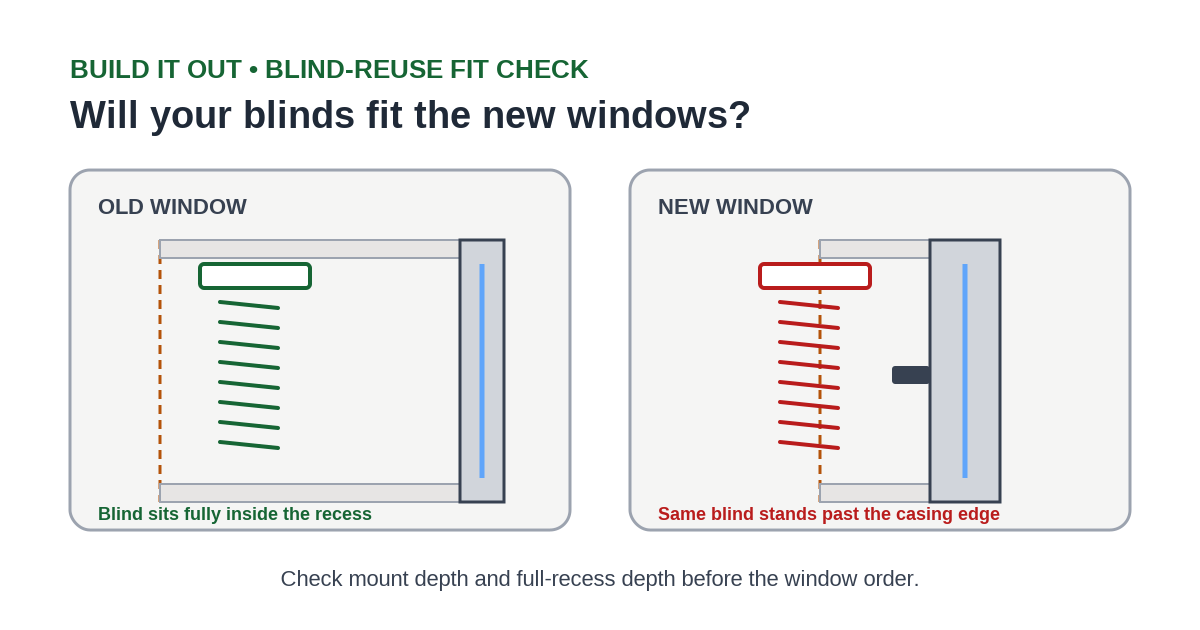
Not automatically. A replacement window can fit the same wall opening and still leave a shallower or narrower recess for the blind, with a lock or crank in a new place. Before the window order is final, ask the window company for the expected finished width, height and depth of each opening in writing. Then run two depth checks against your blind maker's numbers. Is there enough depth to hold the brackets? Is there enough clear depth in front of the first lock, crank or handle for the blind to sit inside the recess and work? If either check fails, choose the fallback before the window is ordered.
Home Depot's installation-prep terms say it plainly: existing window treatments, such as blinds mounted to the window frame, may not fit after the new windows go in, and taking them down and putting them back up is the customer's job. [2] A window-treatment dealer in Knoxville describes the same surprise from the other side. The custom blinds or shutters still work, then the new windows go in and the treatments no longer fit. It names usable mounting depth as one of the most important changes. Its advice is to check while the replacement windows are still being chosen, not after they are installed. [10]
Why a same-size window can change the recess
Window companies and blind makers measure different things. YKK AP's replacement-window guide measures the pocket between the inside trim and the outside blind stop (a strip of molding on the old frame, not part of a window blind) and needs at least 3-1/4 inches there to accept the new frame. [3] That number tells you whether the window fits. It does not tell you how much depth will be left in front of the new frame for a blind.
Andersen describes three kinds of replacement window: an insert that fits inside the existing frame, and two full-frame types that replace the frame too. [1] The type, the installation method and the new trim decide where the new frame, glass and hardware sit in the opening. Express Blinds notes that the new unit may sit farther into the opening and take space the old treatment used. [10] Budget Blinds says new-build vinyl windows and other modern windows with narrow frames can leave 3/4 inch or less between the glass and the front edge of the casing, the trim or finished edge around the opening. [11] Locks, handles and cranks on the sash (the part of the window that holds the glass) or frame also matter, because they can stop an inside-mount treatment from hanging properly. [5]
Andersen tells contractors assessing a replacement to ask whether the owner has custom or expensive window treatments to keep and, if so, to plan the new windows and trim so they can stay in use. [1] Bring the treatments up at the first measuring visit.
Get the finished recess in writing
For each opening where you want to keep the treatment, ask the window company these questions. They build on the questions Express Blinds suggests asking before replacement windows are ordered. [10]
- What will the finished interior width and height be?
- How deep will the recess be, from the front edge of the casing back to the new frame and to the glass?
- How far will the new frame, sash, lock or crank sit into the opening?
- Will the jambs (the sides and top of the opening), the interior stop moldings or the trim change?
- Will the old bracket locations still be there, and which surfaces can brackets be fastened to?
- Who removes, stores and reinstalls the treatments?
If the answers are not in writing, treat the fit as unknown.
Run two depth checks, not one
Measure depth the way the treatment makers describe it: from the glass to the front edge of the window casing or opening. [5] [6] [7] This Old House says to measure depth in three spots, and Budget Blinds checks the top, middle and bottom. [9] [11] Work from the shallowest reading, because the blind has to fit at every point.
The two checks
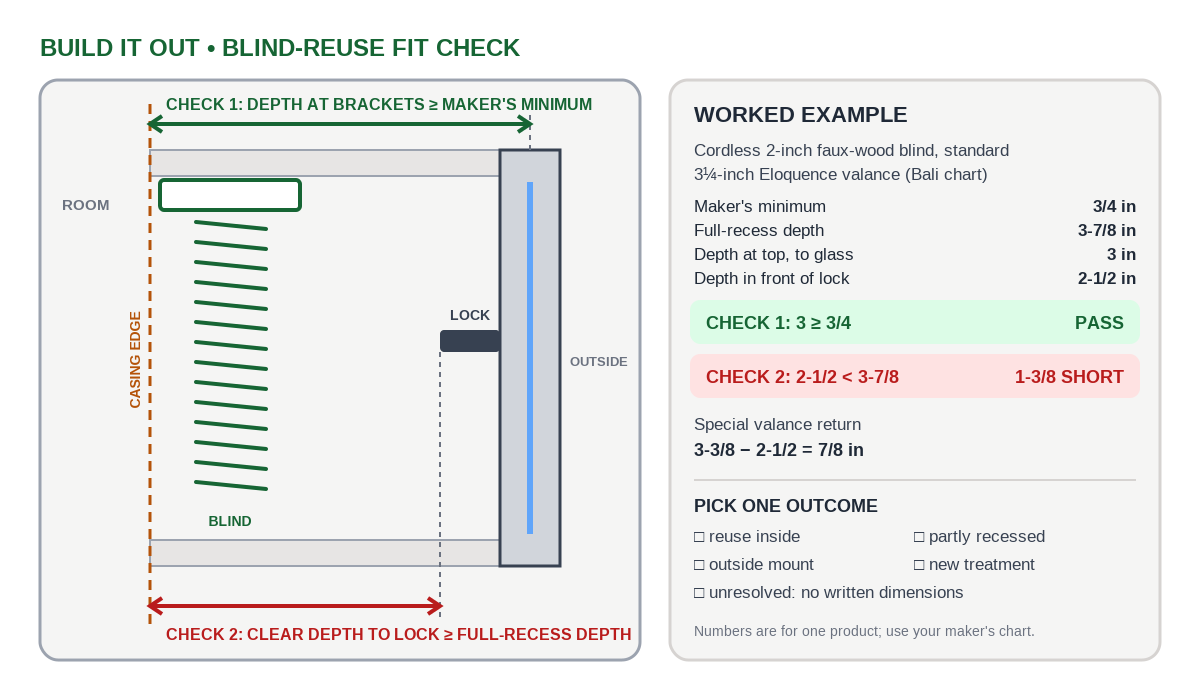
Check 1, mount depth: at the top of the opening, where the brackets go, the shallowest depth from the casing edge back to the glass or frame is at least the maker's minimum depth for an inside mount.
Check 2, full recess: down the blind's whole drop, the depth in front of the first lock, crank, handle or projecting frame is at least the full-recess depth for your exact blind, valance and control.
The two numbers can be far apart. Bali's wood and faux-wood blind measuring guide (10/15 edition) sets 3/4 inch as the minimum depth for an inside mount. It then lists a larger full-recess depth for each blind, valance and control. For its 2-inch faux-wood blind with the 2½-inch Standard Valance, that depth is 3-1/4 inches with a cord tilt, 3-3/4 inches for the cordless version and 3-7/8 inches with a wand tilt. The cordless version comes with the 3¼-inch Eloquence valance as standard, which needs 3-7/8 inches. [4] Between the minimum and the full-recess depth the blind can mount, but part of it sits in front of the casing. Hunter Douglas warns that without enough depth the valance can extend outside the window or the treatment may not sit flush. [5]
Shutters need more than a blind's mount minimum. SelectBlinds says that if the depth from the glass to the outer edge of the casing is less than 2-1/4 inches, its inside-mount shutters will not work and you need an outside mount. [7] Norman adds that the depth must let the louvers (the shutter slats) rotate. [6]
Worked example
You want to keep a cordless 2-inch faux-wood Bali blind with its standard 3¼-inch Eloquence valance. It needs 3/4 inch to mount and 3-7/8 inches to sit fully inside the recess. The window company says the finished depth at the top of the opening will be 3 inches to the glass, and 2-1/2 inches in front of the new lock.
- Check 1: 3 inches is more than 3/4 inch, so the brackets can mount. If the blind must sit forward of the lock, the brackets get only the depth in front of it, and that depth must also meet the minimum. Here that depth is 2-1/2 inches, which is enough.
- Check 2: the slats have to clear the lock, so the usable depth is 2-1/2 inches. That is 1-3/8 inches short of 3-7/8 inches, so about 1-3/8 inches of the blind will stand in front of the casing.
That is not always a dead end. For a blind that will not be fully recessed, Bali's guide lists special valance returns as an ordering option. Returns are the short side pieces that close the ends of the valance, and you size them by subtracting your depth from the standard return length. Here that is 3-3/8 inches minus 2-1/2 inches, a 7/8-inch return. [4] A blind ordered for a full recess may have no returns at all, so ask a Bali dealer whether a valance with special-length returns can be ordered for the blind you already own. Decide whether you accept the projection, and the cost, before the window is ordered.
Width and height follow the maker's rule
For width, the guides agree: measure inside the opening at the top, middle and bottom, and use the narrowest reading. [4] [6] [9] Do not subtract a clearance allowance yourself. Bali says the manufacturer takes the deductions, which is why an inside-mount blind is slightly narrower than its opening. [4] So if you still have the order, compare the new narrowest width with the width the blind was ordered at, not with the headrail (the rail across the top that holds the mechanism). If you no longer have it, measure the current opening now, before the old window comes out, in the same way, and note how deep the blind sits and where its brackets are. Express Blinds suggests recording how each treatment is mounted and the clearances it uses today. [10] If the new opening is narrower, the headrail may not fit between the jambs. If it is wider, the light gaps at the sides grow.
Height rules differ. Bali and This Old House use the longest of three height readings, and so do Norman's instructions for horizontal blinds. [4] [9] [6] Norman uses the shortest for vertical blinds and for inside-mount shutters, and so does SelectBlinds for its shutters. [6] [7] Measure the new height by your product's rule and compare it with the height the blind was ordered at, or with today's opening measured the same way.
Shutters are the least forgiving. Norman says an inside-mount shutter works only in a square opening, and recommends an outside mount if the window is out of square (its diagonal measurements differ) by more than 1/4 to 1/2 inch. [6] Express Blinds points out that shutters are custom-made for the opening and their frames can interact directly with the window and trim, so it advises discussing them before the replacement windows are ordered. For motorized shades it adds access to batteries, charging ports, wiring, brackets and motors to the fit check. [10]
Check old corded blinds before you rehang them
The U.S. Consumer Product Safety Commission says cordless window coverings are the only option that eliminates the strangulation hazard to children, and the safest choice where young children are present. It also says most blinds sold before November 2000 have inner cords that a child can pull into a loop, and that those blinds should be replaced immediately. [8]
If you rehang a corded blind anyway, CPSC lists steps that reduce the hazard but do not eliminate it. Move cribs, beds and furniture away from the window and its cords. Make pull cords as short as possible, and set the cord stops (the small stoppers on each pull cord) within 1 to 2 inches of the headrail when the blind is fully lowered. Anchor continuous-loop cords to the floor or wall so they stay taut but still operable, using fasteners suited to that surface. If the hold-down would go on the new window's frame or sill, ask the installer first. The Window Covering Safety Council offers free kits for blinds without cord stops or hold-down devices, though CPSC notes the kits do not address the dangling pull-cord hazard. [8] If the fit check already points to new treatments for some windows, specify cordless ones.
Ask before anyone drills the new window
Fastening brackets to the new window can affect its warranty. Home Depot's installation terms say that after installation, drilling of any kind into a window voids the window warranty. [2] Other warranties may be worded differently, so read the one for the window you are buying and ask the installer, in writing, which surfaces brackets can go into. Before mounting inside-mount blinds, This Old House contractor Tom Silva also advises checking that the side and top jambs have not been bowed in by insulation or drywall. [9]
Choose the outcome before the window is ordered
| Result | Outcome | Settle in writing |
|---|---|---|
| Both depth checks pass and the width fits | Reuse inside the recess | Bracket surface and who reinstalls |
| Check 1 passes, check 2 fails | Reuse partly recessed, or change the treatment | Projection you accept, any special valance returns, and lock or crank clearance |
| Check 1 fails, or hardware blocks the treatment | Outside mount or a new treatment | Flat mounting surface, new width and brackets |
| Shutter opening too shallow or out of square | Outside-mount shutter or a new shutter | The shutter maker's answer for the new opening |
| No finished dimensions yet | Unresolved | Wait for written dimensions, and measure any new custom treatment on the installed window |
An outside mount clears handles and cranks [4] [5], but it rarely lets you reuse an inside-mount blind. That blind was made slightly narrower than the opening, while Bali recommends that an outside-mount blind overlap the window by 1½ inches on each side. [4] This Old House suggests 2 to 3 inches each side for extra light blocking. [9] Bali's brackets also need at least 2 inches of flat surface above the window or on the window frame, with projection brackets (which hold the blind farther out) or shims to clear the frame or molding. [4] Hunter Douglas gives the same projection-bracket option for heavy molding. [5]
A shallower product is another route. Budget Blinds says some cellular shades need less than an inch of depth, and some narrow cassette shades (with a slim enclosed headrail) as little as 1/2 inch. [11] Confirm the exact product's minimum depth before relying on it.
Put the decision in both quotes
Write the outcome for each opening into the window quote and the treatment quote. Name who removes, stores and reinstalls each treatment, which surfaces the brackets will use, and any new valance, bracket or treatment. Do not assume the window crew will handle it: Home Depot's terms leave removal and reinstallation to the customer. [2] If the window type or trim changes after this check, run it again for that opening. After installation, check the finished opening before drilling new holes or forcing an existing treatment into it, and have any new custom treatment measured on the installed window, as Express Blinds advises. [10]
For related window planning, see how an insert can reduce visible glass area, how to separate glass, frame and rough-opening sizes in a quote, and whether the quote includes screens, trim and disposal.
Sources
- Andersen Windows: How to Assess Windows for Replacement
- The Home Depot: Prepare for Window and Door Installation
- YKK AP: How to Measure Replacement Windows
- Bali Blinds: Wood Blinds and Faux Wood Blinds Measuring Guide (15-1412, 10/15)
- Hunter Douglas: Inside vs Outside Mount Blinds (May 2022)
- Norman USA: How to Measure for Blinds and Window Treatments
- SelectBlinds: Inside-Mounted Shutters Measure Instruction
- U.S. Consumer Product Safety Commission: Window Covering Cords
- This Old House: How to Install Window Blinds
- Express Blinds, Shutters, Shades & Drapes (Knoxville): Replacing Windows? Will Existing Blinds Still Fit?
- Budget Blinds: When the Casing Is Only ¾" Deep (December 2025)