
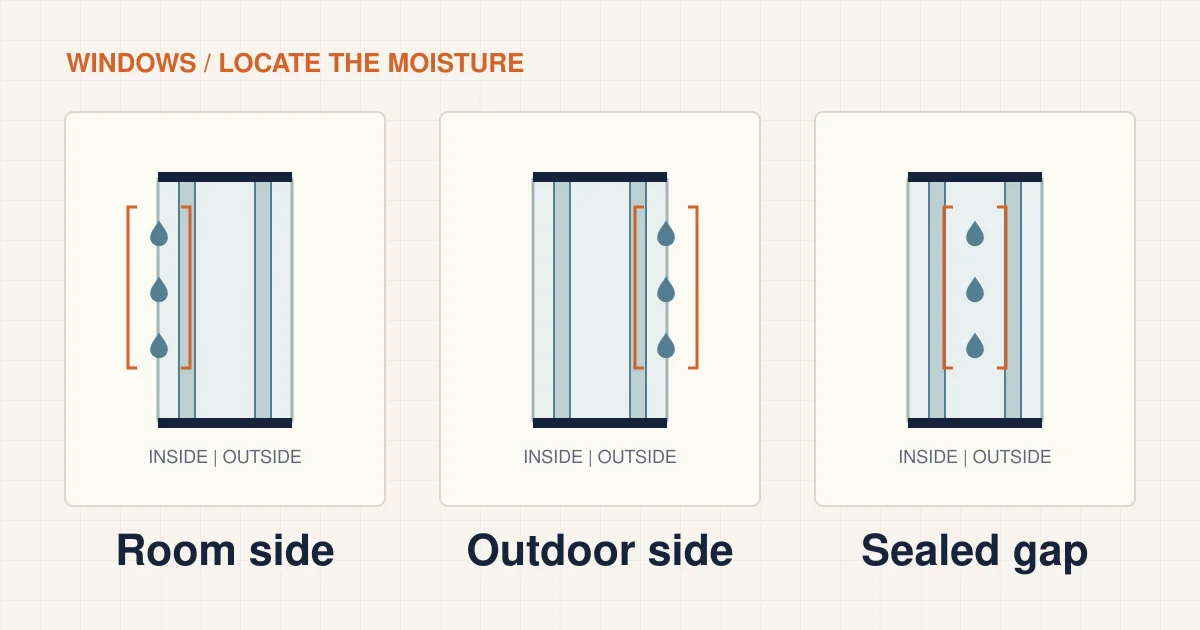
Locate the moisture before deciding the new window is defective. Water on the room-facing surface usually calls for a humidity and airflow check. Dew on the outdoor surface can occur on well-insulated glass. Moisture trapped inside a sealed glass unit needs the manufacturer’s assessment. These are three different situations, even when they look similar from across the room.
You paid for better windows. Now one of them is foggy every morning, while the old window beside it looks clear. That feels backwards. The useful first question is not “Why are my new windows wet?” It is “Which surface is wet?” Pella’s technical explanation makes this location check the starting point because room-side, outdoor and sealed-cavity condensation have different causes. [1]
A three-surface check before you change anything
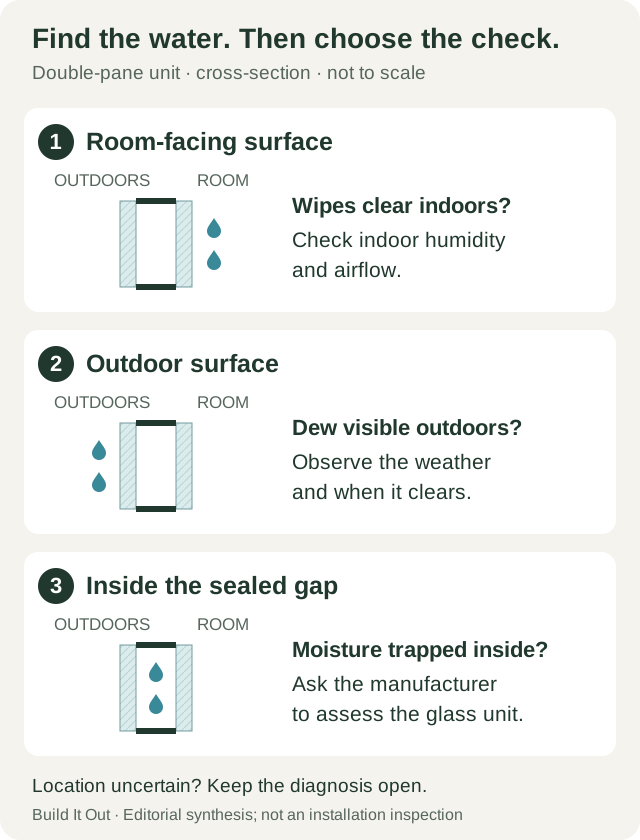
This worksheet is Build It Out’s synthesis of the manufacturer guidance below. It helps organize observations; it is not a seal test, an installation inspection or a warranty decision. Start with a photograph while the fog is visible. Then, following the window’s cleaning instructions, use a clean, soft, dry cloth on a small area of accessible room-facing glass. Do not dismantle the window to find the moisture.
| What you observe | What it suggests | Useful next step |
|---|---|---|
| A small wiped patch clears on the room side | At least some moisture is on the indoor surface. | Dry accessible moisture; check indoor humidity, moisture sources and airflow. |
| The indoor surface is dry; droplets are visibly on the outside | Outdoor dew is possible, particularly if it changes with weather and time of day. | Observe from a safe location and record when it clears. Check separately for wet indoor trim. |
| Both accessible outer faces are clear, but fog remains within a sealed unit | Moisture inside the insulating-glass cavity is a possibility. | Send photographs and product details to the installer or manufacturer. |
| The location remains uncertain | Reflections, dirt or another glazing layer can make the view misleading. | Keep the diagnosis open. Ask the supplier to identify the glazing construction. |
Only check exterior glass if it is safely accessible without climbing, leaning out or removing components. A dry indoor wipe alone does not prove that moisture is between the panes. The outdoor face may still be wet. Two conditions can also occur at once.
Room-side moisture: better windows do not remove indoor water vapor
Condensation forms when a surface is cold enough relative to the surrounding air’s dew point. The glass can be the place where an indoor moisture problem becomes visible; surface water alone does not demonstrate a failed sealed unit. Andersen’s interior-condensation guidance explicitly separates room-side condensation from glass failure. [2]
There is also a replacement-window wrinkle: reducing uncontrolled air leakage can reduce the exchange of moist indoor air with drier outdoor air. JELD-WEN explains why a home may show condensation after replacement even though the new windows are more airtight. This is a reason to investigate the whole moisture situation, rather than immediately ordering another window. [3, p. 1]
- Look for a pattern. Note whether it follows showers, cooking or overnight use of a humidifier.
- Check the air near the glass. Open interior coverings during the day and avoid blocking the room’s intended airflow. Milgard specifically recommends leaving space beneath closed shades for air movement. [4]
- Use existing ventilation properly. Marvin recommends kitchen and bathroom exhaust that vents outdoors, and identifies moisture from new construction or remodeling as another possible contributor. An ordinary fan moves air; it does not itself remove water vapor from the home. [5]
A hygrometer provides useful context, but there is no single indoor humidity number that guarantees dry windows in every winter climate. JELD-WEN’s guidance ties condensation risk to outdoor temperature and specified indoor conditions; FGIA likewise explains that colder conditions can require lower indoor humidity. Use the guidance for the actual window and conditions, rather than a universal “ideal” percentage. [3, p. 1] [6]
Dry accessible standing moisture promptly. Repeatedly wet trim, staining or a musty smell deserves attention beyond the glass. EPA’s moisture guidance calls for drying wet surfaces and addressing the water source; ProVia also warns that persistent interior condensation can affect surrounding wood. If the source is unclear or damage keeps returning, arrange a building-moisture assessment. [7] [8]
Outdoor dew: the new window may behave differently on purpose
Efficient insulating glass limits heat flow from the house to the outdoor pane. Under suitable weather conditions, that exterior surface can become cool enough for outdoor moisture to condense. Milgard’s technical sheet compares this with morning dew on a parked car. It can happen even when the room-facing surface stays dry. [4]
One window may fog while a neighboring one stays clear. Andersen notes that small differences in glass temperature, including shading, can produce different results even within a group of windows. The moisture often evaporates as conditions change during the day. [9]
Outdoor dew alone is not a reason to buy a dehumidifier for the room. Energy Saving Trust also distinguishes generally benign exterior condensation from moisture between glazing layers. That reassurance applies to surface dew: it does not explain rainwater entering around a frame or a wet indoor sill. Photograph those separately. [10]
Between panes: first establish which gap you are looking at
For a conventional sealed insulating-glass unit, moisture inside the sealed cavity can indicate seal failure. Pella describes how a compromised seal can admit moisture into that space. Ask the installer or manufacturer to confirm the location and repair options before agreeing to replace the entire window. [1]
The phrase “between panes” needs care. A storm window or an additional removable glazing panel creates another space that is not necessarily the sealed insulating-glass cavity. Identify the product and consult its manual. Do not open panels, drill glass, add sealant or attempt to dry a sealed cavity as part of this observation exercise.
Warranty coverage depends on the actual product, age and terms; visible fog does not establish entitlement to a free replacement. Keep the original paperwork and ask the supplier what evidence it requires. Pella’s own guidance recommends checking what the manufacturer’s warranty includes and excludes. [1]
Make the service call more useful
Our suggested record is deliberately simple: photograph the affected glass and surrounding trim; note the room, date and time; record indoor temperature and relative humidity if available; describe recent cooking, showering or humidifier use; and state which accessible surface wiped clear. Add whether the fog changes later in the day, plus the order number or product label.
Ask: “Can you confirm the wet surface and glazing construction, and explain whether this needs a moisture assessment, a glass-unit assessment or an installation inspection?” That is a more actionable request than “The windows are bad.”
Even a condensation-resistance rating cannot settle the diagnosis by itself. NFRC’s technical fact sheet explains that its standardized rating compares products’ potential for interior condensation; it does not predict exactly what a particular home will experience. [11, p. 2] Locate the water, document the conditions and let those observations guide the next step.
Sources and method
Prepared from independently published manufacturer guidance, industry technical resources and public moisture-control guidance. The worksheet and service-call record are Build It Out’s editorial synthesis, not a field test or professional inspection. Sources checked October 25, 2026.
- Pella: What Causes Windows to Fog?
- Andersen: Condensation on the Interior of Window or Patio Door Glass
- JELD-WEN: Condensation—Windows and Patio Doors (JGI012)
- Milgard: Learn About Condensation (2024 technical sheet, hosted by Dolan Lumber)
- Marvin: What Causes Condensation on Windows in Your Home?
- FGIA: Understanding Indoor Condensation
- US EPA: A Brief Guide to Mold, Moisture and Your Home
- ProVia: Should I Worry About Condensation Inside or Outside My Windows?
- Andersen: Condensation on the Exterior of Window or Patio Door Glass (same independent origin as source 2)
- Energy Saving Trust: Energy Efficient Windows and Doors (general glazing physics only; UK costs and regulations are not applied here)
- NFRC: Condensation Resistance technical fact sheet (legacy CR methodology and its limits)