
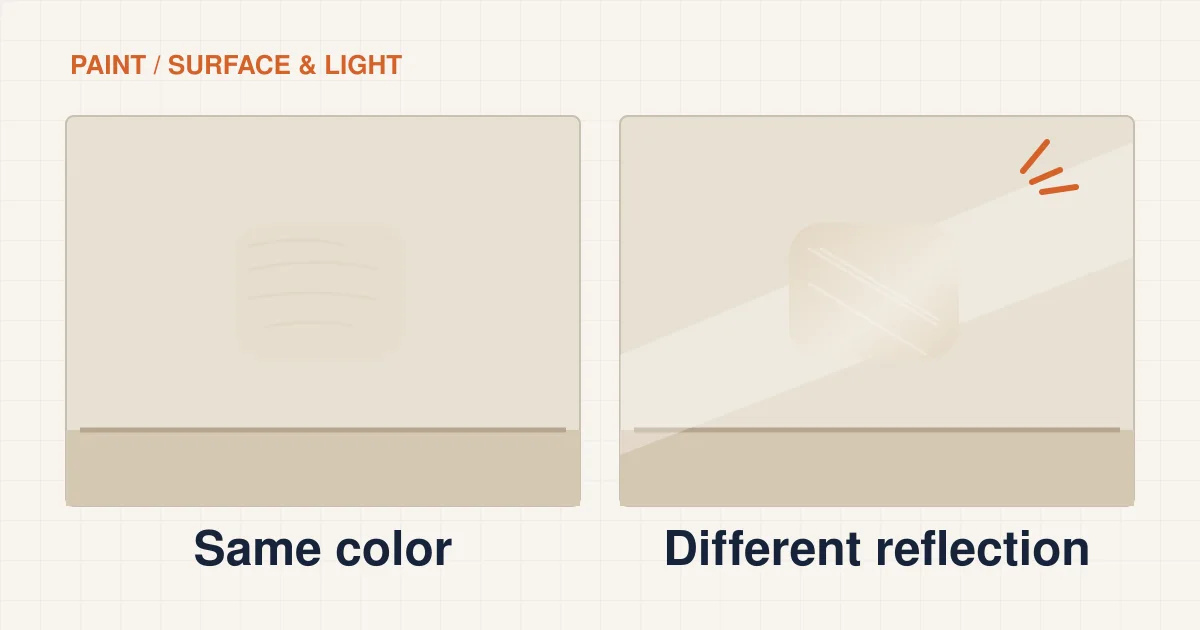
The color can be right while the repair still looks wrong. A touch-up also has to match the wall’s sheen, roller texture, paint build, and underlying surface. If the spot looks acceptable straight on but flashes from the side, another color match may not solve it. Let the paint develop as directed, identify what differs, and decide how far the repair should extend before adding more paint.
A thumb-sized scuff becomes a hand-sized patch. A second coat makes it shinier. Soon the “small repair” is the first thing visible when entering the room. That happens because a paint color name describes only part of the finished surface. Sherwin-Williams identifies applicator, batch, repair texture, and application temperature as separate causes of an obvious touch-up.
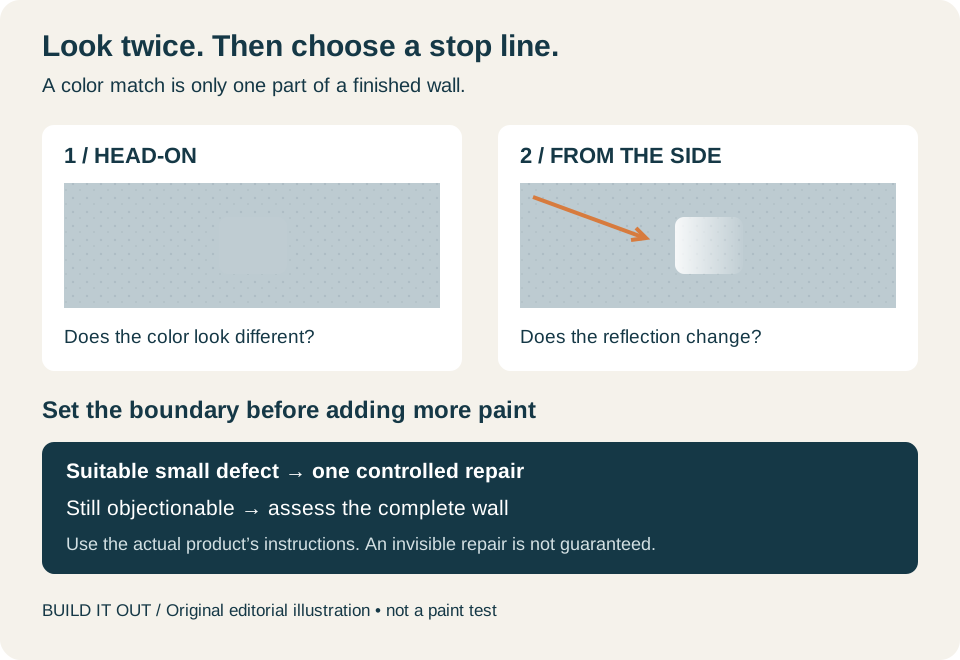
First, look at the patch from two positions
After the product’s specified drying period, view the wall straight on, then from the normal side approach to the room. Repeat in the daylight and artificial lighting normally used there. Do not judge only while the new paint is wet.
A patch that changes conspicuously with viewing angle suggests a reflection or texture difference; it does not prove that the color is correct. Dulux’s technical advice explains that angle-dependent visibility can reveal a different microscopic surface texture. A patch that remains lighter or darker from several positions calls for checking paint identity and coverage as well. These are useful observations, not a laboratory diagnosis.
A successful touch-up needs more than a color match
| Match | What can differ | Useful check |
|---|---|---|
| Paint identity | The color name matches, but the product line, base, or batch differs. | Compare the actual can labels, not a photo of a color swatch. |
| Sheen | The repair reflects light differently. | Check the exact finish and product; inspect from the side. |
| Application texture | Brush marks replace the wall’s roller stipple. | Identify the original applicator and roller sleeve where known. |
| Paint build | Repeated touch-ups create a raised or conspicuous film. | Record previous attempts rather than automatically adding another coat. |
| Surface underneath | Filler or exposed wallboard absorbs paint differently. | Identify whether the defect is in the coating or the repaired substrate. |
This checklist synthesizes the manufacturer guidance below. It does not guarantee an invisible repair.
1. The same name is not the same paint record
Find the brand, product line, finish, color formula, and original container if available. A fresh can tinted to the same name may still come from another batch. Farrow & Ball acknowledges that slight differences can remain between batches. For its own paints, Little Greene recommends repainting a larger area rather than relying on a touch-up because of possible batch variation. Neither statement means every new batch will visibly differ; it means a matching label is not a promise.
2. A shine mismatch can masquerade as a color mismatch
Manufacturers generally find flatter finishes easier to touch up than higher-sheen finishes. Diamond Vogel distinguishes hue, sheen, and the profile of the paint film as separate ways a repair can show. Its technical bulletin also explains that the same satin paint can develop differently over porous wallboard and an already painted surface. Buying a different color cannot correct all those differences.
3. The tool leaves part of the finish behind
Use the original application method where practical. On a rolled wall, a brush can leave a different pattern even with the original paint. Behr’s touch-up guidance recommends matching the applicator to reproduce surface texture, and identifies aged, faded, and higher-sheen coatings as harder to blend. Its Canadian guidance is relevant here for this general appearance principle; follow the label supplied with the actual US product for application requirements.
4. A filled hole is a different starting surface
Painting a filler patch is different from covering a mark on intact paint. Benjamin Moore distinguishes a simple color imperfection from damage to the wallboard: the latter needs appropriate priming before paint. Do not assume “paint and primer” on the can removes every preparation requirement. Check the coating’s instructions and ask its technical team about the repaired material.
Why waiting, feathering, and thinning need different answers
Wait for the product, not an internet countdown. Dry-to-touch, recoat, and cure instructions describe different stages. Dulux notes that final sheen can take several days to develop. Use the actual paint’s label or data sheet, and ask the manufacturer if appearance is still changing. Waiting may help assess the result; it cannot guarantee that a texture or batch mismatch will disappear.
Feathering is not one universal technique. Benjamin Moore describes gradually reducing paint toward a repair’s edges. By comparison, Dunn-Edwards’ touch-up technical bulletin, page 1, warns that brushing outward on a smooth wall can create a dull halo, and discusses a synthetic roller instead. The practical conclusion is to follow instructions for the paint and original finish, rather than combining every tip into one repair.
Do not copy a universal water ratio. Some manufacturer advice discusses dilution for particular touch-ups, but those recommendations have different scopes. Resene’s problem solver, for example, gives its own approach and emphasizes an inconspicuous test. That is not authorization to dilute another brand or product. Check the current label or obtain product-specific advice before altering paint.
Our stop-line worksheet: decide before the patch grows
This is an original editorial decision aid built from the cited guidance, not a tested scoring system. Complete it for one wall:
- Record the starting condition. Is this a removable mark, missing paint, a filled hole, or coating failure? If it is only a mark, check the paint manufacturer’s cleaning advice before adding paint.
- Record what is known. Note the exact paint, finish, batch/container, original applicator, and repair history. Put “unknown” where information is missing.
- Choose the viewing test. Write down the two positions and ordinary lighting conditions that matter in this room. Use those same conditions after the repair has developed.
- Set the boundary. For a suitable small defect on sound paint, try one controlled repair using the product’s method. If it remains objectionable, stop expanding it in repeated rings and assess a full-wall repaint.
- Specify the fallback. Identify the wall’s corners or another genuine architectural boundary. Ask a painter to price that complete surface, including any needed preparation, separately from a spot repair.
For example, a small flat-finish repair behind a chair may be acceptable after a controlled test. Several bright patches across a sunlit satin wall may justify repainting the complete wall. These are illustrative decisions, not promises about either coating. Crown’s flashing guidance recommends repainting to the nearest complete elevation when application differences leave visible patches. A boundary keeps the fresh coating from ending arbitrarily in the middle of the wall.
Leave a useful record for next time
Keep a photograph of the can label and a note of the wall, product, color, finish, application tool, and painting date. Store any usable leftover paint according to its manufacturer’s instructions. A well-documented coating gives the next repair a better starting point; it still cannot make every touch-up disappear.
Sources and editorial method
Prepared by Build It Out from manufacturer guidance and EPA information; sources checked October 25, 2026. No on-site test or professional inspection is claimed. International manufacturer guidance supports general finish behavior here, not US product-specific dilution, application, or warranty instructions.
- Sherwin-Williams: Obvious Repair (Touch-Up).
- Benjamin Moore: How to Touch-Up and Match Paint.
- Dunn-Edwards: Touch-Up technical bulletin (2018), page 1.
- Dulux Australia: Paint Touch-Up technical advice.
- Diamond Vogel: Touch-Up Factors technical bulletin.
- Behr Canada: Touch-Up Versus Repaint.
- Farrow & Ball: Touching Up Paint Coatings.
- Little Greene: Paint FAQs, touch-up question.
- Resene: How to Touch-Up Paint.
- Crown Decorating Centres: Flashing.
- US EPA: Lead-Safe Renovations for DIYers.