

“Installed window” is not a complete scope. Before comparing per-window totals, identify the replacement method, exact product, screens, trim and finishing, removal/disposal, and responsibility for unexpected surrounding damage. Mark each item included, excluded, allowance or unresolved.
One quote includes new casing and paint-ready finishing. Another keeps the original frame and trim. The lower per-window number may describe a different job, even if the window count matches. Our comparison method starts with the boundary of the work and keeps that separate from the price.
Insert and full-frame proposals are not automatically equivalent
Andersen explains that suitable insert replacements preserve the existing frame and trim. Infinity by Marvin distinguishes that method from full-frame work that removes the existing frame and trim. These are manufacturer descriptions, not a recommendation that one method fits every opening. Andersen · Infinity by Marvin
Write the chosen method beside each opening. If the contractor may change the method after assessment, ask what triggers that decision and how the revised scope is documented. Do not rely on a whole-house label when different openings may have different conditions.
Our included/excluded/allowance grid
Put the same rows in front of every bidder. Use four statuses: included, excluded, allowance with a defined limit, or unresolved. Do not treat silence as inclusion or assume that an excluded item is unnecessary.
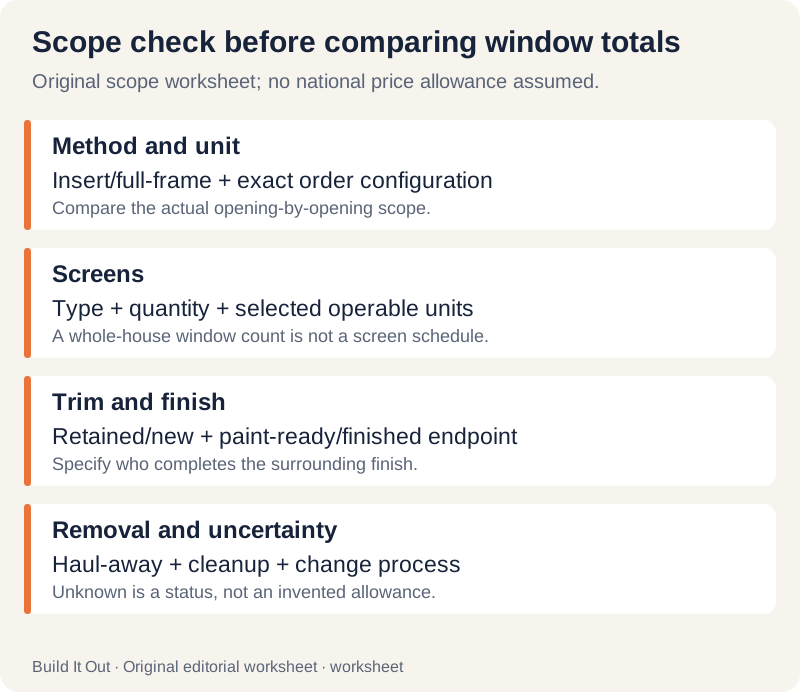
| Row | What to specify | A question that resolves ambiguity |
|---|---|---|
| Window unit | Model, size, operation, glazing and finish | Is this the exact order configuration for each opening? |
| Screen | Type, coverage, color and quantity | Which operable units receive which screens? |
| Surrounding finish | Interior/exterior trim, repairs, preparation and final finish | Does “finished” mean paint-ready or fully painted? |
| Old material | Removal, handling, disposal and cleanup | Who takes it away and what is included? |
| Uncertain condition | Defined allowance or change process | What evidence and approval are needed before additional work? |
The FTC recommends comparing written work and material descriptions. ENERGY STAR advises obtaining several quotes and asking for labor/material breakdowns. Those principles support a scope grid; they do not mean every installer must price every task on an identical form. Federal Trade Commission · ENERGY STAR
Screens deserve a real product line, not a yes/no assumption
Pella’s selection guidance identifies screen design as a product choice. ProVia describes standard and alternative screen configurations for its own replacement products. Ask what is supplied for the exact selected model, and distinguish an upgrade from a missing required order item. Do not generalize one brand’s standard package to another. Pella · ProVia
For a mixed order, make the count explicit. An illustrative order of five operable windows and two fixed picture units contains seven windows, but a proposed screen count needs to be tied to the five operable units and their actual designs. “Seven windows” alone does not answer the screen question.
Also keep original installation scope separate from later warranty service. Simonton’s West warranty document, for example, distinguishes screen coverage and screen-replacement labor. That does not define every initial purchase; it illustrates why product coverage is not the same document as the installer’s proposal. Simonton
Resolve the endpoint of trim and finishing work
Ask what remains when the installer leaves. Is existing trim retained? Is replacement trim supplied? Are nail holes and disturbed surrounding finishes addressed? Is the promised finish primed, paint-ready, stained or fully painted? Put the selected endpoint in writing, including who supplies the final finish when it is outside the contract.
Milgard identifies product style, materials and labor as separate replacement-cost factors. Those variables are a reminder to preserve the actual configuration while comparing. A premium product description cannot tell you whether wall touch-up or exterior trim painting is included. Milgard
Do not request a cosmetic shortcut that conflicts with the product’s installation or water-management instructions. The contractor should explain the compatible assembly and the finish scope. This worksheet is a purchasing aid, not a detail for cutting, fastening or sealing the opening.
“Removal” and “disposal” should be explicit
The Home Depot’s own installation FAQ specifically states what its service includes for old-window removal and disposal. Treat that as one provider’s stated offer, not an industry-wide rule. Ask every bidder to describe handling, haul-away, cleanup and any separately stated charges for the actual project. The Home Depot
For an older home, include the assessment and handling scope for potentially hazardous painted materials. EPA identifies window replacement that disturbs old lead-based paint as a dust concern and recommends lead-safe trained contractors for relevant older-home renovations. Ask the professional to identify applicable requirements; do not remove trim or scrape paint to inspect it yourself. US Environmental Protection Agency
A price comparison that preserves uncertainty
Make a row for each proposal and count unresolved items. If one bidder excludes final painting and another includes it, request a written equivalent scope or keep the difference visible. Do not add an invented national allowance to force the totals into a false comparison.
Our practical stop rule: do not call one bid the cheaper complete job while a necessary scope row remains unresolved. Ask a focused question, receive the answer in writing, and update the grid. Keep the final order, installation scope and warranty documents together. Each answers a different question about what is being bought and who is responsible.
Sources and method
Sources inspected October 25, 2026. The worksheet is Build It Out’s original editorial synthesis, not an on-site inspection, professional review or product certification.
- Federal Trade Commission: How To Avoid a Home Improvement Scam
- ENERGY STAR: Residential Windows, Doors and Skylights: Buying and Installation Guidance
- Andersen: Insert Window Replacement Installation
- Infinity by Marvin: Replacement Window Installation
- Milgard: Replacement Windows and Doors
- Simonton: West Product Lifetime Limited Warranty (2025)
- The Home Depot: Window Installation Service: Included Work and Disposal
- Pella: Windows 101: Tips for Selecting New Windows
- ProVia: Windows with Built-In Screens
- US Environmental Protection Agency: Renovation, Repair and Painting Program: Consumers