
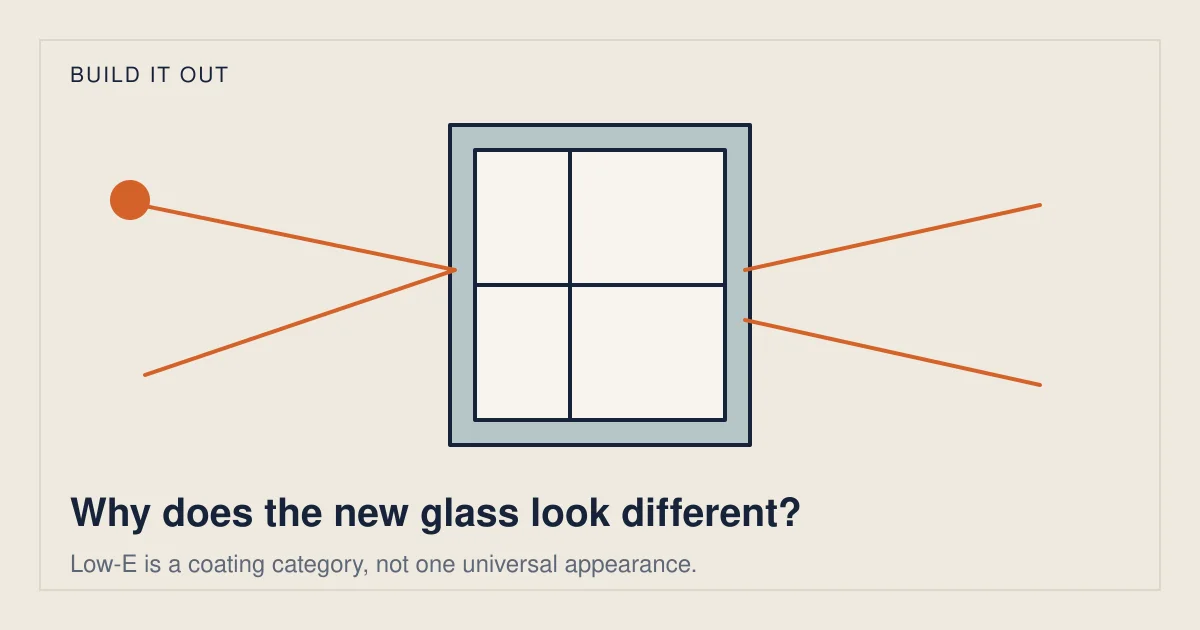
New windows can look greener, grayer or more reflective than the old ones because “Low-E” describes a coating function, not one universal appearance. The complete glass package and the light on either side of it affect what you see. A color difference alone cannot establish whether the supplied glass is correct or defective.
The useful first step is to separate two observations: the color of the world seen through the window and the color of the image reflected in it. Then compare the exact specification with the order and record the conditions in which the difference is visible.
A coating category is not a color specification
Low-emissivity coatings are engineered to affect the transfer of radiant energy. Their optical behavior is part of the design too. Vitro’s explanation of Low-E coatings describes thin coating stacks with different optical characteristics. Pilkington’s thermal-insulation glass range includes different products with their own transmission and reflection properties.
A particularly useful example is Cardinal’s LoE3-340+ product information, which explicitly distinguishes the color profiles of named coating products. That is evidence against a blanket claim that all Low-E glass should look identical. It is not evidence that your window contains either of those products.
The panes around the coating matter as well. AGC’s Planibel Low-E information describes combinations with other glass choices, including tint. Pella’s glass-options page separately lists named Low-E packages and tinted-glass options. A coating name, body tint and complete insulated-glass package are related specifications, but they are not interchangeable labels.
Looking through and looking at are different comparisons
From inside, you may notice a tint when looking through the glass at a neutral object outdoors. From outside, you may mainly see the reflected sky, trees or neighboring buildings. Guardian’s technical paper on glass color distinguishes transmitted color from reflected color and explains why background and viewing angle belong in an appearance assessment.
That makes two quick comparisons unreliable: a sunny south-facing window against a shaded north-facing one, or a close interior view against a distant exterior photograph. Even adjoining units can reflect different parts of the surroundings at different angles. Record those differences rather than asking a phone picture to prove that the glass is the same.
Marvin’s glass guide acknowledges that Low-E coatings can have a slight tint. The word “slight” does not set an acceptance threshold for your order, and it does not mean a strong or uneven appearance should be dismissed. The supplier needs to identify the actual product and evaluate your specific concern.
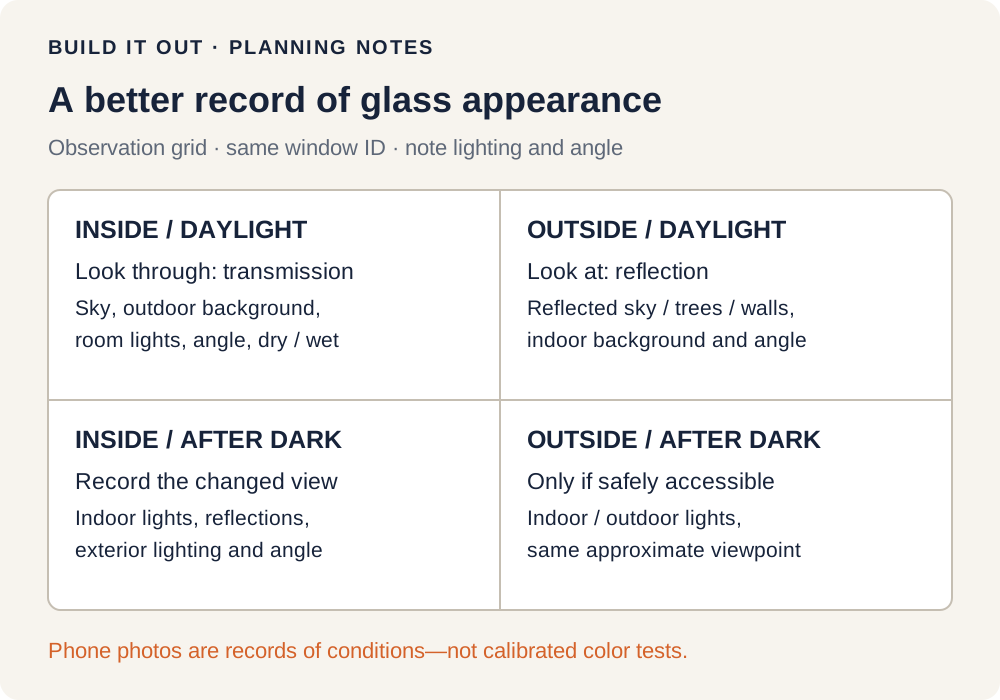
Make a four-view appearance record
Use one window as the reference. If you compare a second unit, give both location IDs and note whether the order specifies the same glass. Stay at safely accessible viewpoints; there is no need to reach an upper-story exterior or dismantle anything.
| View | What to record | What it helps separate |
|---|---|---|
| Inside, daylight | Looking through; direction; sky; outdoor background; room lights | Transmitted appearance from outdoor reflections |
| Outside, daylight | Reflection; viewing angle; reflected trees, sky or wall; indoor background | Glass appearance from the image reflected in it |
| Inside, after dark | Indoor lights and reflection; exterior lighting | How a changed brightness balance changes the view |
| Outside, after dark | Only if safely accessible; indoor lights; exterior lights; same approximate viewpoint | Whether the observation persists under different lighting |
Add the date, whether the surface is dry, and whether a visible haze appears uniform or localized. Take a wider photograph showing the setting and a closer one showing the concern. Keep original files; phone white balance, exposure and screens can change apparent color. Photos document the pattern and location, rather than serving as calibrated color measurements.
Wetness, surface dirt and an apparent film belong in the record as observations, not diagnoses. If moisture appears trapped between panes or one unit has a persistent localized haze, describe that separately to the supplier. Do not assume every change is the coating, and do not attempt to remove a factory coating to investigate it.
Check the order before debating the tint
Ask the supplier to match each window ID to the exact product line, glass package, pane configuration and specified tint. Andersen’s window-selection guidance distinguishes pane and glazing options; a short invoice entry saying “energy glass” leaves too much unresolved. Request the actual order description and the manufacturer’s explanation of its appearance.
For windows not yet ordered, ask to see a representative sample of the proposed complete glazing package under useful viewing conditions. Confirm what the sample represents. A different coating, pane construction or tint is not a substitute simply because both samples are described as Low-E.
Performance numbers help answer performance questions. The Department of Energy’s purchasing guidance separates visible transmittance from solar heat gain. NFRC’s technical definitions describe visible transmittance as a weighted transmission quantity. VT does not, by itself, describe all aspects of hue, reflection or visual quality. Two packages should not be declared an appearance match solely because a rating is similar.
When to ask for a closer review
Request a supplier review when units specified to match look persistently different under comparable conditions, when the delivered package does not match the order, or when there is a new localized haze, mark or between-pane concern. Send the location IDs, order information and four-view record. Ask what the manufacturer’s prescribed viewing conditions and evaluation process are.
The aim is a specific answer: what glass was supplied, whether that matches the agreement, and how the observed appearance should be assessed. Neither “all Low-E is green” nor “green means defective” can provide that answer.
Sources and method
We inspected these ten independent manufacturer, technical or service resources on October 25, 2026. Product examples explain why requirements differ; use the current US instructions for the exact product being supplied. Worksheets and illustrative calculations are Build It Out editorial tools, not field tests or professional certification.
- Cardinal Glass Industries: LoE3-340+ Glare Control Glass
- Vitro Architectural Glass: The Science of Low-e Coatings
- Guardian Glass: Expert Series: Glass Color
- Pilkington: Window and Thermal Insulation
- AGC Glass Asia Pacific: Planibel Low-E
- Pella: Window Glass Features and Options
- Andersen Windows: Choosing the Right Windows
- Marvin: A Homeowner’s Guide to Understanding Glass Types and Performance
- National Fenestration Rating Council: NFRC 101-2026: thermophysical properties and definitions
- U.S. Department of Energy: Purchasing Energy-Efficient Residential Windows, Doors, and Skylights