

Feeling cold beside a closed window does not prove outdoor air is leaking through it. A cold glass surface can cool nearby room air, creating downward circulation, and can affect how much heat your body loses by radiation. Actual leakage is another possibility. Describe the location and conditions before choosing a remedy.
You reach toward the window and feel cooler air near the sill. It is tempting to call that a failed seal. But three different mechanisms can produce an uncomfortable window seat, and they can coexist. Treat the feeling as a useful observation rather than a complete diagnosis.
Three mechanisms that should not be collapsed into “draft”
Andersen’s support guidance distinguishes cold-surface convection from air coming through gaps. Technoform’s technical explanation adds radiant heat exchange: a person can feel chilly next to a colder surface even without a stream of outdoor air. These mechanisms point to different questions. Andersen · Technoform
- Air leakage: Outdoor and indoor air move through an unintended path in or around the assembly.
- Cold-surface circulation: Room air cools beside the glass and moves downward within the room.
- Radiant discomfort: Heat exchange between your body and surrounding surfaces affects comfort, even when there is little noticeable air movement.
Lawrence Berkeley National Laboratory’s original comfort-model abstract treats those effects separately. It also explains why proximity and conditions matter. This supports distinguishing the mechanisms; it does not let this article calculate the cause of discomfort in an individual room. Lawrence Berkeley National Laboratory
Our location-and-condition record
Use this worksheet before a service appointment. Observe from the room with the window in its normal closed position. Do not dismantle trim, apply a temporary seal across drainage features, use an open flame or change building-pressure equipment as a home test.
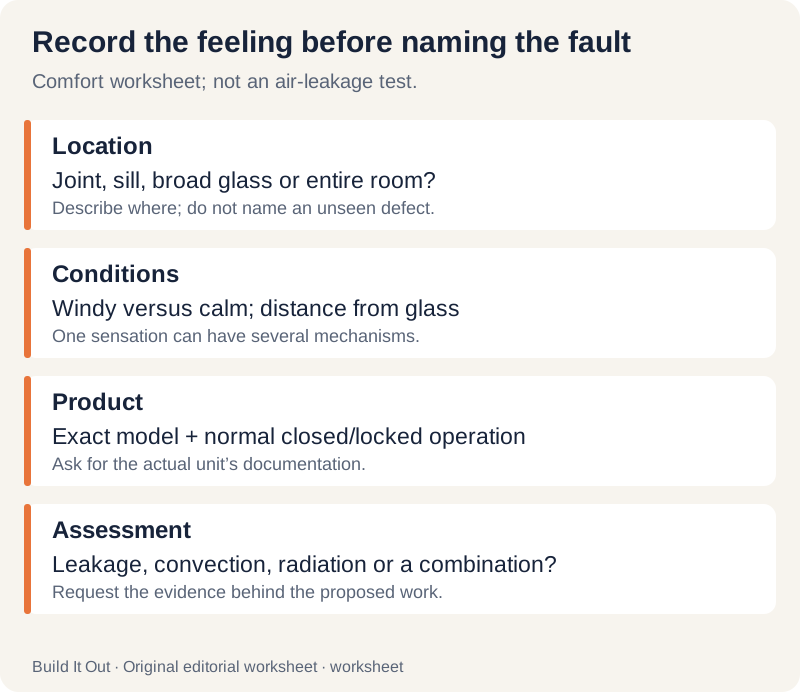
| Observation | A useful note | Question for the assessor |
|---|---|---|
| Exact location | Along a joint, at the sill, beside broad glass or throughout the room | Is there an identified leakage path or a cold-surface effect? |
| Weather relationship | Compare a windy period with a calmer period | Does the pattern change with outdoor pressure/wind conditions? |
| Window operation | Record whether it closes and locks normally | Does the actual unit need product-specific adjustment? |
| Nearby conditions | Furniture position, coverings and ordinary room airflow | Could more than one mechanism explain the discomfort? |
The record should use language such as “cool sensation along the lower-right joint on windy evenings,” not “the glass has a broken seal.” If another window behaves differently, note its type, size and location. Different exposures and products are not a controlled comparison.
Cold glass is a clue about temperature, not proof of a hole
FGIA explicitly notes that glass surface temperature alone does not indicate infiltration. Truman’s customer-support answer likewise explains that room air can circulate beside a cold window even when the unit is fitted and weatherstripped. Do not turn that explanation into the opposite claim that every draft is normal. FGIA · Truman Homes
Pella’s selection guidance distinguishes glazing performance from other window features. ENERGY STAR also describes winter discomfort beside inefficient cold glass and separately warns that poor installation can cause drafts. Both product performance and the installed interface belong in an assessment. Pella · ENERGY STAR
Changing the place where a chair sits may change the sensation, but that does not prove whether leakage exists. Record it as a comfort observation. A useful diagnosis should explain which mechanism was assessed and how the proposed improvement addresses it.
U-factor and air leakage answer different questions
U-factor concerns heat transfer; an air-leakage metric concerns airflow under specified test conditions. The Department of Energy discusses them separately, and NFRC’s consumer guidance describes air leakage as air passing through a window. A thermal rating is not a guarantee of zero site leakage, and a product test does not inspect the window-to-wall joint in your home. US Department of Energy · National Fenestration Rating Council
Ask for the ratings for the exact selected window and glazing package, not another model’s brochure. Ask how the installation and operating condition were assessed. Avoid comparing numbers with different units or test bases as if they were interchangeable.
Ask for an assessment before prescribing the fix
Infinity by Marvin identifies a home energy assessment as a way to locate trouble spots. For a new installation, start with the installer and product documentation. For a broader room-comfort concern, an appropriately qualified energy assessor can help distinguish product, installation and whole-room factors. Infinity by Marvin
Our suggested request is: “The cold sensation occurs here, under these conditions. Please identify whether the finding is outdoor-air leakage, cold-surface circulation, radiant discomfort or a combination, and explain what evidence supports the recommended work.”
A proper follow-up might involve the unit’s operation, an installation issue, product thermal performance or a broader room condition. None should be chosen solely because a hand feels cold near the sill. Keep your observations, the actual product identification and the assessor’s findings together so the proposal addresses the reported problem.
Sources and method
Sources inspected October 25, 2026. The worksheet is Build It Out’s original editorial synthesis, not an on-site inspection, professional review or product certification.
- Andersen: Air Infiltration in Andersen Gliding Windows
- Technoform: Back to Basics: Achieving Thermal Comfort Next to Windows
- Truman Homes: Winter Window Draft
- Infinity by Marvin: Drafty Windows: Causes and Assessment
- Pella: Windows 101: Tips for Selecting New Windows
- US Department of Energy: Purchasing Energy-Efficient Residential Windows, Doors and Skylights
- National Fenestration Rating Council: Air Leakage: The Hole Story
- Lawrence Berkeley National Laboratory: Window Performance for Human Thermal Comfort (1999 original study abstract)
- FGIA: Understanding Residential Air Infiltration
- ENERGY STAR: Residential Windows, Doors and Skylights: Buying and Installation Guidance