
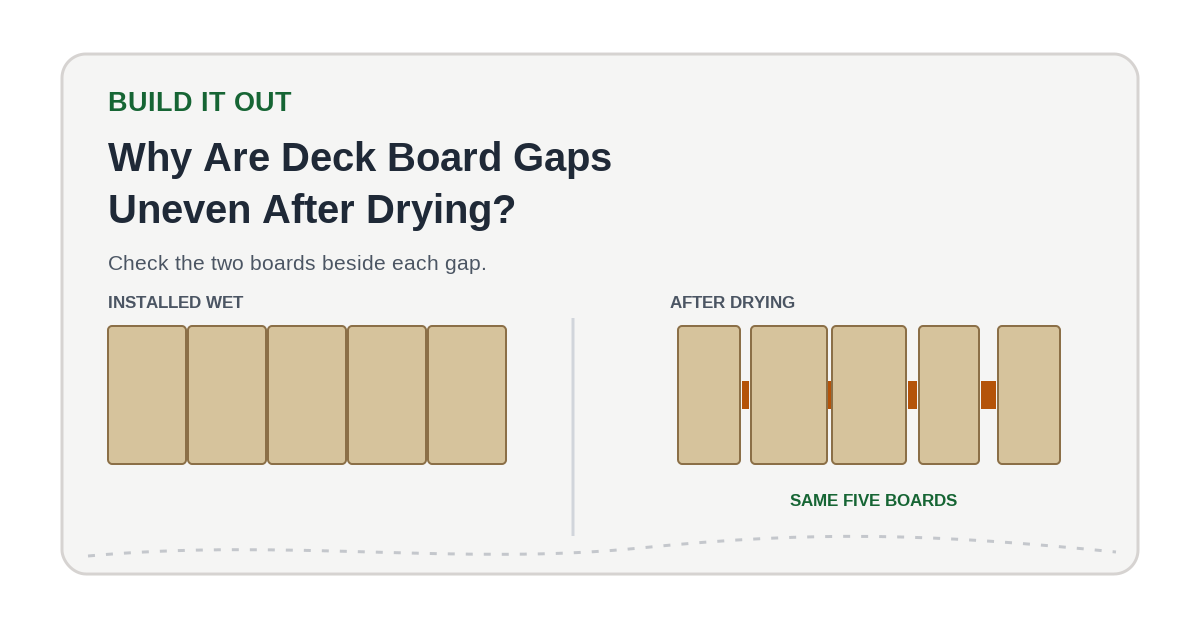
Usually it is normal. Pressure-treated boards are often installed wet and shrink in width as they dry. Boards cut from different parts of the log shrink by different amounts, so neighboring gaps can differ by 1/16 inch or more without anything being wrong. For wet boards installed tight, the USDA shrinkage method predicts gaps of roughly 5/32 to 1/4 inch at typical outdoor moisture, and wider in dry climates. Judge the deck after it has dried through a warm season, and measure several gaps rather than the widest one. Raise it with the builder if gaps are wider than about 3/8 inch or close up completely, or if you see raised or loose fasteners, cupped or loose boards, or water standing on the surface.
A new pressure-treated deck can start with boards nearly touching and a few months later show a mix of narrow and wide gaps. That alone does not prove the installer used the wrong spacer. How wide each gap ends up depends mostly on how each board was cut, how wet it was when it went down and how dry it has become since.
Why treated boards keep shrinking after installation
Treatment forces a water-based preservative into the wood. The Southern Forest Products Association says a southern pine 2x6 can swell by 1/8 to 1/4 inch in width during treatment, depending on the density of the wood, and that most treated southern pine reaches the supplier or job site wet, usually above 25% moisture content. Lumber kiln-dried or air-dried after treatment (KDAT or ADAT) is redried to 19% or less. [3]
Wood does not shrink while it is losing the free water in its cell cavities. Oregon State University Extension explains that shrinkage starts only below the fiber saturation point, about 25% to 30% moisture content for most species. Below that, the board narrows until it reaches equilibrium with the outdoor air, which the USDA Forest Products Laboratory puts at about 12% for wood outdoors, with large variation by climate and local conditions. Its outdoor moisture table runs from below 5% in Phoenix and Las Vegas in early summer to about 16% to 18.5% in Seattle, Portland, Ore., and Juneau from fall into early winter, while Mobile and New Orleans stay near 13% to 15% all year. [6] [1]
That is why the makers tell installers to start wet boards tight. YellaWood says to butt wet deck boards together and that if the wood is dry, allowing for shrinkage is not necessary. Viance says a small gap should be left if the wood dried before installation, and that the finished edge gap should end up between 1/4 and 3/8 inch for ventilation, drainage and debris. Today's Homeowner and Think Wood suggest about 1/8 inch for KDAT boards. [4] [5] [10] [11]
SFPA's deck guide turns this into a spacing table for 2x6 and 5/4 x 6 southern pine decking, based on the width of the board on installation day [2]:
| Board width at installation | Recommended spacing |
|---|---|
| 5-1/2 in (wet or dry) | 1/8 to 1/4 in |
| 5-5/8 in (wet) | 1/16 to 1/8 in |
| 5-3/4 in (wet) | No space |
| More than 5-3/4 in (wet) | Allow drying time before installation |
Why neighboring gaps differ
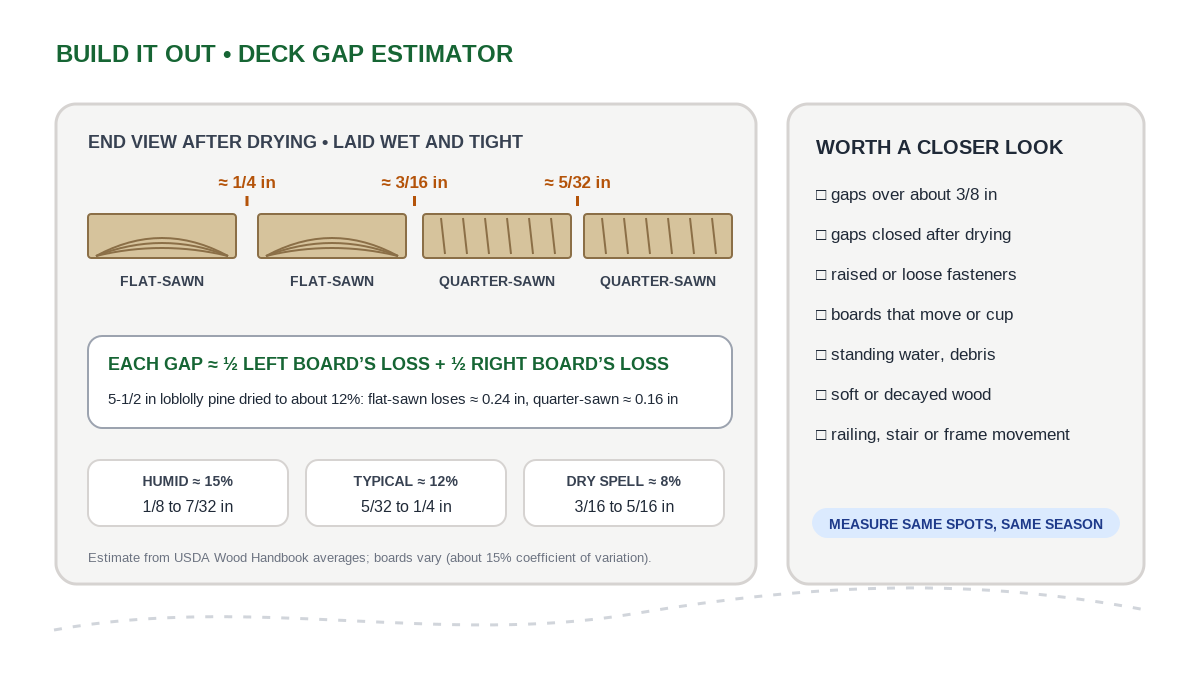
The biggest reason is grain direction. On a flat-sawn board the growth rings show as flat arcs across the end, and the board shrinks tangentially (along the rings) in width. On a quarter-sawn board the rings run up and down through the thickness, and the board shrinks radially (across the rings) in width, which is noticeably less. Most boards fall somewhere in between. Purdue describes this difference, and the USDA Wood Handbook says to use tangential values for the width of flat-sawn boards, radial values for quarter-sawn boards and tangential values when the ring direction is mixed or unknown. It lists average green-to-oven-dry shrinkage for loblolly pine, a common southern pine, of 7.4% tangential and 4.8% radial. [7] [1]
Individual boards also vary from those averages. The handbook says predicting the shrinkage of one piece accurately is impossible. It puts the variation between pieces at a coefficient of variation of about 15% even when the grain direction is known, and probably more in commercial lumber, where the rings seldom line up neatly with the faces. Sun, shade and nearness to the ground change how dry each part of the deck gets: the handbook notes that wood close to the ground or in shade is typically wetter than wood exposed to sun and moving air. [1]
Estimate the gap you should expect
A board face-screwed or nailed near both edges shrinks toward its own middle, so each edge moves in by about half of the board's loss and a gap grows by half of what each neighbor loses. Decks.com describes the same split, with each edge moving half as much as the board. [9] The Wood Handbook gives a simple way to estimate the loss: shrinkage starts at about 30% moisture content and increases steadily as the wood dries below it. [1]
Applying that method to nominal 6-inch loblolly pine decking that went down soaking wet from treatment and butted tight gives these approximate finished gaps. The calculation uses a width of 5-1/2 inches; using a swollen width of 5-3/4 inches instead changes the gaps by less than 1/64 inch. SFPA recommends spacing boards that measure 5-1/2 inches at installation, wet or dry, 1/8 to 1/4 inch, and notes that a 2x6 measures 5-1/2 inches at 19% moisture before treatment, so its spacing implies such a board has less shrinkage left than a swollen one. [2] [3] The gap table below is for boards butted tight, so do not simply add SFPA's 1/8 to 1/4 inch to it. For boards spaced by SFPA's 5-1/2-inch row, expect the spacing plus the shrinkage left at their actual moisture: about the KDAT amount below if they were near 19%, and more if they were still wet, up to the spacing plus the full table amount, which can pass 3/8 inch.
| Boards on either side | Humid season (about 15% moisture) | Typical outdoor (about 12%) | Dry spell (about 8%) |
|---|---|---|---|
| Both flat-sawn | 7/32 in | 1/4 in | 5/16 in |
| One flat-sawn, one quarter-sawn | 5/32 in | 3/16 in | 1/4 in |
| Both quarter-sawn | 1/8 in | 5/32 in | 3/16 in |
How the numbers work: at 12%, a flat-sawn board loses 7.4% × (1 − 12 ÷ 30) = about 4.4% of its width, or 0.24 inch on a 5-1/2-inch board. A quarter-sawn board loses 4.8% × 0.6 = about 2.9%, or 0.16 inch. A gap between one of each is about (0.24 + 0.16) ÷ 2 = 0.20 inch. Treat these as estimates for average wood: with the handbook's 15% variation, a 1/4-inch gap commonly lands within about 1/32 inch of the table, and some gaps differ by more. Other species shrink by different amounts. [1]
The estimate has limits worth knowing before you compare it with your deck:
- Angled grain. If the rings cross the end of a board at an angle, use the flat-sawn row, as the handbook suggests for mixed or unknown ring direction. [1]
- Climate. The typical column does not fit the desert Southwest. At 6% moisture, common in Phoenix or Las Vegas for months at a time, a gap between two flat-sawn boards works out to about 0.33 inch, close to the 3/8-inch point discussed below. Along the Gulf coast, where outdoor moisture stays near 13% to 15%, gaps stay nearer the humid column. In the Pacific Northwest and southeast Alaska from fall into early winter, where it reaches about 16% to 18.5%, gaps run a little narrower than the humid column. [1]
- Boards that swelled more, or less. SFPA says a 2x6 can swell by 1/8 to 1/4 inch during treatment, depending on the density of the wood, and the Wood Handbook says greater shrinkage is generally associated with greater density, so gaps beside denser boards can open wider than the table. The extra width alone changes little. Boards that had already dried somewhat before installation open less. [3] [1]
- Fastening and edges. The estimate assumes face fasteners near both edges and flat boards. It ignores cupping and fastener restraint, and it does not apply to border boards or to hidden clips, where the clip system's instructions control the gap.
Published targets differ. Decks.com says conventional decking should be installed so that, once seasoned, the gaps are 1/8 to 1/4 inch, and the estimate for typical outdoor moisture falls in that range. The same guide also gives 1/4 to 3/8 inch as the general space between deck boards, and Viance says the edge gap should end up between 1/4 and 3/8 inch. Decks.com suggests comparing fresh treated boards with the same product on a deck that has been down a few years and says the difference can be as much as 1/4 inch, close to the 0.24 inch a flat-sawn board loses in the estimate. A gap at the low end of the table is not a defect in itself, but one that stays near 1/8 inch can trap debris, as described below. [9] [5]
Three practical readings follow from the table:
- Gaps that differ by 1/16 inch or so are expected. They usually come from the two boards beside each gap rather than from careless spacing.
- Gaps change with the season. The Wood Handbook's outdoor table shows moisture content shifting from month to month in most cities. Compare measurements taken at the same time of year. [1]
- Spacers on wet boards add up. If swollen wet boards (wider than 5-1/2 inches) were installed with a 3/16-inch spacer, add that to the table: gaps of about 11/32 to 7/16 inch become likely at typical moisture, nearing 1/2 inch in a dry spell. Most of that range is past the 3/8-inch point where Decks.com says spacing can become a problem, so raise it with the builder. A reader tip in Fine Homebuilding warns that very wet treated decking shrinks a lot and may need a narrower spacer or none at all. [9] [8]
KDAT boards behave differently. Starting from 19%, a flat-sawn board loses only about 3/32 inch more on its way to 12%, so a 1/8-inch gap between two flat-sawn KDAT boards ends near 7/32 inch. Dry boards can also swell in wet weather, which is why SFPA says KDAT and ADAT lumber should be spaced at installation to avoid buckling. [1] [3]
When gaps point to a real problem
Very wide gaps are a hazard as well as an eyesore. Decks.com says spacing greater than 3/8 inch can become problematic and mentions high heels. For comparison, the 2010 ADA Standards, which cover public and commercial facilities, do not allow floor openings that would let a sphere more than 1/2 inch across pass through, and they require long openings to run across the main direction of travel. They generally do not apply to a deck at a private home, but they are a useful benchmark if someone who uses a wheelchair, walker or cane uses the deck. By the same logic, gaps that run in the direction people walk, such as boards laid toward the house door, deserve the most attention. [9] [13]
Gaps that close completely are also worth noting. Decks.com says narrow gaps of about 1/8 inch can catch debris on top of the joists and are hard to clean out. Think Wood warns that leaves trapped between deck boards break down and decay over time, and that poor airflow under a deck can leave the undersides of the boards damp while the sun dries the tops, which can lead to warping and mold. [9] [11]
Look for these symptoms during ordinary use and after rain:
- Water standing on the surface because edges touch or debris blocks the gaps
- Screw or nail heads raised above the surface or working loose. Viance warns that nails that pop out of a deck can injure feet. [5]
- A board that moves or rocks underfoot
- Boards cupped enough to hold water, or split near a fastener or over a joist
- Soft, crumbling or visibly decayed wood
- Movement in railings, stairs, posts, beams or the connection to the house
Loose boards, decay, failed fasteners or movement in railings and framing are not gap problems, and gap measurements cannot tell you whether a deck is safe. Keep people off the affected area and have a qualified deck professional assess it.
How to measure your deck
- Pick the right time. Decks.com notes that in colder climates treated lumber can take many months to dry and stabilize. Measure after a warm, dry stretch and not within a few days of rain, then repeat at the same time next year. [9]
- Mark repeatable stations. Choose ten boards in a row and mark two places to measure, each next to a joist, so you can return to the same spots.
- Gauge each gap at the top surface. Use drill bits or a feeler gauge rather than reading a tape across rounded edges. Record each of the nine gaps separately. Note the gap at the house, border boards and fascia on separate lines.
- Note the grain of each board. Look at the end: rings curving across the end mean flat-sawn, rings running up and down mean quarter-sawn. If the rings run at an angle, count the board as flat-sawn. Check whether the widest gaps sit between flat-sawn boards, as the table predicts.
- Find out what was installed. Look for the invoice, end tags or a photo of a tag that shows KDAT or ADAT. Ask whether the boards were wet when delivered and whether a spacer was used.
- Optional: check moisture. A pin moisture meter set for southern yellow pine shows whether boards are still drying, but treat it as approximate. Purdue says meters are less accurate than oven-drying and are subject to error if used improperly. A USDA Forest Products Laboratory study found that ACQ (alkaline copper quaternary) treatment raises the electrical conductance of southern pine lumber, which pushes uncorrected readings high. It did not test copper azole, which Viance notes is in common use today. Readings that stay well above your area's seasonal level (the Wood Handbook's outdoor table lists monthly values for 50 U.S. locations) after a dry spell suggest the boards are still drying. [7] [12] [5] [1]
| Record | What to write down | Why it matters |
|---|---|---|
| Board identity | Product, species, treatment, KDAT/ADAT or wet, width at delivery if known, spacer used | Tells you which starting rule applied |
| Date and weather | Date, recent rain or dry spell, sun or shade at each station | Gaps change with season and exposure |
| Gaps | Each of nine gaps at two stations, gauged at the surface | Shows the spread, not only the widest gap |
| Grain | Flat-sawn or quarter-sawn for each board | Explains most differences between neighbors |
| Boundaries | House side, border boards and fascia separately | Edge gaps are set separately |
| Symptoms | Standing water, debris, raised fasteners, movement, cupping, decay | Separates normal shrinkage from service or safety problems |
Questions for the builder or inspector
- What exact board product, species and treatment was installed, and was it wet or KDAT when it went down?
- Was a spacer used, and how wide was it?
- Which gaps are wider than the estimate for their neighbors by more than about 1/16 inch, and why?
- Are any fasteners loose, raised or missing, and are any boards moving?
- Is water draining through the gaps, or are debris and touching edges stopping it?
- If boards are replaced or reset, what moisture condition and spacing will the new work use?
For a deck built with hidden clips, the hidden-clip compatibility guide explains how to check that the clips suit the boards. New board fences can develop gaps the same way as their boards dry; see why new wood fence boards develop gaps.
Sources
- USDA Forest Products Laboratory: Wood Handbook (FPL-GTR-282, 2021), Chapters 4, 10 and 13
- Southern Forest Products Association: Southern Pine Decks and Porches
- Southern Forest Products Association: Marine Construction Guide (2014 edition)
- YellaWood: Building Tips
- Viance (TreatedWood.com): Deck Installation FAQs
- Oregon State University Extension: Wood and Moisture Relationships
- Purdue Extension: Drying Small Quantities of Hardwood Lumber: Understanding the Effects of Moisture on Wood (FNR-37)
- Fine Homebuilding: Spacer for Deck Boards
- Decks.com: Deck Board Spacing Guide
- Today's Homeowner: Leaving Gaps Between Pressure-Treated Wood Deck Boards
- Think Wood: Pressure-Treated Wood Common Misuses and Related Best Practices
- USDA Forest Products Laboratory: Moisture Meter Calibrations for Untreated and ACQ-Treated Southern Yellow Pine Lumber and Plywood (2011)
- U.S. Access Board: ADA Accessibility Standards, Section 302.3 Openings