
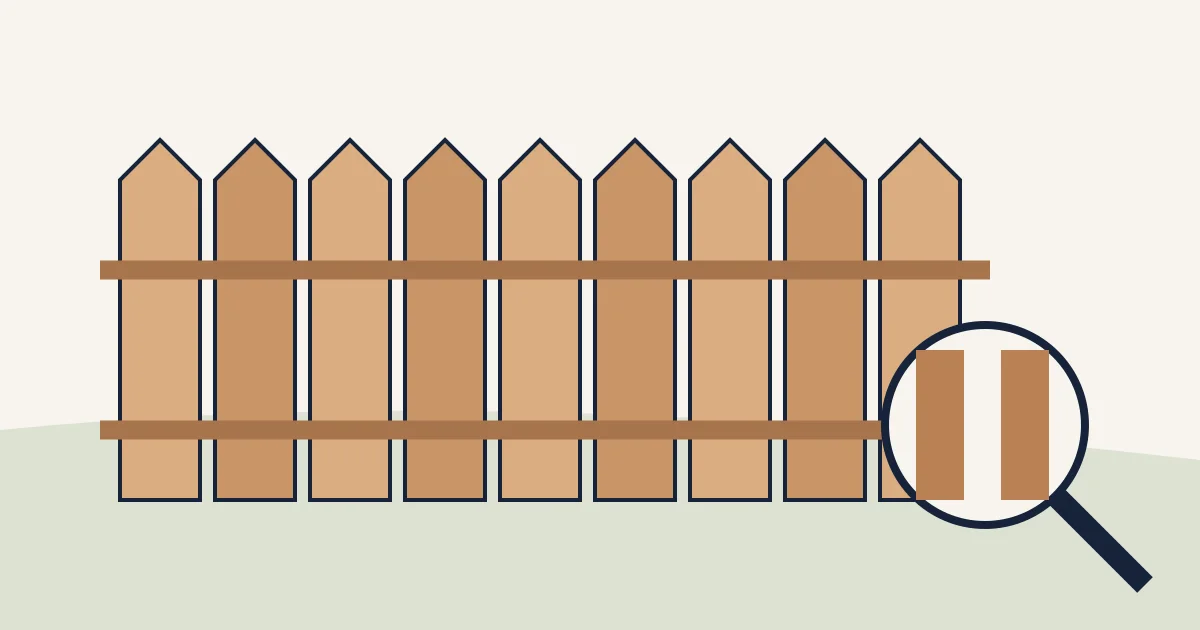
New gaps between wood fence boards can appear as the boards lose moisture and become narrower. But a photograph of a gap cannot tell you the original moisture condition, installation spacing or whether the agreed fence design met its intended privacy. Record the actual boards and gaps before treating every opening as a defect—or assuming every opening is unavoidable.
The useful comparison is between the specified product, its condition when installed and what has changed. This guide covers observations and purchasing questions, not fence repair or a determination of structural condition.
Why a tightly fitted board can become a narrower board
The USDA Wood Handbook explains that wood changes dimensions as it gains or loses bound moisture below fiber saturation. Species, grain and moisture history affect that response. Oregon State's wood-and-moisture manual also stresses that dried solid wood can continue to gain and lose moisture. Neither source provides a single shrinkage percentage that can be assigned to every fence. USDA's dimensional-stability section; Oregon State's manual.
A narrower board and a distorted board are different observations. Purdue's discussion distinguishes shrinkage from checking, cupping, bowing and twisting. A gap that looks wider in one part of a photograph may involve a change of shape as well as a change of width. Record the visible condition without trying to force the board back into position. Purdue's explanation of moisture effects.
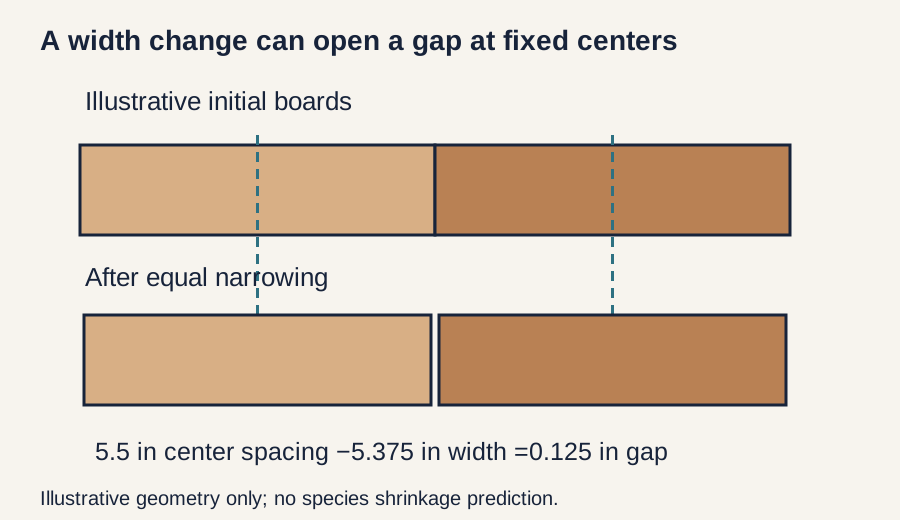
Our two-board example: a small width change creates a visible slit
Imagine two initially touching boards, each 5.5 inches wide, with their centerlines 5.5 inches apart. If each board later measures 5.375 inches while the centerlines remain fixed, the gap becomes 5.5−5.375=0.125 inch, or 1/8 inch.
That calculation is deliberately limited. It assumes equal board widths, fixed centerlines and no initial gap. It does not predict moisture loss, movement of supports, shape changes or the final gap on a real fence. Its purpose is to show why an opening can become noticeable without a board moving sideways as a whole.
Use the actual installation record and current dimensions for the discussion with the installer. Do not substitute the nominal lumber name for a measured width. The Southern Forest Products Association explains why nominal and actual lumber dimensions differ after drying and surfacing. Its nominal-versus-actual explanation is a useful reminder to identify which dimension the quote describes.
“Pressure treated” does not describe the whole moisture history
Ask whether the supplied material was kiln dried after treatment, how it was stored, and which product label or invoice supports that answer. ProWood and YellaWood describe KDAT as a separate drying step intended to reduce later movement. That distinction does not establish that a particular board can never move, or that a fence installed from a different product was necessarily defective. ProWood's KDAT description; YellaWood's explanation.
A seasoning stamp is historical information. WWPA identifies its seasoning marks as the conditioning or moisture state at manufacturing. Do not treat a stamp alone as a reading of the fence today. Equally, a freshly reported moisture reading does not reconstruct the condition on installation day. WWPA's grade-mark guide.
Check what privacy the actual pattern was meant to provide
A product called a privacy fence may use a butted board arrangement, an overlapping pattern or a prebuilt panel with its own details. The Western Red Cedar Lumber Association describes several panel patterns and both butted and intentionally spaced boards. Ask for the selected pattern and actual panel specification, rather than assuming all wood fencing should look the same from every angle. The association's panel overview.
Keep the purchasing question precise: was the desired appearance documented, and what product/design was chosen to address it? A finish or an extra board is not automatically a compatible solution. Ask the installer about the appropriate options for that system before commissioning an alteration.
A repeatable gap-and-board observation sheet
Choose a few representative, safely accessible positions from the ground and give them labels such as A1, A2 and A3. Photograph the same positions with a visible scale and the same general viewing angle, without pulling boards or disturbing the fence. Record the following alongside the pictures.
| Record | What it can clarify |
|---|---|
| Product and installation date | Species, treatment/conditioning information, panel pattern and the installation record. |
| Exact observation point | The same adjacent boards and the same height on each repeat visit. |
| Current width and gap | Visible dimensions, kept separate from nominal product sizes. |
| Visible shape | Whether a board appears cupped, twisted or differently aligned along its height. |
| Recent conditions | Observation date and recent wet/dry exposure, without pretending it is a measured moisture history. |
| Prior record | Original photos, specified spacing and any actual installation-day measurements. |
If the installer uses a moisture meter, ask for the instrument, setting, location and date with the result. Delmhorst's correction guidance shows why species and temperature settings matter; Wagner's EMC explanation shows why a board responds to surrounding conditions. A single number without that context is weak evidence for a precise shrinkage forecast. Delmhorst's correction tables; Wagner's moisture explanation.
Take the record to the installer with two separate questions: what explains the observed change, and what options fit the promised appearance and actual fence system? Keeping those questions distinct makes the conversation more useful than a blanket claim that wood always does this or should never do it.
Sources and method
We reviewed the following original guidance on October 25, 2026. Product and jurisdiction examples apply to the identified source, not every project. Our worksheets are editorial planning tools, not professional determinations.
- USDA Forest Products Laboratory: Wood Handbook 2021, Chapter 4: Moisture Relations and Physical Properties
- Oregon State University Extension: Wood and Moisture Relationships, EM8600, reviewed 2024
- Purdue University Extension: Drying Small Quantities of Hardwood Lumber, FNR37
- ProWood / UFP Industries: Kiln Dried After Treatment lumber
- YellaWood / Great Southern Wood Preserving: What is KDAT?
- Western Red Cedar Lumber Association: Prebuilt Fence Panels
- Southern Forest Products Association: Why is a 2×4 not actually a 2×4?
- Wagner Meters: What is Equilibrium Moisture Content?
- Delmhorst Instrument Company: Correction Tables
- Western Wood Products Association: Interpreting Grade Stamps: Overview