
There is no single US rule that decides which side of every fence faces the neighbor. Some public agencies require the finished face outward; others describe that as courtesy. Before ordering, get the applicable local rule, any HOA requirement and a drawing showing the facing direction of each fence run.
The visible posts or rails are a design feature, not a reliable shortcut for deciding who owns a fence. Ownership or a boundary dispute needs its own evidence and appropriate local advice. This guide helps organize an orientation decision; it does not decide those rights.
First, define what the quote calls the finished side
On a one-sided board fence, one face may display the boards while the other exposes rails and posts. But a double-sided or shadowbox design changes what each person sees. Ask for the actual product drawing or a photograph of both faces rather than relying on labels such as “good neighbor fence.”
Orange Beach, Alabama, is a useful published example: its FAQ describes finished-side-out and posts-inside conditions but also addresses designs finished on both sides. That exception belongs to that city's guidance, not to every product marketed as double-sided. Read the original fence FAQ.
The same question gets different official answers
We inspected original public-agency guidance rather than treating contractor etiquette as national law. The contrast is the point; these examples apply only where the issuing agency has jurisdiction, subject to its current rules and any applicable exceptions.
| Agency | What its guidance says | Planning consequence |
|---|---|---|
| Winona, Minnesota | Nice-side-out is described as courtesy, with no code requiring the practice. | Do not convert courtesy into an invented legal mandate. |
| Smithtown, New York | Posts and structural members should face inward rather than neighboring properties. | Show structural members, not just a vague “finished side” note. |
| Miami-Dade County, Florida | Finished side faces the neighboring property or street; a waiver-affidavit process is identified. | Ask whether an exception requires a formal process. |
| Union Grove, Wisconsin | Finished side faces adjoining property and road right-of-way; posts go inside. | Street-facing and neighbor-facing runs both need attention. |
See the original guidance from Winona, Smithtown, Miami-Dade and Union Grove. A neighbor's informal agreement should not be assumed to satisfy a public agency's exception process.
“No permit needed” does not answer the facing question
Some homeowners stop researching when they hear that a fence permit is unnecessary. Addison, Wisconsin, publishes a no-permit answer for its described residential situation while still specifying the finished face toward neighboring property. Orange Beach likewise gives orientation requirements alongside its permit statement. Addison's original FAQ makes the distinction explicit.
Conversely, a permit drawing does not resolve every private restriction. Miami-Dade tells applicants to follow homeowner-association guidelines as well as zoning requirements. Ask the HOA for its actual written conditions if it applies to the property; keep that response separate from the municipality's or county's response.
Zephyrhills, Florida, lists finished-side-out together with location, visibility and meter considerations and warns that its summary is not exhaustive. A facing decision can therefore be correct while another part of the layout still needs revision. Read the city's checklist and code references.
Our run-by-run facing schedule
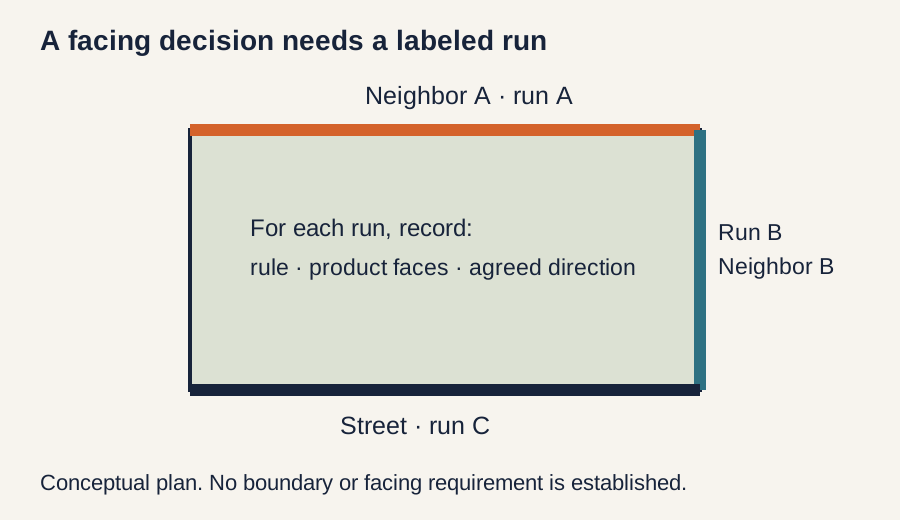
Take the contractor's plan and label each segment A, B and C. Use the street and fixed features as references so everyone can discuss the same segment. Add this schedule before the product order is final.
| Field for each run | What to record |
|---|---|
| Outside reference | Street, neighboring parcel or another specifically identified area. |
| Selected fence style | Exact product/style and drawings of both faces, including posts and rails. |
| Applicable public guidance | Issuing office, current rule or written response, and any unresolved exception. |
| Private design requirement | Relevant HOA response or other restriction identified for review. |
| Agreed facing direction | An arrow or clear written note on that run's drawing, confirmed by the contractor. |
| Open question | The responsible person and the decision needed before ordering. |
For a corner property, this might produce separate answers for the rear neighbor, side neighbor and street run. A sentence saying “good side faces out” leaves the meaning of “out” unclear at returns, gates and transitions. A marked plan makes the chosen appearance reviewable without turning a homeowner sketch into a construction specification.
Keep facing separate from the boundary
A facing schedule cannot establish where the property line is. Carroll County, Illinois, says its GIS maps are approximate and separates boundary questions from private fence disputes. Cannon Falls, Minnesota, asks owners to establish lines and publishes material-dependent placement conditions. These are reasons to settle the route independently of which face looks toward it. Carroll County's explanation; Cannon Falls' fence information.
If a quote includes surveying, ask what that scope actually includes. The California surveying board's consumer manual distinguishes boundary retracement, discrepancies and construction staking, and emphasizes clear service agreements. The useful question is whether the professional will provide the information this project needs, not whether the quote contains the word “survey.” See its surveying-services and contract sections.
Before approving the order
Confirm that the chosen panel or board style can deliver the approved appearance on both the straight runs and gates. Ask the contractor to reconcile any contradiction between the product drawing, the facing arrows and the local response. Do this before treating an attractive sample as an approved site plan.
If a neighbor disagrees about rights or ownership, preserve the documents and seek appropriate local advice. If the disagreement is simply what the finished fence will look like, a view of both faces and the run-by-run plan is a more useful conversation starter than an assumed nationwide rule.
Sources and method
We reviewed the following original guidance on October 25, 2026. Named local examples describe the cited jurisdiction only. Our worksheets are editorial planning tools, not professional determinations.
- Carroll County, Illinois: Fencing & Property Boundary Questions
- California Board for Professional Engineers, Land Surveyors, and Geologists: A Guide for Consumers, printed pages 10–17
- City of Cannon Falls, Minnesota: Fence Permit Information
- City of Winona, Minnesota: Planning & Zoning fence and property-line FAQs
- Miami-Dade County, Florida: Fences and Gates
- City of Orange Beach, Alabama: What are the zoning requirements for fences?
- Village of Union Grove, Wisconsin: Fences
- Town of Addison, Wisconsin: Do I need a permit to install a fence?
- City of Zephyrhills, Florida: Fence Requirements
- Town of Smithtown, New York: Building Department FAQs: fence facing and survey records