
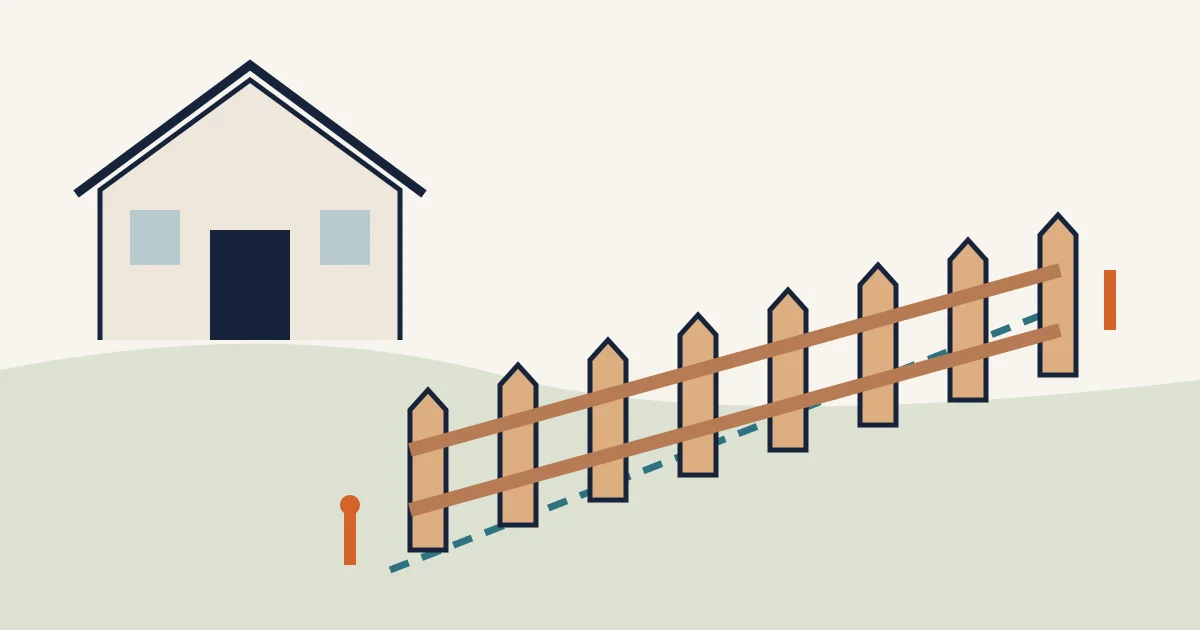
Before accepting a replacement-fence quote, separate the old fence's location from the boundary your new fence is meant to follow. Ask what evidence establishes that boundary, who will identify the proposed fence line on site, and which local placement restrictions apply. An existing fence and a parcel-map screenshot do not answer all three questions.
This is a planning guide for discussing the scope with a contractor, surveyor and permitting office. It does not determine ownership, move a boundary, or tell you whether a disputed fence may be removed.
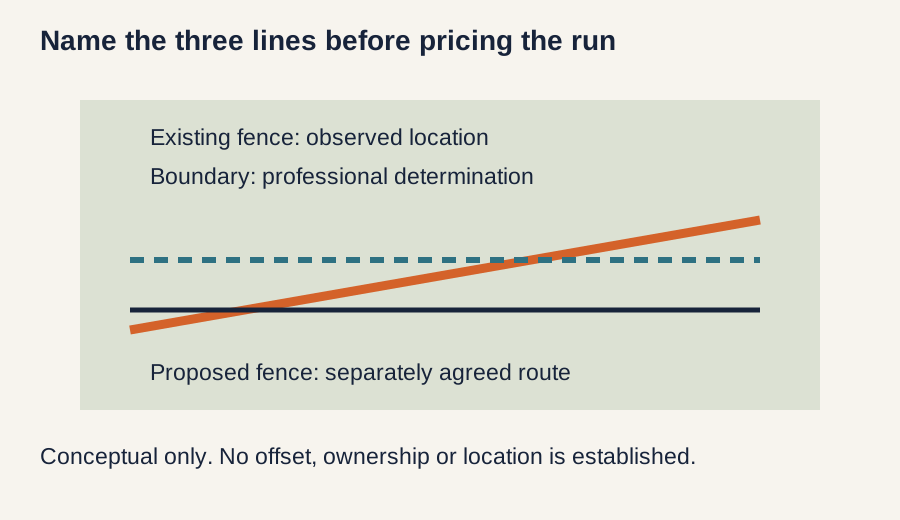
There may be three different lines in the conversation
Start by naming them: the existing fence line, the property boundary, and the proposed fence location. They can coincide, but a quote should not silently treat them as the same. The proposed fence may need to sit inside a boundary because of the applicable rules or the agreed design. Conversely, putting posts exactly where the old posts stood does not establish the boundary.
Carroll County, Illinois, explicitly describes GIS parcel boundaries as approximate and distinguishes a professional survey from online reference maps. Its guidance also separates boundary-location questions from zoning and private ownership disputes. Those distinctions are useful questions to bring to the responsible professionals wherever the property is located. Read the county's explanation.
Ask what the documents actually establish
Gather the survey or plat already in the property records, any relevant recorded documents, the permit drawing and the contractor's sketch. Record each document's title, date, preparer and what it shows. A homeowner's annotated printout can communicate a preference, but it is not a substitute for a professional boundary determination.
The California surveying board's consumer manual identifies retracing boundaries for fences, determining discrepancies and staking construction locations as distinct professional services. That is a useful scope distinction: ask whether a surveyor's proposal includes only a document, boundary identification in the field, or layout information the fence crew can use. The manual's licensing rules are specific to California. See the surveying and contract sections, printed pages 10–17.
Do not assume the permitting office has a current survey. Smithtown, New York, says it may have a copy in its records and asks owners to bring a survey when discussing setbacks. Its building department also identifies incorporated villages outside its application jurisdiction. Confirm which office serves the actual address, rather than relying on the nearest town name. Smithtown's survey and jurisdiction FAQs.
A property boundary does not settle the placement rules
These published examples show why a national rule of thumb is unreliable. They are not instructions for properties elsewhere, and other requirements can apply even within the named jurisdiction.
| Published example | What to ask for your property |
|---|---|
| Cannon Falls, Minnesota, distinguishes placement conditions by fence material. | Does the allowed location change with the material or maintenance access? |
| Winona, Minnesota, describes placement up to, but not on, the property line. | Does this office distinguish the boundary from the permitted fence location? |
| Union Grove, Wisconsin, identifies public drainage easements and rights-of-way. | What recorded or public-access areas affect this run? |
| Zephyrhills, Florida, asks for a plot plan showing meters, easements and lines. | Which features must be shown before a location can be approved? |
These examples come from Cannon Falls, Winona, Union Grove and Zephyrhills. Verify the current requirements with the office responsible for your parcel.
A permit requirement is a separate question. Addison, Wisconsin, and Orange Beach, Alabama, publish fence conditions despite saying a fence permit is not required for the residential situations described. A statement that no permit is needed therefore does not establish that any location or facing direction is allowed. Addison's fence FAQ; Orange Beach's fence FAQ.
Miami-Dade County also directs applicants to homeowner-association guidelines and identifies easement considerations. Keep an HOA response and the public office's response as separate records; one is not evidence that the other question has been resolved. Miami-Dade's fence guidance.
Our boundary-to-quote worksheet
Label each run A, B and C on a simple sketch. Give each run one row in the following sheet. The purpose is to expose missing responsibilities before a price is treated as complete.
| Field | What a useful answer contains |
|---|---|
| Boundary basis | Document title/date and the professional identifying what it establishes. |
| Proposed location | A referenced drawing showing the intended run, not just “replace existing.” |
| Field layout | Who identifies the location for the crew and when it will be confirmed. |
| Placement approval | Responsible office, relevant drawing and unresolved easement or access questions. |
| Scope consequence | How an unresolved location affects measured length, demolition and the quoted work. |
| Hold point | What must be resolved before demolition, ordering or installation begins. |
For example, a quote may say “replace the rear fence” while its sketch does not say whether the new run follows the old fence or a separately confirmed line. The useful next step is a revised sketch and an assigned responsibility, not an assumed offset or a homemade boundary calculation.
If the records and the existing fence disagree
Record the discrepancy without deciding what it means. Ask the surveyor about boundary location, the permitting office about allowed placement, and appropriate local legal counsel about ownership or disputed rights. Carroll County's guidance makes that division explicit; the location of a fence does not, by itself, answer every rights question.
Keep photographs, documents, correspondence and the dated proposed layout together. Do not move markers or remove a disputed fence on the strength of this article. The practical objective is a quote with a known route, a documented basis and an agreed process for unresolved questions.
Sources and method
We reviewed the following original guidance on October 25, 2026. Named local examples describe the cited jurisdiction only. Our worksheets are editorial planning tools, not professional determinations.
- Carroll County, Illinois: Fencing & Property Boundary Questions
- California Board for Professional Engineers, Land Surveyors, and Geologists: A Guide for Consumers, printed pages 10–17
- City of Cannon Falls, Minnesota: Fence Permit Information
- City of Winona, Minnesota: Planning & Zoning fence and property-line FAQs
- Miami-Dade County, Florida: Fences and Gates
- City of Orange Beach, Alabama: What are the zoning requirements for fences?
- Village of Union Grove, Wisconsin: Fences
- Town of Addison, Wisconsin: Do I need a permit to install a fence?
- City of Zephyrhills, Florida: Fence Requirements
- Town of Smithtown, New York: Building Department FAQs: fence facing and survey records