
A deck's square footage and its board order measure different things. The platform has an area; the supplier sells particular profiles in particular lengths. To understand the quote, ask for the finished dimensions, exact board specification, row layout, stock lengths and separately identified trim, borders and spare material.
A flat waste percentage is not a substitute for that layout. This guide checks surface-board purchasing quantities only. It does not size joists, supports, stairs, railings, connections or loads, and its example is not an installation design.
Keep three quantities separate
Platform area is the footprint of the finished surface. Board quantity is the number and length of the specified pieces ordered. Additional components include items such as a picture-frame border, fascia or stairs when those are part of the job. They need their own clear scope.
TimberTech's planning guide separates area, board lengths, spacing and offcuts. That is a useful sequence because a board's nominal label does not give the complete purchasing specification. Envision's Distinction page, for example, distinguishes its nominal description from actual dimensions. TimberTech's quantity guide; Envision's dimension table.
Our worked example: area does not order the pieces
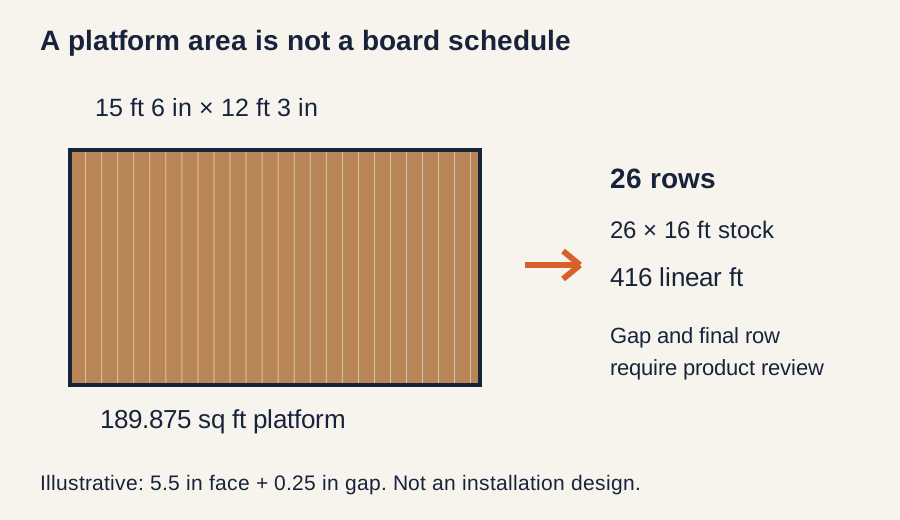
Assume a simple rectangle 15 feet 6 inches long and 12 feet 3 inches wide. Boards run along the 15-foot 6-inch direction. For arithmetic only, assume 5.5-inch actual board width, a 0.25-inch gap, 16-foot stock boards, no border and no obstructions. These are illustrative inputs, not specifications for a brand.
- Platform area: 15.5×12.25=189.875 square feet, or about 189.9.
- Width to cover: 12 feet 3 inches=147 inches.
- Row count: for N rows, covered width is N×5.5+(N−1)×0.25. Twenty-five full rows cover 143.5 inches; 26 cover 149.25 inches. The simplified layout therefore needs 26 rows with a planned final-row adjustment.
- Purchased stock: 26 boards×16 feet=416 linear feet.
- Finished row lengths: 26×15.5 feet=403 linear feet. The 13-foot difference is the combined stock-length remainder before allocating cut losses or other trim.
The 26 full-width purchased boards contain 416×5.5÷12=190.667 square feet of board face. That figure is neither an alternative measurement of the platform nor a complete waste calculation: the installed surface also contains gaps and a width adjustment. The final row, usable stock length and all end/edge conditions still need the installer's product-specific layout review.
This example shows why “189.9 square feet plus 10%” cannot, by itself, explain a purchase. It leaves the available lengths, whole-board rounding and final-row configuration unanswered. We are not recommending a 10% allowance or claiming a 13-foot remainder can be reused.
The profile matters as much as the color
Two boards described casually as “six-inch decking” may not have the same actual face width, edge profile or available lengths. Deckorators' Voyage sheet lists multiple widths and profile-specific lengths; Sylvanix's Elite page distinguishes grooved and square-edge options. NewTechWood likewise publishes a profile-by-profile specification table. Deckorators' product sheet; Sylvanix's dimensions; NewTechWood's specifications.
Ask the quote to identify which profile serves the field and which serves the border or edge. Fiberon's ArmorGuard FAQ, for example, lists different length options for grooved and square-edge boards. Do not substitute one order line for another merely because the color name matches. Fiberon's length information.
Gaps and end allowances are product decisions
Our 0.25-inch gap exists only to demonstrate the arithmetic. Trex's spacing discussion tells readers to consult the selected manufacturer's installation guide. Lumberock's current technical guide also has its own gapping and temperature considerations. A gap copied from another material changes both the calculation and the intended installation. Trex's spacing discussion; Lumberock's current guide.
Similarly, the stock length on a label may need an allowance for the manufacturer's end conditions and the agreed finished layout. Armadillo's must-read guidance asks installers to check factory-end squareness. DuxxBak's current Optima LT instructions treat width planning and product-specific clearances separately. Ask the installer to show the usable-length assumption; do not infer it from the nominal stock length alone. Armadillo's guide; DuxxBak's current guide.
A surface-board order reconciliation
| Ask for | What it explains |
|---|---|
| Finished platform dimensions | The area being priced and any separately measured surfaces. |
| Board product/profile and actual width | The correct unit and dimensions for the takeoff. |
| Layout and manufacturer gap basis | Row count, borders, transitions and any final-row adjustment. |
| Piece count by stock length | Exactly what the supplier will deliver. |
| Allowances and spare stock | Which quantity covers planned cuts, uncertainty or future repairs. |
| Separate components and labor basis | Whether fascia, stairs, borders and their installation are included. |
A useful quote lets the reader trace an area to a board schedule without pretending the units are interchangeable. If the layout changes, ask for the schedule to be recalculated rather than carrying forward a percentage from the old design.
Sources and method
We reviewed the following original guidance on October 25, 2026. Product and jurisdiction examples apply to the identified source, not every project. Our worksheets are editorial planning tools, not professional determinations.
- Trex: How to Easily Space Deck Boards
- TimberTech / AZEK: How to Calculate How Much Decking You Need
- Fiberon: ArmorGuard Decking FAQ: sizes and lengths
- Deckorators / UFP Industries: Voyage Decking 2026 sell sheet, page 1
- Envision Outdoor Living Products: Distinction Collection: dimensions
- Lumberock: Deck Installation Guide 2025
- NewTechWood: Composite decking profile specifications
- Armadillo Deck / Avon Plastics: Installation and Care Guide 2025, page 3
- Sylvanix Outdoor Products: Elite Collection: dimensions
- DuxxBak Composite Decking: Optima Dekk LT Installation Instructions V17.3, June 9,2026