
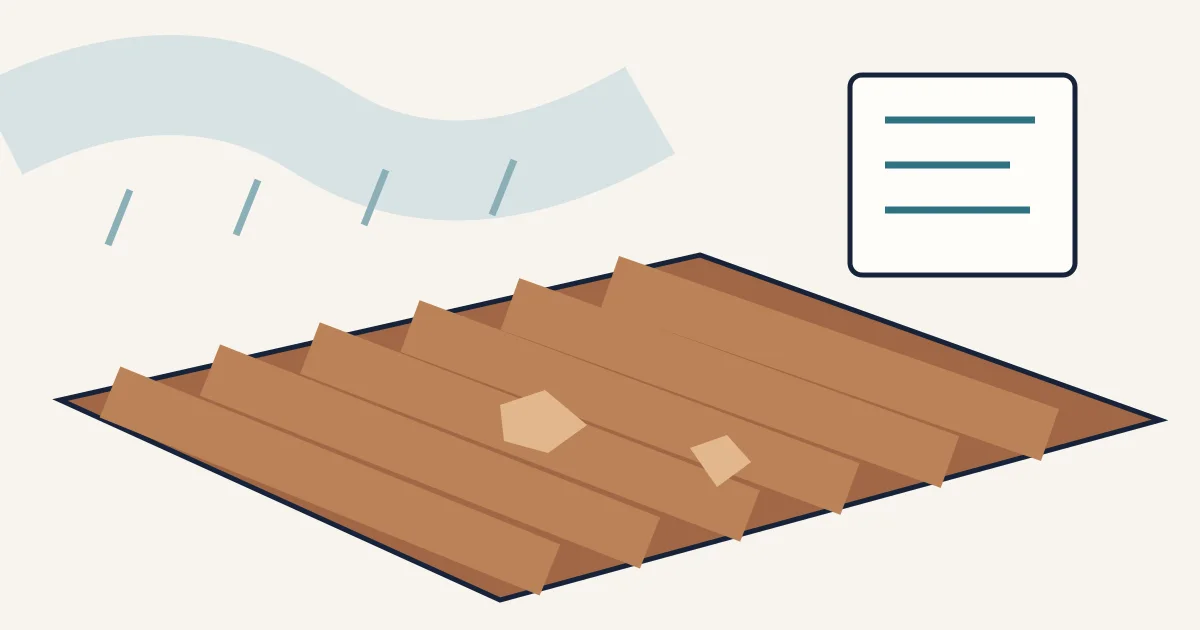
Deck stain peeling after one rainy season is a reason to identify the finish and document the failure before buying another coat. The season alone does not prove rain caused the problem. Product type, previous coatings, adhesion, application amount and moisture conditions can all change what the next assessment needs to address.
This guide organizes observations for the original installer or coating manufacturer. It does not provide sanding, stripping, chemical-cleaning or recoating instructions for an unknown finish.
Start with the exact product, not the word stain
A penetrating finish and a coating that forms a surface film are not the same system. The USDA Wood Handbook describes finish types and how wood properties and moisture movement affect their performance. A product sold for a deck is not automatically interchangeable with every other finish used there. Read USDA's finishing chapter.
Find a container photo, invoice or product record showing the manufacturer, product line, formulation and color. Record what was on the wood before that application. If either product is unknown, keep it unknown in the record; do not assume the newest visible color is the only coating present.
Separate peeling from fading, wear and early rain marks
Photograph an intact area and the affected area in comparable light, including a close view and a wider view showing where each sits on the deck. Describe what is visible: detached flakes, thin worn areas, color change, blotches or exposed wood. Avoid selecting a treatment from a photograph alone.
Messmer's UV Plus FAQ distinguishes the behavior of its penetrating finish from a surface film and describes blotchiness when newly stained wood receives rain too soon. That is not proof that every blotch or later flake has the same cause. Benjamin Moore's preparation guide likewise treats previously peeling finish as a different starting condition from weathered wood. Messmer's product FAQ; Benjamin Moore's assessment categories.
Questions that belong in the assessment
DEFY's manufacturer guidance identifies overapplication and poor adhesion as important peeling mechanisms and notes that problems may become evident after winter moisture. BEHR also warns that an overly heavy application of its identified product can lead to peeling or cracking. These sources support asking about the amount and condition of the application; they do not diagnose your deck or establish who is responsible. DEFY's explanation; BEHR's product limitations.
Ask about the substrate as well. Sherwin-Williams identifies cleanliness and dryness as adhesion considerations. Ready Seal's current instructions distinguish an existing coating from bare wood and require its own moisture verification before application. A universal statement such as “it had two sunny days to dry” does not replace the actual product's conditions and any recorded measurements. Sherwin-Williams' adhesion guidance; Ready Seal's product-specific requirements.
Exposure after application matters too. Armstrong-Clark's planning guidance identifies concentrated roof runoff and other repeated wetting among relevant conditions. Record where water arrives, where the deck remains shaded and whether peeling clusters in a particular area. A pattern helps frame the supplier's questions; it is not a substitute for an assessment. Armstrong-Clark's exposure discussion.
Keep recorded wood-surface conditions separate from a forecast air temperature. FLOOD's guidance on the Pittsburgh Paints site explains why the two are not interchangeable and why conditions during cure matter. A weather-app screenshot is useful context, but it cannot establish the temperature of the boards when they were coated. Read the surface-temperature distinction.
Read the qualification behind “does not peel”
A finish intended to penetrate can behave differently if product remains as a surface layer. Penofin's FAQ discusses its intended non-film-forming behavior but also describes tackiness and peeling when product dries on the surface under unsuitable conditions. Keep the application qualification with the product claim. Do not conclude from a broad marketing phrase that a visible failure is impossible—or that the homeowner must be at fault. Penofin's full FAQ.
Our failure record: four groups of evidence
| Group | Keep these facts together |
|---|---|
| Product identity | Exact current and previous finish, container/invoice photos, wood material and installation age. |
| Application record | Date, installer, preparation record, coat count, quantity used and actual recorded conditions or moisture readings. |
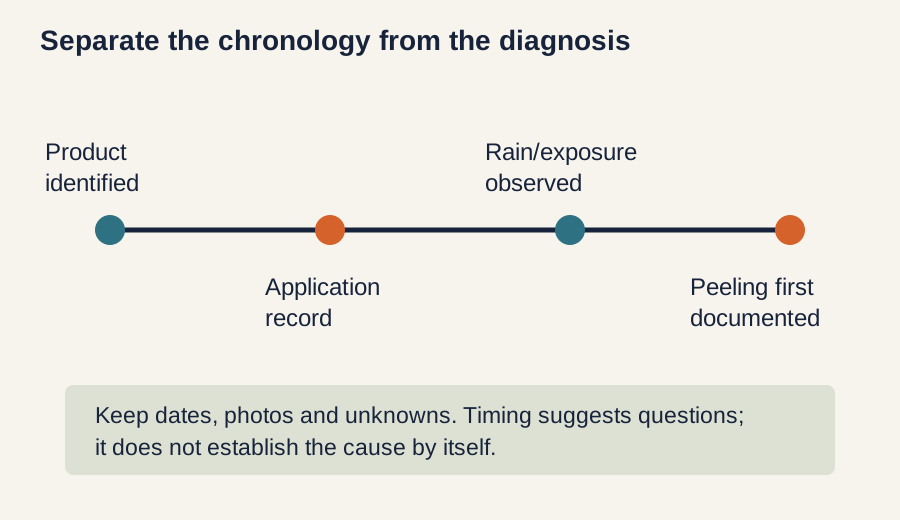
| Exposure chronology | First known rain after application, later unusual wetting and the first date the problem was noticed. Mark unknowns. |
| Failure map | Matching close/wide photos, sun/shade location, traffic route and where the appearance differs. |
For example, “noticed peeling in spring” and “rain fell the evening after application” are two distinct records. The first establishes when the symptom was noticed, while the second is a possible factor to compare with that product's requirements. Neither establishes the complete cause without the other evidence.
Keep recoat time, light-traffic time and full-cure time as separate terms when reading the label; BEHR's product information distinguishes them. Do not apply one product's waiting period to another formulation. Product instructions can change, so give the manufacturer the product identity and application date when requesting the relevant guidance.
Ask for a compatible assessment before a new coat
Send the record to the installer or manufacturer's technical support and ask what remains uncertain. A useful response should explain the likely mechanism, the evidence still needed and a preparation/finish system compatible with what is actually present. Ask who will assess any work that disturbs the old coating rather than improvising a removal method.
Preserve the original photos and application records before work changes the surface. The practical objective is to avoid repeating an unexamined application, while distinguishing a product-selection issue, an exposure problem and a preparation question from one another.
Sources and method
We reviewed the following original guidance on October 25, 2026. Product and jurisdiction examples apply to the identified source, not every project. Our worksheets are editorial planning tools, not professional determinations.
- USDA Forest Products Laboratory: Wood Handbook 2021, Chapter 16: Finishing Wood
- BEHR / Masco: DECKplus Solid Color Waterproofing Wood Stain: application and dry-time information
- Sherwin-Williams: How to Prepare a Deck for Staining
- Benjamin Moore: How to Stain a Deck: flaking and peeling assessment
- DEFY / SaverSystems: Why Do Deck Stains Peel?
- Ready Seal: Initial Application: dry wood and prior coatings
- Armstrong-Clark: Wood Staining Process: Before You Begin
- Penofin / Performance Coatings: Wood Stain FAQs
- Messmer's: UV Plus: product FAQ and rain timing
- Pittsburgh Paints Company / FLOOD: Take Your Temperature to Ensure Success