
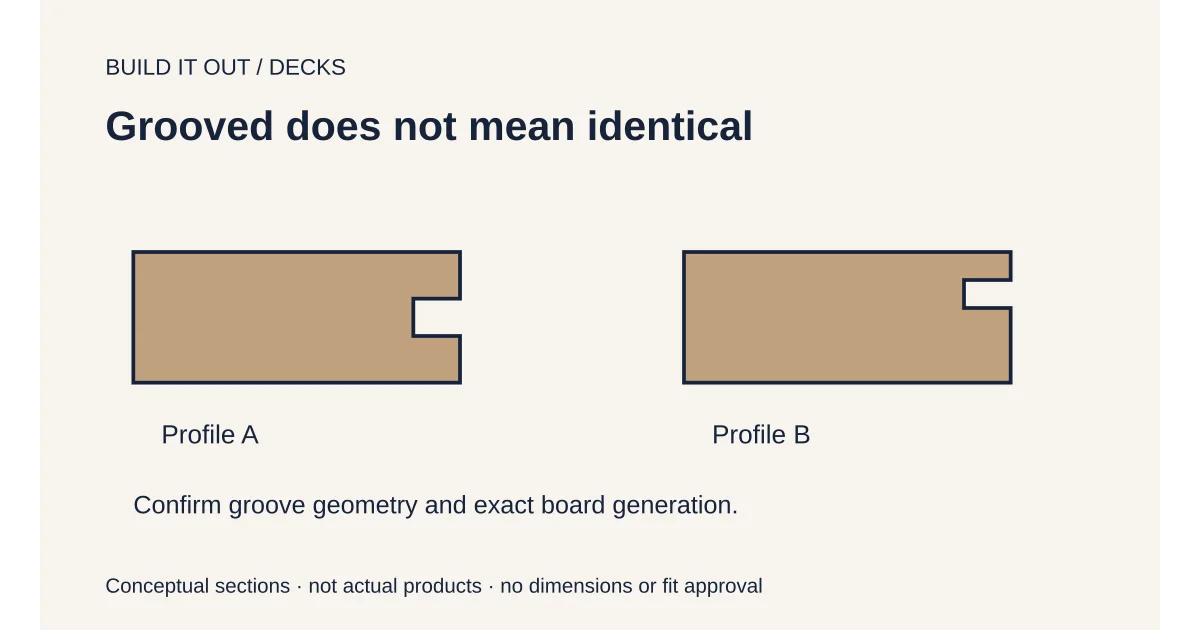
Confirm the exact deck-board profile and generation against the exact hidden-fastener model before ordering. Then check the framing material and where each fastener will be used. A clip labeled “universal” and a board labeled “grooved” do not, by themselves, document the complete pairing.
Start with both manufacturers’ current instructions: the board maker’s approved or specified fastening options, and the clip maker’s board/application limits. If either document leaves the proposed combination unclear, ask the supplier or installer to obtain written confirmation. Do not resolve a mismatch by altering the groove or substituting a screw.
Why the groove alone is not an approval
Mike Guertin’s historical Fine Homebuilding comparison explains that groove width, depth and height vary, and advises checking with the board and fastener makers for combinations outside their recommendations. That is useful context, but its older product lists and warranty summaries are not current buying instructions. [6]
A current manufacturer example makes the identity problem concrete. TruNorth’s FAQ distinguishes board generations and states that CAMO fasteners are not compatible with grooved Gen I TruNorth boards because the groove is too wide, while describing compatible newer profiles. “TruNorth grooved board” is therefore not a sufficiently precise purchase description. Record the generation too. [10]
Other documents organize the decision differently. TimberTech’s fastening page separates Advanced PVC from composite and grooved profiles from square-shouldered profiles. Fiberon’s FAQ distinguishes Phantom Universal plastic fasteners from its other fasteners and names compatible board collections. Use the actual listed product, rather than extending a brand-wide statement to an unnamed collection. [2] [3]
Read “universal” with its application limits
CAMO’s EDGE page describes an application involving grooved boards, wood joists and a particular deck pattern. Its training guide separates other clip types and framing/pattern applications. FastenMaster’s TC-G page uses broad compatibility language but also lists different purchase SKUs, including packs with or without screws and a separate butt-seam clip. The product-family name does not specify every part of the order. [4] [11] [5]
That does not mean all cross-brand combinations are unsuitable. It means a broad claim needs to be reconciled with the exact board, fastener and application. A tool that can drive a clip is also not proof that the clip is approved for the chosen board. Keep tool compatibility and material compatibility as separate lines.
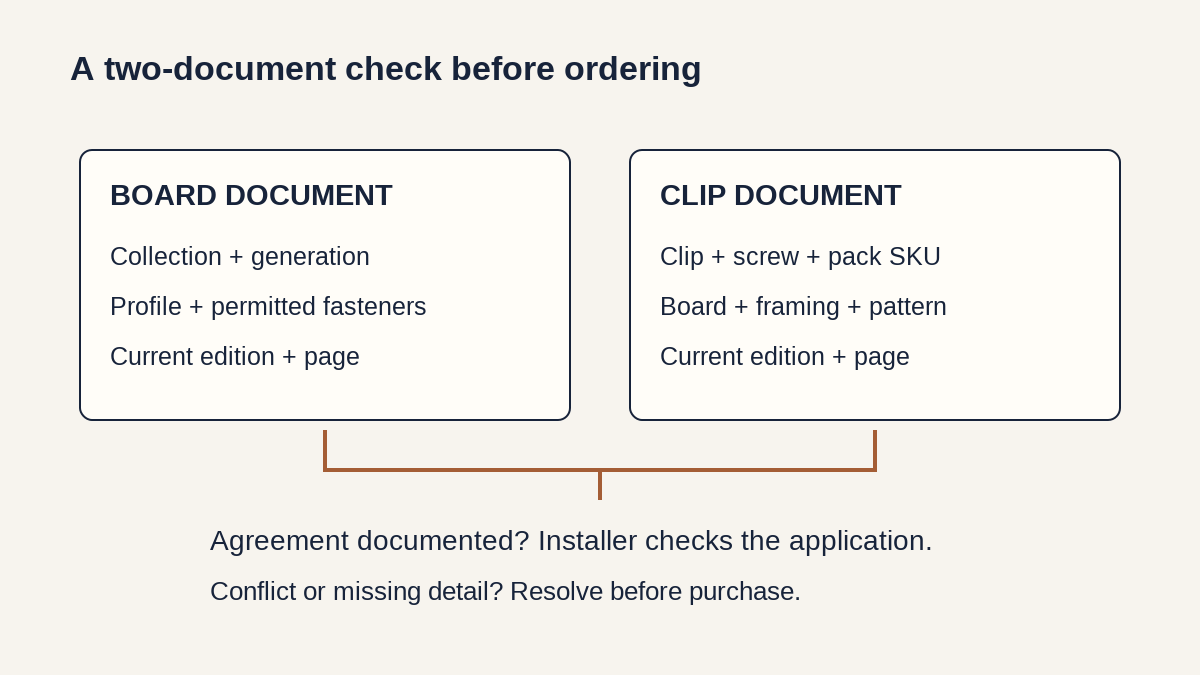
Use a two-document compatibility gate
- Identify the board. Record manufacturer, collection, generation where relevant, profile, thickness description and exact order code. Keep a label photo or supplier record. If the identity is unknown, stop the pairing decision there.
- Identify the fastener assembly. Record clip model, screw model or included screw specification, pack SKU and the role of any separate starter or seam component.
- Read the board document. Find the applicable fastening section and any restrictions for this profile or location. Record the edition and page.
- Read the clip document. Check its named boards or limits, framing material and pattern/application scope. Record the edition and page.
- Resolve uncertainty. If instructions conflict, omit the pairing or leave it unresolved until the makers clarify it. If they document it, the installer still needs to confirm its use under the project conditions.
This is a purchasing gate, not an installation method or engineering approval. A sample that physically slides into a groove does not establish the required fastening performance or permission to use it.
One main clip may not cover the entire deck
Deckorators separates its grooved-board clip recommendation from fastening options for stairs, perimeter boards and replacement work. NewTechWood’s guide distinguishes profiles used in the field and at edges, including profiles with different groove arrangements. Keep each proposed board location in the order record rather than assuming the main-field clip covers every detail. [7] [8]
| Location | Board identity | Fastener and confirmation needed |
|---|---|---|
| Main field | Collection, generation, grooved profile. | Exact clip/screw combination; framing and board-pattern application. |
| First and last rows | Actual edge profile ordered. | Documented starter/end solution and included parts. |
| Board-end joints | Board/profile and joint layout. | Applicable seam fastening detail confirmed by installer. |
| Borders, stairs and fascia | Separate profile and purpose for each. | Location-specific fastening instructions; do not copy the main-field order. |
Historical manuals illustrate the same need for detail. Fortress’s 2020 Apex guide distinguishes clip variants for groove heights and wood/metal framing. Trex’s 2023 guide separates recommended fasteners by board profile and distinguishes clips from plug-based systems. These older editions explain why the fields matter; obtain current documents for a live purchase. [9] [1]
Keep changes tied to the order
For each row above, record documented, not permitted or unresolved, with the supporting document and date. A blank compatibility cell means unknown, not approved. If a supplier substitutes a board line, groove generation, clip pack or screw, recheck the affected row before accepting it.
Do not use a generic board-gap number or an old approval chart to settle a substitution. Ask the installer to confirm the complete assembly from current instructions. If an existing deck has movement or fastening concerns, obtain a qualified assessment rather than buying different clips as a diagnosis.
For a separate quantity check, see why deck area and the board order differ. For surface selection, see composite decking and sun exposure. Neither answers the board-and-clip pairing question.
Sources
- Trex: Decking Installation Guide: recommended fasteners
- TimberTech: Deck Fasteners
- Fiberon: Hidden Deck Fastener FAQ
- National Nail / CAMO: EDGE Clips
- OMG / FastenMaster: Tiger Claw TC-G
- Fine Homebuilding: Fasteners for Grooved Decking, Mike Guertin, issue218
- UFP / Deckorators: Composite Decking and Railing FAQ
- NewTechWood: Composite Decking Installation Guide
- Fortress: Apex Deck Installation Guidelines v2
- TruNorth Composites: Frequently asked questions
- National Nail / CAMO: 2026 Universal Deck Clips Training Guide