
Do not accept “reuse existing flashing” as one whole-roof decision. Ask the roofer to list each location—sidewalls, headwalls, chimney, valleys, plumbing vents, skylights and roof edges—and state replace, conditional reuse or not yet visible. Any reuse should have a written condition and compatibility test, plus a change process if tear-off exposes damage.
Two bids can both promise a “new roof” while treating the metal around walls and penetrations very differently. That difference may stay hidden inside a short flashing allowance or the phrase “as needed.” The useful comparison is not whether a contractor says reuse is always good or always bad. It is whether the proposal identifies each assembly and explains what evidence will settle it.
Why one reuse line is too broad
Flashing is not one interchangeable part. ARMA’s residential manual discusses valleys, vertical sidewalls, vent pipes and chimneys separately. IKO likewise distinguishes step flashing, counterflashing and vent boots. Each occupies a different junction and can involve different access, materials and concealed conditions. [3] [6]
The project type matters too. A full tear-off exposes the deck and transitions differently from installing another roof covering over an existing one. Fine Homebuilding’s specialist guide shows different flashing treatment for a roof-over, while ARMA changes its details depending on whether old roofing remains. The written scope should therefore say tear-off and replacement or recover, not just “reroof.” [3] [8]
The technical guidance is conditional—and not identical
GAF recommends replacing metal flashings whenever possible, but its bulletin also describes conditional reuse after qualified inspection when the metal is like new, has suitable remaining service life and matches the new shingle dimensions. It separately warns that damage caused by reused flashing is outside the shingle limited warranty. [1]
NRCA suggests replacing step flashings and aprons with a new roof system, yet acknowledges regional reuse practice when existing pieces are in good condition and have service lives comparable to the new roof. It treats sound through-wall flashing as a different case. [4] PNNL’s Building America guide takes a stronger approach at existing roof-wall intersections, calling for new flashing when the roof covering is replaced and showing how the flashing connects to siding, wall drainage layers and a kick-out at the eave. [2]
Those positions should not be averaged into a made-up rule. They reveal the questions the proposal must answer: Which flashing type? What condition? What new product? What wall covering or counterflashing must be disturbed? What does the adopted local code require? Who decides after tear-off?
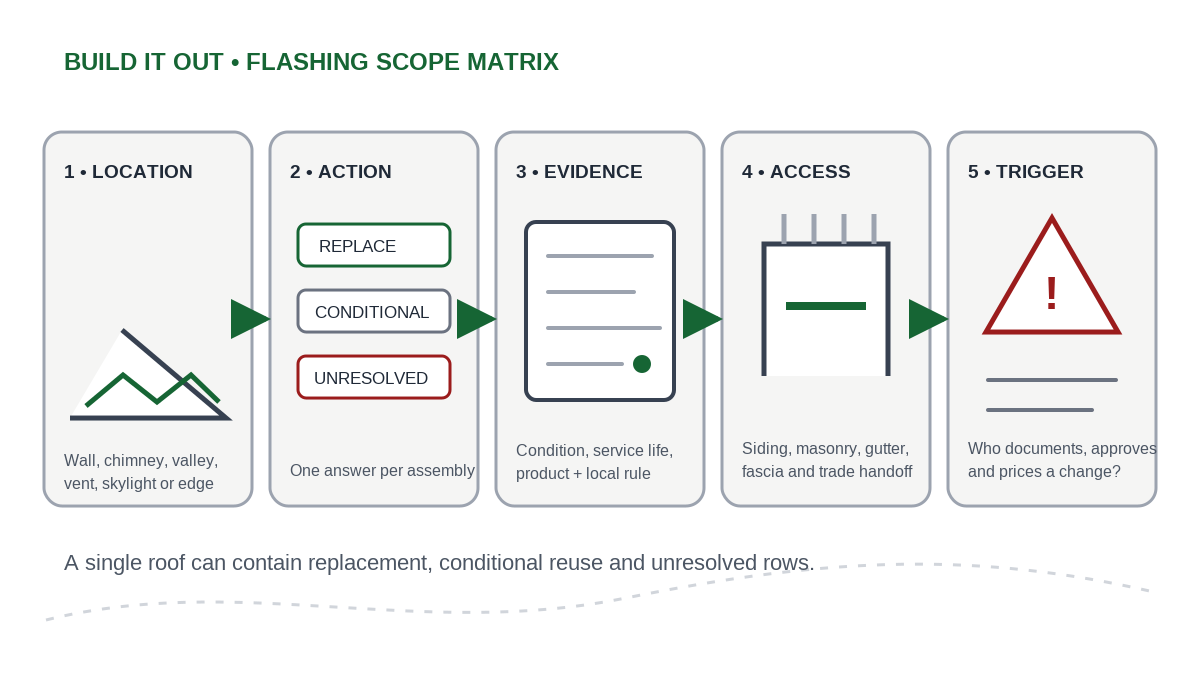
Complete the flashing scope matrix
| Location | Planned action | Evidence for any reuse | Access included | Change trigger |
|---|---|---|---|---|
| Sidewall and kick-out | Replace / conditional reuse / unresolved | Metal condition, size for new shingle, drainage-plane integration | Siding removal and reinstatement; wall membrane work | Damage, wrong size, missing kick-out or concealed wall decay |
| Headwall or apron | State base and counterflashing separately | Condition, overlap and remaining service life | Cladding, stucco or masonry work | Incompatible detail or damage found after removal |
| Chimney | Name apron, step, cricket and counterflashing | Condition of each layer; current detail | Masonry reglet or siding work | Corrosion, loose masonry, missing cricket or concealed leakage |
| Valleys | Name open metal, closed-cut or other approved system | New roof design and manufacturer instructions | Underlayment and metal removal | Design changes or damaged existing metal |
| Vents and skylights | List each boot, curb or manufacturer kit | Exact unit, compatible kit and condition | Removal/reinstallation and interior coordination | Brittle seals, wrong kit, low curb or damaged unit |
| Eaves and rakes | State drip-edge replacement and material | Condition, local requirement and underlayment sequence | Gutter or fascia coordination | Corrosion, incompatible profile or hidden edge damage |
For every unresolved row, add four administrative details: who documents the finding, what evidence the homeowner receives, who may authorize a change, and how the price is calculated. A roof should not remain open while the parties first discover that the contract has no decision path.
Match the existing metal to the new roofing product
Condition is only one reuse test. Owens Corning’s current Duration instructions specify corrosion-resistant step flashing dimensions and tell installers to check local code. [5] GAF notes that step-flashing length must correspond to the new shingle design and size. An existing piece can look intact yet still be the wrong geometry for the selected system. [1]
Ask the proposal to identify the shingle product and the manufacturer document used for each flashing detail. Then ask the contractor to mark each scope-matrix row as compliant, replacement required or unresolved. “We have always done it this way” is not the same as matching the current product instructions.
Include wall access, not just roof metal
Step flashing works with the wall’s water-control layer. PNNL illustrates new step and kick-out flashing integrated with underlayment, house wrap and siding. [2] NRCA notes that vinyl, metal, stucco and other claddings can conceal the existing condition and can be difficult to remove and reinstall. [4] A low flashing line item can therefore hide a separate siding or masonry exclusion.
Write down whether siding, stucco, brick counterflashing, gutters and fascia are included, excluded or handled by another trade. If another contractor is responsible, identify the handoff and the weather-tight sequence rather than assuming the roof crew will improvise it.
Use local requirements without pretending one code fits every home
A City of Grand Rapids handout, for example, requires flashing at roof-wall intersections, changes in roof slope and roof openings, and ties the assembly to approved manufacturer instructions. It is evidence of how one jurisdiction expresses the requirement—not proof of the rule adopted at your address. Ask the contractor or permit office which code edition and amendments apply locally. [7]
Do not climb onto the roof to make this determination. Request ground-level photos where useful, pre-tear-off documentation, and post-tear-off images from the qualified roofer. IKO explicitly frames flashing work as professional roof work, and this worksheet is for scope control rather than DIY inspection or installation. [6]
Compare bids on the same rows
Homeowner discussions and contractor question guides show the recurring problem: people ask whether “new roof” includes new chimney, step and pipe flashing, then discover that verbal assumptions do not match the contract. Use the same matrix for every bidder. If one contractor recommends replacement and another recommends reuse, compare their evidence, access scope, product compatibility and change process—not just the bottom-line price. [9] [10]
Carry the result into the rest of the quote. If tear-off may expose bad sheathing, pair this worksheet with the guide to a roof decking allowance. If the proposal changes vents while the roof is open, also compare its intake and exhaust plan. A clear scope does not guarantee perfect work, but it removes an avoidable ambiguity before the house is exposed.
Sources
- GAF: Re-Use of Metal Flashings on Asphalt Shingle Roofs
- Building America Solution Center: Flashing of Roof-Wall Intersections in Existing Homes
- ARMA: Residential Asphalt Roofing Manual
- Professional Roofing: Steep-Slope Reroofing Considerations
- Owens Corning: Duration Series Installation Instructions
- IKO: The Roof Flashing Installation Guide
- City of Grand Rapids: Roof Assemblies
- Fine Homebuilding: Installing Asphalt Shingles over an Existing Shingle Roof
- Houzz Discussion: What Should Be Included in Contract for Roofing/Siding?
- Roof Masters: Technical Questions to Ask a Roofing Contractor