

Before calling it gutter overflow, record where the water leaves the system. Water over the front, a stream near a roof valley, drips behind the gutter and a downspout discharge problem are different observations. After roof work, send the installer a ground-level location record and ask for an assessment of the roof-edge-to-gutter path.
The first rain after a roof replacement is a frustrating time to discover water pouring beside the house. The timing is worth documenting, but it does not prove one particular cause. Start with what the water does, not a repair selected from a photograph.
Think of the path as collection, conveyance and discharge
PNNL’s Building America guide separates the horizontal gutter channel that collects runoff from the downspout carrying it to grade. The Santa Cruz conservation district’s drainage guide adds that the system must be appropriately sized and maintained. A problem at any stage may appear to a homeowner as “the gutters are leaking.” Pacific Northwest National Laboratory · Resource Conservation District of Santa Cruz County
Our observation method follows that path without asking you to inspect from a ladder. Remain in a safe ground-level position, away from lightning, falling material, slippery surfaces and moving water. A useful video can wait for safe conditions; documenting a problem is not worth standing under a failing gutter or hazardous roof edge.
Four patterns worth describing separately
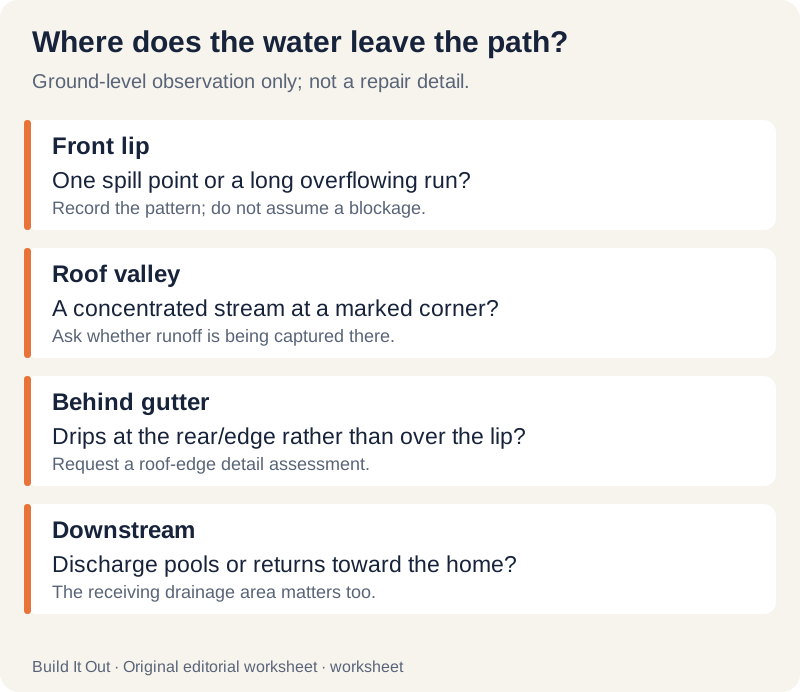
| Observed pattern | Record this detail | Ask the installer |
|---|---|---|
| Water crosses the front lip | One point or a broad length? During what rain conditions? | What do inspection findings show about collection, flow path and outlets? |
| A concentrated stream near a valley | Mark the valley-to-eave location on a wide photo | Is runoff being captured at this location? |
| Water drops behind the gutter | Identify the back/edge area without claiming the hidden route | Does the roof-edge detail route runoff into the channel? |
| Water leaves the downspout but pools nearby | Record the discharge destination and any return toward the house | Is the downstream drainage arrangement appropriate for the site? |
The table is Build It Out’s original sorting aid. It is not a diagnosis: a front spill does not prove a blockage, and water behind a gutter does not identify the exact flashing defect. Several patterns can occur during the same storm.
Behind the gutter is a different question from over the front
GAF’s drip-edge technical bulletin explains the purpose of roof-edge flashing and the need to route water toward the gutter. Quality Edge’s illustrated guidance also distinguishes the relationships among edge metal, gutter and fascia. Ask the contractor to assess the installed detail against the applicable product instructions. GAF · Quality Edge
Gutterworks’ original support page describes water traveling along edge material and appearing behind a gutter. That provides a reason to distinguish the location; its suggested detail is not a universal repair for every roof assembly. This article does not tell you to lift shingles, insert flashing or apply sealant. Gutterworks Manufacturing
Ask whether the roof project disturbed or replaced the edge detail, whether gutters were removed/reinstalled, and what was inspected afterward. Keep those as scope questions until the installer provides findings. “It started afterward” is an important timeline entry, not a substitute for the assessment.
An overflow is not enough information to choose a larger gutter
The Minnesota Stormwater Manual identifies several inputs to sizing, including roof area and configuration, slope, local design rainfall and downspout arrangement. It would be misleading to prescribe one gutter size based only on the width of a house or one phone video. Minnesota Pollution Control Agency
Amerimax’s manufacturer instructions treat channels, outlets, downspouts and roof-edge pieces as distinct components, and discuss outlet capacity in relation to roof area and downpours. Use that distinction when requesting an assessment. Ask whether a local restriction, the catchment layout, the outlet path or the design capacity was evaluated; do not assume they all require the same fix. Amerimax
IKO’s roof-anatomy guidance names valleys and eaves separately. Mark a concentrated valley location rather than reporting only the entire side of the house. A technician can then inspect the relevant runoff path instead of guessing from “the corner leaks.” IKO
Check the destination without moving the water somewhere else
University of Maryland Extension explains that downspouts transport roof runoff away from buildings. Virginia Cooperative Extension emphasizes that the receiving area must be able to handle the inflow. A roof-edge correction is incomplete if water still collects where it creates another problem. University of Maryland Extension · Virginia Cooperative Extension
Record whether discharge flows toward the foundation, an already saturated area, a path, a neighboring property or another drainage connection. Do not improvise a new route from generic advice: local drainage arrangements, slopes and receiving conditions matter. Ask the appropriate professional which destination is suitable.
Send one useful report rather than a guessed repair
Include the roof-work date, the first observed event, a wide photo with locations marked, a short safe video if available, and the four-pattern description. Note whether the issue appears during all rain or only an unusually intense event; without a local record, describe the weather qualitatively rather than inventing a rainfall rate.
Ask for the inspection findings, the relevant product/detail reference and the proposed next step in writing. If roof and gutter contractors are different, request that their explanations identify the interface rather than sending you back and forth with opposing assumptions. Promptly report water entering the home, loose components or visible damage as a separate condition requiring attention.
The useful endpoint is a documented explanation of where collection or routing fails and what will be assessed or corrected. Keeping front overflow, behind-gutter drips and downstream ponding separate makes that explanation much easier to evaluate.
Sources and method
Sources inspected October 25, 2026. The worksheet is Build It Out’s original editorial synthesis, not an on-site inspection, professional review or product certification.
- Pacific Northwest National Laboratory: Gutters and Downspouts, Building America Solution Center
- GAF: Drip Edges and Shingles, TAB-R-141
- Resource Conservation District of Santa Cruz County: A Homeowner’s Guide to Greening Stormwater Runoff (hosted by USDA NRCS)
- Amerimax: Installing Metal Gutter Systems (manufacturer instructions reproduced by Manualzz)
- Quality Edge: Drip Edge Installation Quick Tips, Rev.11/22
- Gutterworks Manufacturing: Water Running Behind Your Installed Gutter
- University of Maryland Extension: Downspout Redirection
- Virginia Cooperative Extension: Stormwater Management for Homeowners: Rooftop Redirection
- Minnesota Pollution Control Agency: Minnesota Stormwater Manual: Rainwater Harvest Design Criteria
- IKO: Blueprint for Roofing: Roof Anatomy and Edge Components