
A roofing square is 100 square feet of roof coverage, not 100 square feet of living space. A quote can show more area than the house footprint because the roof slopes, overhangs extend beyond the walls, and the material order may include a separate allowance. Ask which quantity each line uses before treating the difference as overbilling.
The property listing says 1,200 square feet. The roofing quote says nearly 17 squares before a material allowance. Those numbers can coexist because they describe different surfaces. You need the measurement basis, not a guessed conversion from the home’s advertised floor area.
First translate the unit without changing the area
Atlas defines a square as 100 square feet of coverage. Roofr’s measurement guide likewise distinguishes roof-plane area from a building’s footprint. Dividing a stated roof surface by 100 changes the unit only; it does not add slope, overhang or waste. Atlas Roofing · Roofr
For example, 1,600 square feet of measured roof surface equals 16 squares. That conversion is straightforward. The harder question is what the original 1,600 measured: a horizontal projection, actual sloping surface, or an order quantity already adjusted for cuts? Keep that label attached to every number.
Our worked example: one simple gable, three different areas
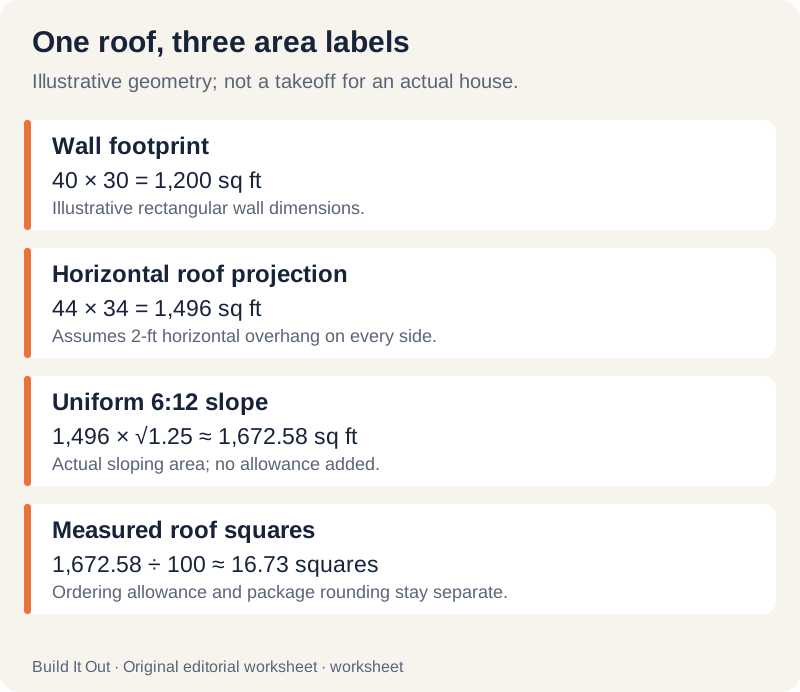
This is an illustrative geometric model, not a takeoff for an actual home. Assume a rectangular 40-by-30-foot wall footprint, a two-foot horizontal overhang on every side, and one uniform 6:12 slope. Exclude dormers, porches, valleys and any separate structures. The dimensions and overhang are assumptions, not recommended construction details.
| Quantity | Calculation | Result |
|---|---|---|
| Wall footprint | 40 × 30 | 1,200 sq ft |
| Roof horizontal projection | (40 + 4) × (30 + 4) | 1,496 sq ft |
| Slope factor | √(1 + (6 ÷ 12)²) | Approximately 1.118034 |
| Sloping roof surface | 1,496 × 1.118034 | Approximately 1,672.58 sq ft |
| Measured roof squares | 1,672.58 ÷ 100 | Approximately 16.73 squares |
The square-root factor follows the right-triangle relationship between horizontal run, rise and sloping length. IKO’s estimating manual lists approximately 1.118 for a 6:12 slope, independently corroborating the factor used here. Keep full precision until the final displayed result. IKO
Notice what we have not added: an ordering allowance, package rounding, starter material, hip or ridge products, or a price. Those are separate decisions. Also, if a report already states actual sloping roof area, multiplying it by a slope factor again would count the slope twice.
Ask to see the measurement breakdown
A complex roof should not be reduced to one guessed slope. Hover’s report explanation shows per-facet area, pitch and location. Eagleview separately lists roof area, facets, pitch diagrams and roof-edge lengths among its report fields. Ask which report or takeoff was used and whether the quote includes the same roof sections. Hover · Eagleview
Mark exclusions: garage, porch, low-slope addition, detached building or roof section using another system. A difference between bids may begin here rather than in anyone’s arithmetic. You do not need to climb onto the roof to request a legible report and a clear scope boundary.
Measured squares and ordered squares are separate rows
Loveland Innovations’ explanation treats slope adjustment and material allowance as distinct steps. Its published percentage examples do not establish the correct allowance for every project. Roof geometry, the selected product and the contractor’s takeoff should support the actual proposal. Loveland Innovations
Suppose the contractor states an illustrative 10% allowance for this example. The arithmetic would be 16.7258 × 1.10 ≈ 18.40 squares before package rounding. The 10% is an assumed scenario, not our recommendation or a verified requirement. Ask whether the quoted allowance already includes starter or ridge material, and whether those products are also listed separately.
Malarkey’s installation manual distinguishes field shingles and other roof details. That is a reason to use the exact product’s coverage and accessory information rather than assuming every bundle covers the same area or every component is purchased by the same unit. Malarkey Roofing Products
Our quote-reconciliation checklist
- Record the measured actual surface area and its source.
- List each included roof section and identify exclusions.
- Show the conversion from square feet to squares.
- Keep allowance and package rounding separate from measured coverage.
- Identify separately priced edges, accessories, removal and deck work.
- Ask which quantity forms the billing basis for labor and materials.
NRCA emphasizes complete work descriptions, and the BBB roofing checklist distinguishes removal, flashing, ventilation and waste removal. The FTC also recommends written estimates and explanations for large differences. These support comparing complete scopes; they do not prescribe a universal price per square. National Roofing Contractors Association · Better Business Bureau · Federal Trade Commission
A measured area can be reasonable while a proposed scope still needs clarification. Conversely, a smaller square count can simply leave out a roof section. Resolve the labels and boundaries first, then compare like quantities. The question to send is: “Please separate the measured roof surface, ordering allowance, package rounding and labor basis, with the included sections marked.”
Sources and method
Sources inspected October 25, 2026. The worksheet is Build It Out’s original editorial synthesis, not an on-site inspection, professional review or product certification.
- IKO: Estimating How Much Roofing Is Required
- Atlas Roofing: Roofing & Shingle FAQs
- Roofr: What Is a Roofing Square?
- Hover: Understanding Roof Facets Within the Measurement PDF
- Eagleview: Residential Property Reports
- Loveland Innovations: Understanding Roofing Squares
- Malarkey Roofing Products: Architectural Laminate Shingles Installation Guide
- National Roofing Contractors Association: Selecting a Contractor
- Federal Trade Commission: How To Avoid a Home Improvement Scam
- Better Business Bureau: BBB Tip: Roofing Contractors