
“Roof replacement” does not tell you how much deck repair is included. Before comparing totals, ask for the included quantity, billing unit, replacement specification and approval process for additional work. A shingle price and an open-ended deck allowance are different commitments.
The estimate looks complete until the crew starts and a new line appears: “additional decking.” The useful response is to reconcile scope and evidence. An extra charge is not automatically justified because it was unexpected, and a deck item is not automatically unnecessary because the original quote omitted it.
Separate the roof covering from its base
GAF describes the substrate as the base supporting asphalt shingles. Owens Corning’s specification separately addresses deck acceptance and replacement of damaged material. Those manufacturer requirements explain why deck condition belongs in the conversation; they do not establish how many sheets a particular house needs. GAF · Owens Corning
A contract should turn that distinction into plain quantities. Is the price for removing and replacing the covering only? Does it include a stated deck repair allowance? Is an overlay of existing boards included, excluded or subject to assessment? Ask the contractor to identify the actual assembly rather than treating every product called “decking” as interchangeable.
Our four-field deck allowance worksheet
Copy the following four fields into the estimate comparison. This is our original scope-check tool, not a construction specification. Use the contractor’s written proposal and product information to fill it in; leave an unknown field marked “unresolved” instead of entering zero.
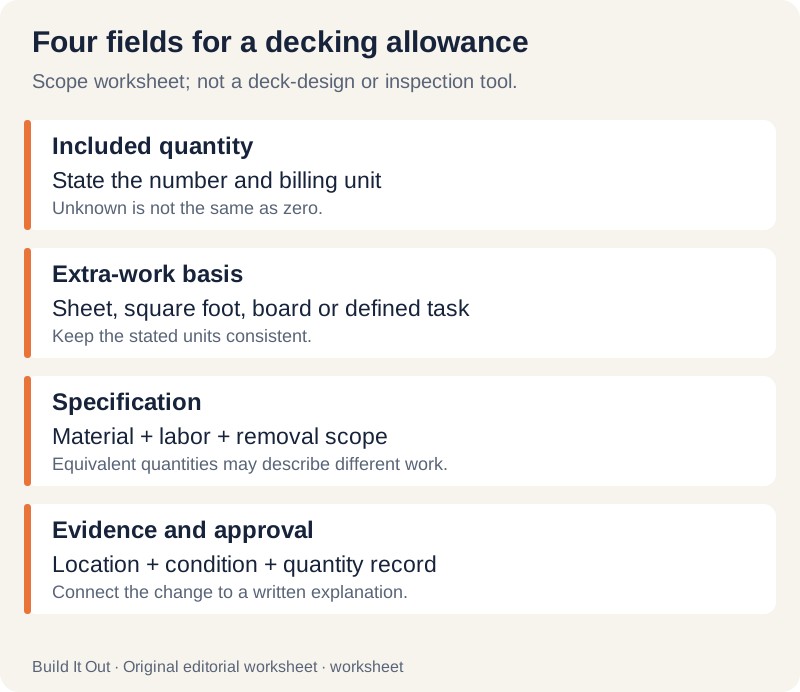
| Field | A useful written answer | Why it matters |
|---|---|---|
| Included quantity | An explicit number and unit, or “none included” | The word “allowance” alone has no quantity. |
| Additional-work unit | Per sheet, per square foot, per board or defined lump sum | Different units cannot be compared directly. |
| Material and scope | Product/grade/thickness as specified for this project; labor and removal inclusion | An area figure does not identify the assembly. |
| Evidence and approval | Who documents condition and quantities, and how approval is recorded | A clear process connects an observed condition to an authorized item. |
The worksheet builds on the NRCA recommendation for complete work descriptions and the FTC’s advice to compare written estimates. It is not an assertion that a specific contract form is legally required everywhere. Local contract requirements differ. National Roofing Contractors Association · Federal Trade Commission
A sheet count is not the same as installed repair area
Suppose a proposal explicitly assumes four nominal 4-by-8-foot panels. The nominal material area is 4 × 4 × 8 = 128 square feet. If the documented additional purchase is three such panels, that is another nominal 96 square feet of stock. These are arithmetic examples using stated dimensions, not a measurement of damaged roof or a claim about usable area after cutting.
Ask whether billing follows full panels supplied, installed repair area, individual boards or another stated basis. Do not silently convert one into the other. A stock sheet may be cut around framing and boundaries. An invoice needs to identify its actual billing rule; our nominal-area calculation cannot validate the layout or necessity.
APA’s roof-system guidance connects panel choices to the assembly and design requirements. Atlas and Malarkey likewise identify acceptable deck materials and conditions in their own installation instructions. This is why “same number of sheets” is only one comparison field, not proof of equivalent work. APA—The Engineered Wood Association · Atlas Roofing · Malarkey Roofing Products
What to ask when the proposed quantity changes
Request a location-marked photograph or other accessible record from the contractor, a description of the condition being addressed, the proposed material, and the quantity basis. Ask how the proposal distinguishes local replacement from a larger overlay or other change. If the explanation refers to a manufacturer requirement, request the applicable document and product—not an unrelated screenshot.
IKO’s deck-preparation guidance distinguishes deteriorated or warped material from the clean, sound base needed for the covering. TAMKO also treats deck preparation and stage-by-stage quality checks as separate parts of a roof system. Neither resource lets a homeowner diagnose concealed decking from a driveway photograph. IKO · TAMKO
Keep the request practical: “Please show the affected locations, the proposed quantity and the agreed billing unit, and confirm what was already included.” If the job is underway, ask the contractor to explain the weather-protection plan while a scope decision is resolved. Do not climb onto the roof or disturb partially completed work to check a quantity.
Compare the complete scope, not an isolated sheet rate
The BBB roofing proposal checklist covers flashing, ventilation, removal, cleanup and responsibility for damage as well as the covering itself. Use it to check what the deck rate includes: material alone, cutting, installation, disposal, handling and any clearly stated separate items. Better Business Bureau
For two bids, create one row per contractor and preserve its own units. Put an included allowance in one column and the additional-work basis in another. Mark whether both describe the same material and task. A lower base total can coexist with a narrower included scope; a larger allowance can also be inappropriate if the project does not call for it. Ask for evidence rather than assuming either outcome.
Save the original estimate, written changes, photographs and final itemization together. The resulting record should answer three questions: What changed, why was it proposed, and how was its quantity calculated? That is a stronger basis for a discussion than comparing a national price range with an unexplained extra charge.
Sources and method
Sources inspected October 25, 2026. The worksheet is Build It Out’s original editorial synthesis, not an on-site inspection, professional review or product certification.
- GAF: Appropriate Substrates for GAF Asphalt Shingles, TAB-R-101
- Owens Corning: Fiberglass-Based Asphalt Shingles & Accessories Guide Specifications (January 2026)
- Atlas Roofing: Roof Shingles Installation Instructions
- Malarkey Roofing Products: Architectural Laminate Shingles Installation Guide
- APA—The Engineered Wood Association: Roof Systems
- IKO: Blueprint for Roofing: Deck Preparation and Roof Components
- National Roofing Contractors Association: Selecting a Contractor
- Federal Trade Commission: How To Avoid a Home Improvement Scam
- Better Business Bureau: BBB Tip: Roofing Contractors
- TAMKO: Roofing Installation Best Practices for Contractors