

A wavy-looking new roof needs a specific explanation, not an automatic “wait for the sun” verdict. Identify whether you are seeing the intended dimensional pattern, individual lifted-looking edges or a broader repeating distortion. Record it from the ground and ask the installer which product guidance and inspection findings support the explanation.
A new roof can look different in low evening light than it did at midday. That makes a photograph worth keeping, but one picture cannot establish whether the issue is cosmetic, product-related, installation-related or beneath the shingles. Our goal is to make the follow-up conversation more precise while keeping observations at ground level.
Start by naming the pattern you can actually see
Dimensional asphalt shingles are intentionally built from laminated layers. CertainTeed describes their three-dimensional appearance; they are not meant to resemble a featureless flat sheet. An intended repeating shadow pattern is different from a raised-looking line that crosses several courses. CertainTeed
A useful record says where the appearance occurs, how far it extends and whether it changes with the viewing angle. Avoid writing “bad decking” or “unsealed shingles” unless an appropriate inspection has established that finding. A ground-level observation can describe a shape; it cannot see fastening, deck condition or sealant performance beneath the covering.
Our two-photo, four-question observation sheet
Take one wide photograph showing the affected slope and one zoomed photograph from the same safe ground position. When possible, repeat the wide view in different light without changing the observation point. Do not climb, lift tabs or press the covering to test an explanation.
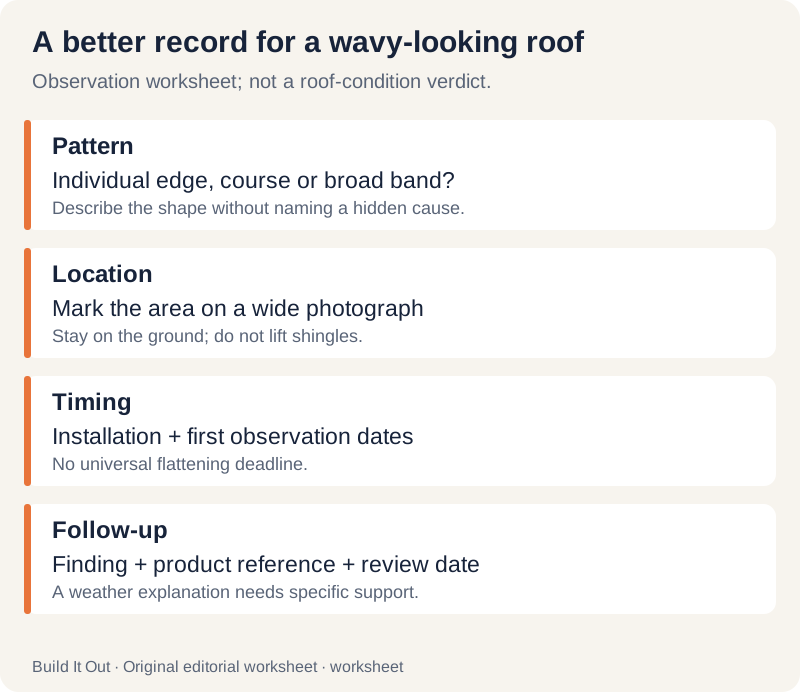
| Record | Useful detail | What it does not prove |
|---|---|---|
| Pattern | One edge, an entire course, broad band or repeating grid | The cause beneath the surface |
| Location | Marked area on a wide photograph | A complete roof assessment |
| Timing | Installation date and when the appearance was first noticed | A universal settling deadline |
| Conditions | Light direction, recent weather and visible changes | Whether every fastening or seal is correct |
This record is our editorial aid. It does not classify a roof as safe, defective or warrantable. If there is active water entering the home, loose material or a rapidly changing condition, contact the installer promptly and describe that separately; do not treat it as an appearance-only waiting exercise.
Cold-weather sealing is real, but it is not a blanket diagnosis
Owens Corning’s cold-weather bulletin explains that sunlight activates a factory-applied sealant and that activation timing depends on conditions including orientation, slope and temperature. The document does not supply a single waiting period that proves every wavy roof will become flat. It is an archival technical explanation, so the contractor should also identify the current instructions for the installed product. Owens Corning
TAMKO also identifies delayed sealing as a cold-weather consideration. Ask “Which condition are you observing, and what product-specific follow-up is planned?” A statement about delayed sealing is not, by itself, evidence that a broad ridge in the roof surface comes from that mechanism. TAMKO
If the proposed next step is observation over time, request a date or agreed review condition and the person responsible for follow-up. Keep the original report open until that review occurs. Do not accept an invented universal deadline from a general article, including this one.
ARMA’s cold-weather technical bulletin makes the limitation explicit: when a reroofing surface is uneven, the resulting appearance can persist after the weather warms. That is why an unexplained broad distortion needs an assessment instead of an automatic promise that heat will flatten it. ARMA, p. 2
The finished appearance can involve more than the shingle
GAF’s substrate bulletin describes the supporting base beneath asphalt shingles. Owens Corning’s guide specification calls for a dry, sound and smooth deck, while Atlas addresses deck flatness in its installation requirements. These are reasons an inspector may need to look beyond the exposed shingle; they are not a homeowner test for hidden conditions. GAF · Owens Corning · Atlas Roofing
APA’s technical-note introduction describes how moisture-related panel expansion can produce waviness. That is one possible mechanism, not a verdict from a photograph. Malarkey’s manual also discusses the way an irregular existing surface can influence a reroofed appearance. The actual assembly and inspection findings matter. APA—The Engineered Wood Association · Malarkey Roofing Products
Do not infer “the structure is failing” from those possibilities, or the opposite claim that every visible distortion is harmless. The narrow question for the contractor is which layer was assessed and what evidence distinguishes the proposed explanation from the alternatives.
Ask for a finding, a reference and a follow-up
- Finding: What condition did the installer observe, and where?
- Reference: Which instructions apply to the exact shingle and underlying assembly?
- Action: Is an on-site inspection, documented observation period or other professional assessment proposed?
- Follow-up: Who will revisit it, and what would change that plan?
IKO’s preparation guidance connects a smooth finished covering with a properly prepared base. NRCA recommends discussing quality-control procedures and warranty terms with the contractor. Use those principles to request a concise written explanation rather than a long list of online diagnoses. IKO · National Roofing Contractors Association
A useful outcome might be confirmation that the visible pattern matches the selected dimensional product, or it might be a documented issue requiring further assessment. Both are more concrete than a promise that sunlight will fix every shape. Keep your photos, product identity and the installer’s response together so a later review addresses the same area.
Sources and method
Sources inspected October 25, 2026. The worksheet is Build It Out’s original editorial synthesis, not an on-site inspection, professional review or product certification.
- CertainTeed: Roofing Shingles 101
- Owens Corning: Cold Weather Shingle Installation, TB-05 (archival manufacturer bulletin hosted by Oak Forest)
- APA—The Engineered Wood Association: Minimizing Buckling of Wood Structural Panels, D481
- GAF: Appropriate Substrates for GAF Asphalt Shingles, TAB-R-101
- Owens Corning: Fiberglass-Based Asphalt Shingles & Accessories Guide Specifications (January 2026)
- Atlas Roofing: Roof Shingles Installation Instructions
- Malarkey Roofing Products: Architectural Laminate Shingles Installation Guide
- TAMKO: Roofing Installation Best Practices for Contractors
- IKO: Blueprint for Roofing: Deck Preparation and Roof Components
- National Roofing Contractors Association: Selecting a Contractor
- ARMA: Cold-Weather Shingle Installation Recommendations (2022)