
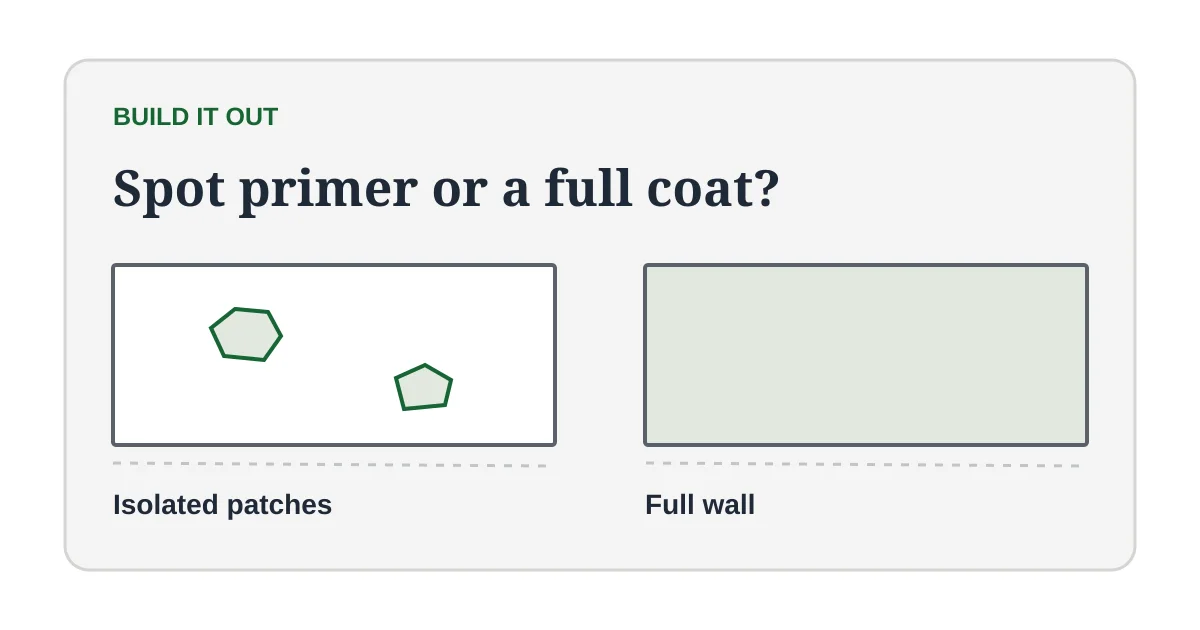
A quote should say where primer goes and what problem each primer is intended to solve. Spot priming can be appropriate for an isolated repair or stain when the product allows it; a full coat may be needed over new drywall or where uniform porosity and sheen matter. “Primer as needed” leaves the finish and price scope unresolved.
Primer is not one interchangeable line item. Bare drywall, joint compound, a glossy painted wall and a water stain present different questions. The exact substrate and exact primer belong together in the quote.
Start with a wall map, not a primer brand
| Area | Condition to record | Quote must resolve |
|---|---|---|
| New drywall field | Paper, joint compound and skim-coated areas | Full drywall-primer coat and compatible topcoat |
| Small patch | Bare compound against existing paint | Local primer plus how sheen/color uniformity will be checked |
| Known stain | Type, extent and whether source is corrected | Named stain-blocking product and treated boundary |
| Sound existing paint | Gloss, cleanliness and adhesion condition | Preparation and whether bonding primer is required |
| Unknown older coating | Age and disturbance plan | Lead-safe/legal assessment before abrasive work |
The Gypsum Association says properly prepared gypsum board should receive a drywall primer to equalize absorption between face paper, joint compound and skim coatings. USG and PPG describe products designed for the same porosity/texture transition. [1] [3] [6]
Why a patch can still show
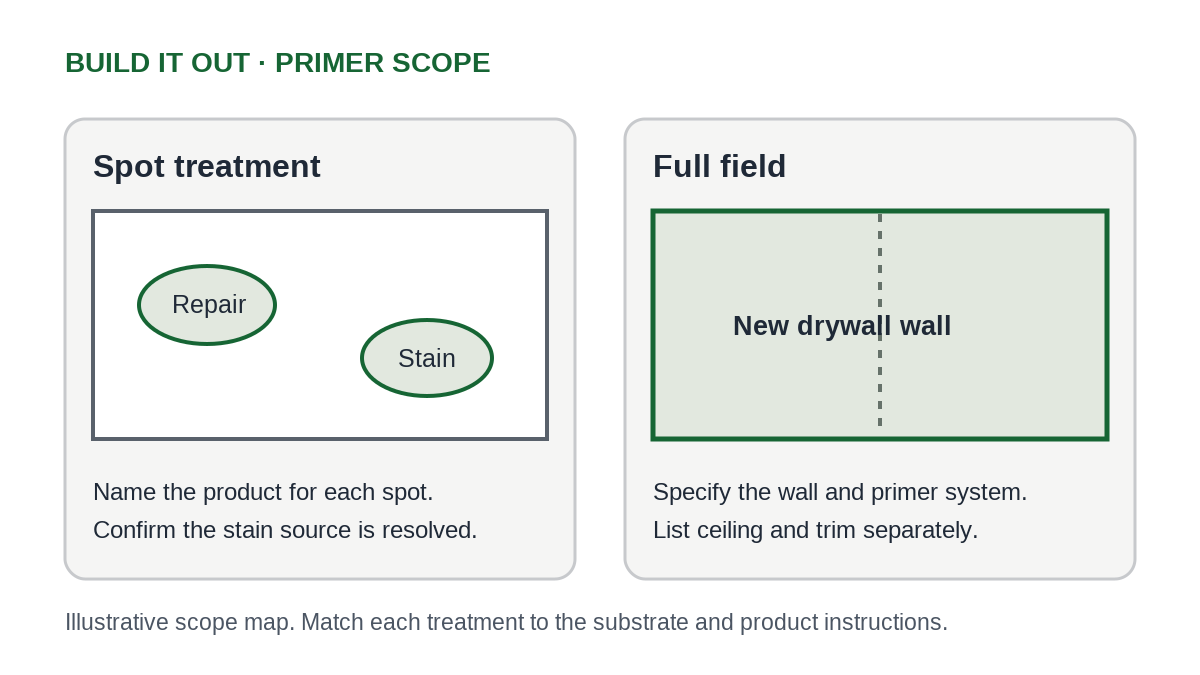
A patch changes both texture and absorption. KILZ describes its drywall primer as reducing excessive absorption and flashing. Zinsser recommends priming the entire surface for best results on new drywall. Fine Homebuilding’s specialist discussion warns that higher-gloss topcoats can reveal a difference over a drywall patch. [4] [5] [9]
That does not mean every repaint requires wall-to-wall primer. It means the contractor should explain how a local repair will be blended into the existing film and what happens if the first topcoat reveals a sheen boundary. Put that correction responsibility in the scope instead of assuming another finish coat will always hide it.
Drywall primer and stain blocker answer different questions
Benjamin Moore’s technical sheet separates ordinary drywall/plaster use from difficult substrates such as bleeding wood, grease, crayon, hard glossy surfaces and stain-suppression problems. Lowe’s guide likewise distinguishes drywall primer from several stain-blocking categories. Use those distinctions to ask for the product, not to choose a universal chemistry. [2] [8]
Before a stain is sealed, resolve its source. A blocked water mark is not evidence that a leak is fixed. The quote can list diagnosis or repair as excluded while still identifying who confirms the substrate is dry and ready.
Five lines that remove most ambiguity
- Surface: room, wall and approximate treated area.
- Condition: new drywall, patch, stain, glossy film or other documented condition.
- Product: manufacturer, line and primer type—not “quality primer.”
- Coverage: spot boundaries or full field, including whether ceilings/trim are separate.
- Acceptance: what uniformity will be checked after drying and who corrects visible flashing.
Sherwin-Williams’ preparation guidance warns against spot priming where it can create non-uniform appearance. Treat that as a reason for a project-specific plan, not an absolute rule that erases every legitimate spot treatment. [7]
Pause when existing paint may be lead-based
For pre-1978 housing, paint disturbance can fall under federal lead-safe renovation requirements. Do not turn a quote worksheet into sanding or removal instructions. Ask the contractor how the applicable EPA and local requirements are being handled. [10]
For finish selection after the primer scope is settled, compare the exact sheen rather than relying on eggshell/satin names alone. For an existing color repair, see why touch-up paint can remain visible.
Sources
- Gypsum Association: GA-232-04 Painting New Gypsum Board
- Benjamin Moore: Drywall Primer K265 Technical Data Sheet
- PPG Paints: SPEEDHIDE MAX PRIME Interior Primer/Surfacer
- KILZ: KILZ PVA Drywall Primer
- Zinsser: Zinsser Drywall Primer
- USG Sheetrock: First Coat Primer
- Sherwin-Williams: How to Prep Surfaces for Painting
- Lowe's: Primer Buying Guide
- Fine Homebuilding: Choose the Right Primer for Your Next Painting Project
- US EPA: Renovation, Repair and Painting Program