
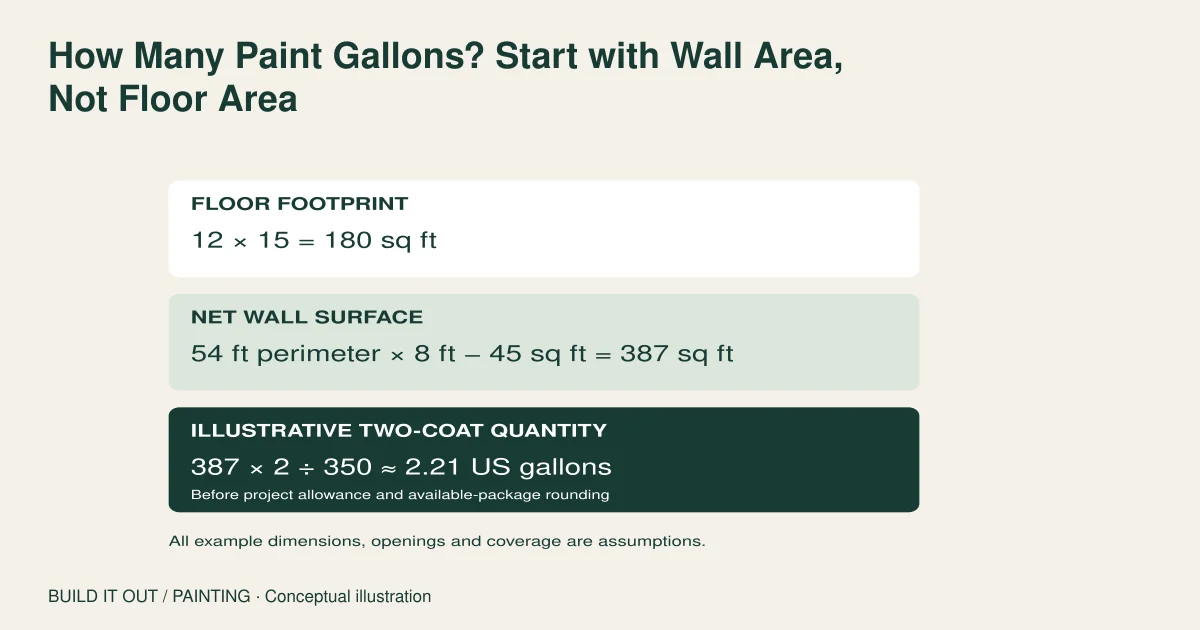
Floor area is not wall area. For a simple rectangular room, wall area starts with perimeter multiplied by wall height, then subtracts openings that will not be painted. Multiply the paintable area by the planned coats and divide by the selected paint’s coverage per coat. Keep ceilings, trim, primer and different finishes on separate lines.
A 180-square-foot bedroom does not have 180 square feet of wall. Its wall quantity depends on the room’s perimeter, height, openings and shape. Behr’s measuring guide uses perimeter times height; Sherwin-Williams’ transcript describes measuring and summing the individual walls. Those approaches address the painted surface, not the floor footprint.
Worked example: the room is 180 sq ft, the walls are 432
Every input below is illustrative. Assume a rectangular room 12 feet by 15 feet, walls 8 feet high, one 3-by-7-foot door, and two 3-by-4-foot windows. Assume two coats of one wall finish at 350 square feet per US gallon per coat. That coverage is a demonstration input, not a recommendation or measured result.
- Floor footprint: 12 × 15 = 180 sq ft.
- Wall perimeter: 2 × (12 + 15) = 54 ft.
- Gross wall area: 54 × 8 = 432 sq ft.
- Excluded openings: (3 × 7) + 2 × (3 × 4) = 45 sq ft.
- Net paintable wall area: 432 − 45 = 387 sq ft.
- Two-coat coverage requirement: 387 × 2 = 774 coat-sq-ft.
- Theoretical quantity: 774 ÷ 350 ≈ 2.21 US gallons.
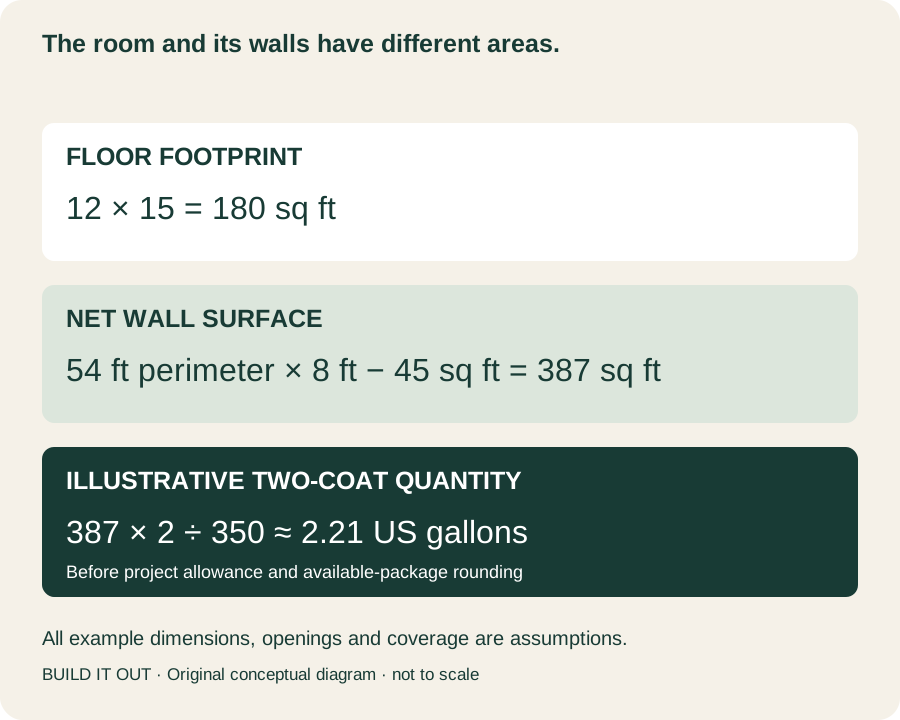
The result is a starting quantity, before product-specific allowance and package decisions. It is not an instruction to order exactly 2.21 gallons or dilute paint to make it cover. Resene’s estimating explanation uses the same area, spreading-rate and coat-count structure, while emphasizing the chosen product’s data.
Gallons calculated and cans purchased are different numbers
If only whole one-gallon cans were available for this example, the quantity would round up to three cans. If other sizes are available, compare the actual packages after the retailer checks the project allowance. A smaller package combination that barely exceeds theoretical consumption may leave little margin for application losses or touch-ups.
State the allowance rather than hiding it inside an unexplained total. Behr describes quarts and larger pails as possible package sizes, but not every product, color or retailer stocks every size. Keep price comparison separate from this quantity example; no current market price is claimed here.
Use the label’s coverage as an input, not a universal constant
Coverage varies with the product and surface. Farrow & Ball’s US Modern Emulsion sheet, page 8, states an “up to” per-coat coverage figure and notes that some colors may need more coats. That is not a guaranteed rate for another paint or an uneven, porous surface.
Little Greene’s coverage FAQ distinguishes finish, texture and porosity and expresses coverage in square metres per litre. Keep units consistent. A figure in square metres per litre cannot be inserted unchanged into a calculation asking for square feet per US gallon.
Crown’s FAQ also makes coat count conditional on the surface and color being covered. Confirm the proposed paint system with the supplier, including primer where needed. “Paint and primer” on a can is not a quantity calculation or a guarantee that every project needs just one application.
Check whether a calculator already includes the coats
Benjamin Moore’s calculator explicitly assumes two coats and excludes the ceiling. Dulux Australia’s calculator also assumes two topcoats. Multiplying either result by two again without checking would repeat that allowance. Their rates and defaults remain their own; the useful lesson is to read assumptions before using the answer.
PPG New Zealand’s calculator identifies a four-wall room assumption and separates walls, trim and ceiling. A simple room model may not capture an alcove, stairwell, vaulted section or open side. Use a wall-by-wall schedule where the shape is irregular rather than forcing the room into one rectangle.
Our surface schedule: one line per paint system
| Surface | Measure | Keep separate |
|---|---|---|
| Main walls | Each wall’s width × height, less agreed exclusions | Other colors and sheen changes |
| Ceiling | Its actual painted surface; a slope differs from its footprint | Ceiling product and coat count |
| Doors and trim | The selected surfaces, sides and profiles | Trim finish and primer if specified |
| Primer / sealer | The area the specified system needs primed | Its own coverage and package quantity |
Dunn-Edwards’ interior painting brochure, page 4, supplies a wall-by-wall estimating worksheet. Our addition is the explicit separation of geometric area, coat-sq-ft, product coverage and packages, so a number can be traced back to its purpose.
Before ordering, reconcile these five details
- Scope: are the same walls/openings included in the measurement and quote?
- Height: were tall or sloped sections measured rather than assumed?
- System: which product, color and finish goes on each surface?
- Coats: are they already included in a calculator result?
- Purchase: what explicit project allowance and available package combination is proposed?
A useful order record can explain every step from room geometry to cans. It avoids both the floor-area shortcut and the opposite mistake of adding coats, allowances or ceiling quantities twice.
Sources and method
Prepared by Build It Out from the primary and specialist resources below; checked October 25, 2026. The decision aid and artwork are editorial synthesis, not a field test or professional inspection. Product examples retain their own scope; follow the current instructions for the exact US product being used.
- Benjamin Moore: Paint Calculator
- Sherwin-Williams: How Much Paint To Buy
- Behr: Determine how much interior paint to buy
- Dunn-Edwards: How to Paint Your Home: interior brochure
- Farrow & Ball: Modern Emulsion US product advice sheet
- Little Greene: Paint FAQs: Coverage
- Resene: Paint calculator and estimating method
- Dulux Australia: Paint Calculator
- PPG Paints New Zealand: Paint Calculator
- Crown Paints: Frequently Asked Questions: paint amount