
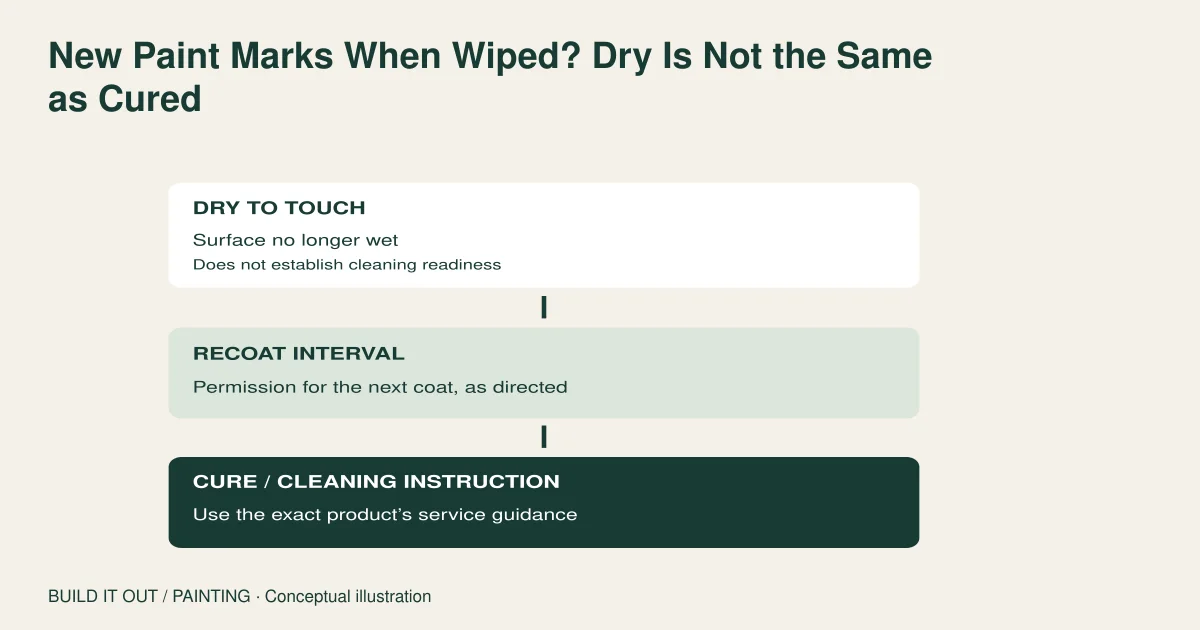
A wall can feel dry before its coating is ready for cleaning. Find the exact paint’s cleaning or cure instruction before wiping harder. If a first attempt leaves a shiny patch, color on the cloth or a softened surface, stop the cleaning test and record what happened. More pressure can turn a removable mark into a finish problem.
The freshly painted room is back in use. A small fingerprint seems easy to remove, but the wiped area now catches the light. That does not automatically prove the paint was defective, nor does it prove the wall was cleaned correctly. Benjamin Moore distinguishes surface dryness from the later stage when paint has fully hardened. The practical task is to identify the product, its age and the kind of change you are seeing.
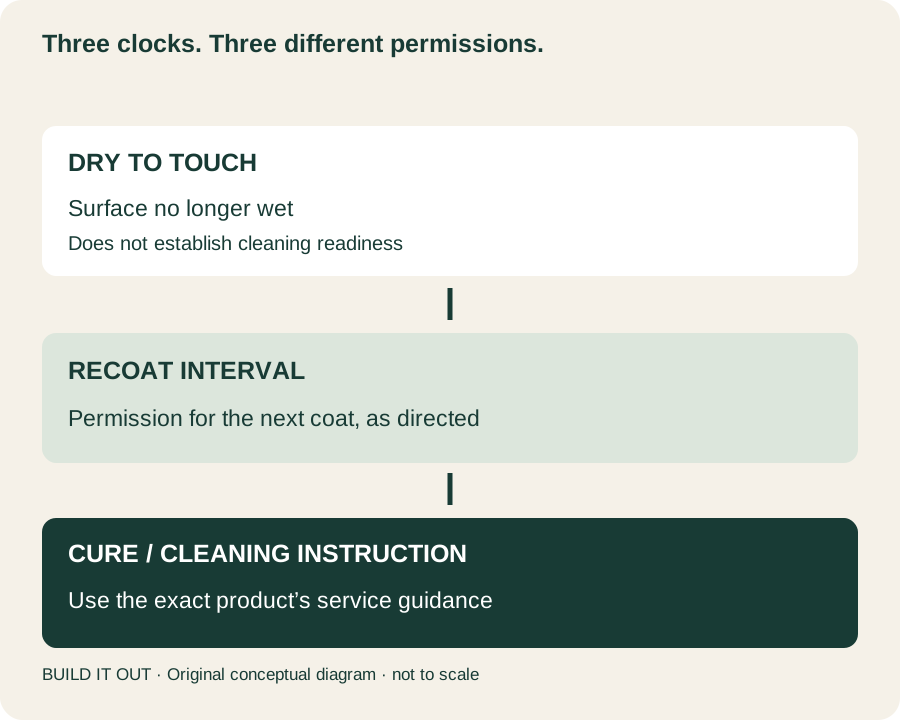
Write down three clocks, not one drying time
| Instruction | What it addresses | What it does not establish |
|---|---|---|
| Dry to touch | When the surface is no longer wet under specified conditions | Readiness for washing or friction |
| Recoat interval | When another coat may be applied as directed | Full hardness or ordinary cleaning resistance |
| Cure / cleaning interval | Development of the stated service properties and permitted cleaning | Immunity to abrasives or every stain |
Those entries can differ substantially on a single product. Behr’s MARQUEE Interior Eggshell data sheet, page 2, separates avoiding heavy traffic for 24 hours from allowing four weeks before washing or cleaning. The same sheet’s first-page table lists two weeks for full cure under stated conditions, while the washing caution says four weeks. Keep the cleaning restriction separate and ask Behr to clarify any uncertainty. This is an example for that coating, not a four-week rule for every paint. Read the actual can and current technical sheet together.
Why one source says two weeks and another says four
Manufacturer care advice has different product scopes and assumptions. Dunn-Edwards’ cleaning bulletin, page 1, describes a minimum two-week wait under ideal conditions and identifies temperature, humidity and film thickness as influences. Resene’s maintenance guide uses four weeks for its finishes. Those numbers should not be averaged into a new “three-week” instruction.
The product-specific answer takes priority. For example, Farrow & Ball’s US Modern Emulsion advice, page 7, specifies at least 14 days before cleaning and describes gentle methods. Ask the manufacturer about the exact finish and conditions if the label is unclear. Foreign-brand general care examples here demonstrate why timings vary; they do not override a US coating’s directions.
Describe the change before choosing a response
Look at the area after it has dried from any permitted cleaning. Resene advises allowing a hidden cleaning test to dry before repeating the method elsewhere. A temporarily damp area and a permanent change in sheen are different observations. Photograph the area both straight on and from the ordinary side approach to the room.
- A shiny patch: friction may have changed the finish. PPG explains burnishing as shiny marks associated with friction on flat finishes. More scrubbing is not a reliable way to remove that shine.
- Color or material on the cloth: stop and ask the coating maker to assess the product and cleaning method. The observation alone does not identify the cause.
- A soft, sticky or visibly damaged film: preserve the product details and seek advice before recoating or applying a stronger cleaner.
- A mark remains but the finish appears unchanged: identify the stain and use only the product’s approved cleaning approach.
This is an observation list, not a test for cure. Repeated rubbing to see whether paint “passes” can itself change the result.
“Washable matte” still has conditions
A broad sheen name does not establish the same cleaning performance across brands or product lines. Little Greene distinguishes its classic flat finish from washable Intelligent finishes. Check the specific coating rather than assuming every matte finish is delicate or every washable finish tolerates immediate aggressive cleaning.
Dulux’s care advice likewise connects cleaning methods to finish and warns against rough abrasives on flat coatings. Sherwin-Williams recommends a nonabrasive approach and a small inconspicuous test. Cleaning products marketed for other surfaces are not automatically appropriate for a painted wall.
Our paint-care handover card
Complete this short record before a busy room returns to ordinary cleaning. It turns “the painter said it was dry” into usable instructions:
- Product: photograph the brand, product line, finish and color label. Record the room and wall.
- Final coat: note the actual application date, not the day furniture returned.
- Conditions: record any unusually cool, humid or poorly ventilated period relevant to the manufacturer’s advice.
- Permission: copy the current product’s cleaning interval and approved method into the record, keeping a link to the sheet.
- First mark: record what caused it, any cleaner/cloth already used, and the dry appearance afterward.
- Question: ask whether to wait, perform a limited approved test, or arrange a coating assessment.
Do not put “30 days” in the permission field simply because an online guide uses it. Record the instruction applicable to the actual paint. Do not use smell, touch or an improvised scratch test as proof of full cure.
Reduce contact while the coating develops
Keep furniture from pressing or repeatedly rubbing against the wall while following the coating’s service instructions. Asian Paints notes that furniture contact can mark a coating before it develops sufficient hardness. This is different from declaring the entire room unusable for a universal period. Plan the activities that touch the finish: cleaning, hanging objects, moving furniture and masking for another color.
If a spill needs attention before the ordinary cleaning interval, contact the coating maker for the least damaging response. Preserve the stain/product information; do not experiment with solvents or mix cleaners. A small, documented problem is easier to assess than a large patch changed by several unrecorded treatments.
Sources and method
Prepared by Build It Out from the primary and specialist resources below; checked October 25, 2026. The decision aid and artwork are editorial synthesis, not a field test or professional inspection. Product examples retain their own scope; follow the current instructions for the exact US product being used.
- Benjamin Moore: How to Clean and Maintain Freshly Painted Walls & Cabinets
- Dunn-Edwards: How to Care & Clean Painted Surfaces technical bulletin
- Resene: Maintenance guide for Resene paint finishes
- Farrow & Ball: Modern Emulsion US product advice sheet
- Dulux Australia: How to care for Dulux paint
- Sherwin-Williams: Maintenance & Repair FAQs
- Behr: MARQUEE Interior Eggshell Enamel technical data sheet
- PPG Paints: How To Fix Burnishing
- Asian Paints: Interior Paint Drying vs Curing
- Little Greene: Paint FAQs: finish durability