
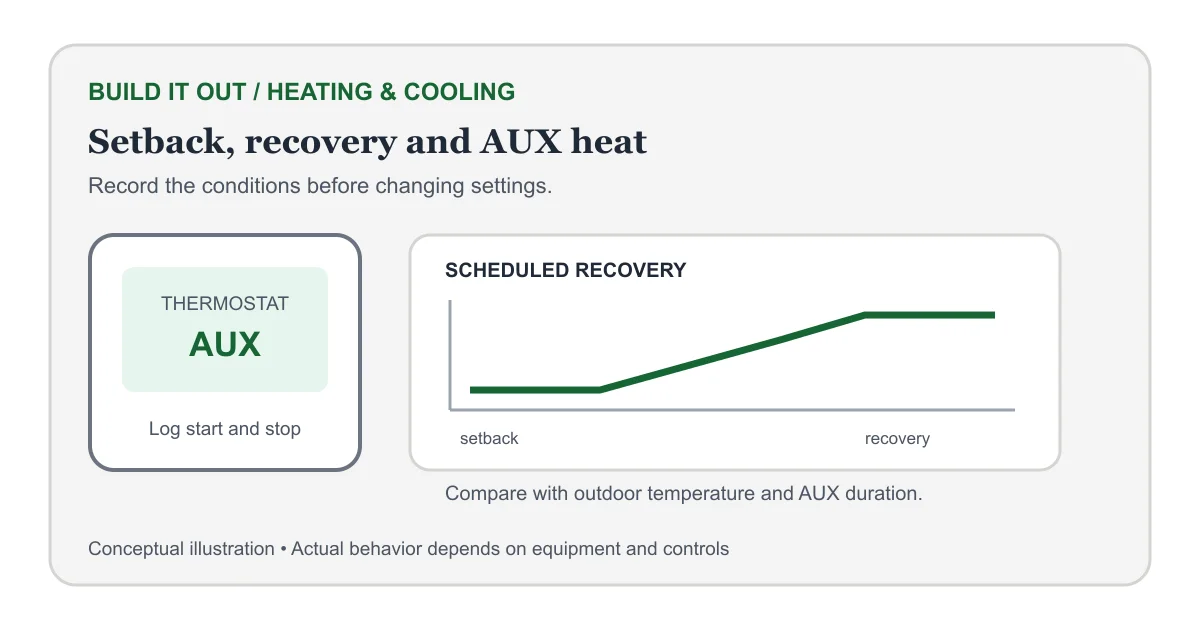
A heat pump recovering from a setback may call auxiliary heat because the thermostat sees a large temperature gap or a time-to-target demand. That does not, by itself, prove a fault. Record the schedule, outdoor temperature, equipment status and how long auxiliary heat runs, then compare the pattern with the exact thermostat and heat-pump documentation.
Auxiliary heat can also appear during cold weather, defrost or when the heat pump alone cannot meet the load. The useful question is not “Did AUX ever appear?” but “Under what conditions, for how long, and did the pattern change after the schedule?”
Why recovery behaves differently from steady operation
PNNL describes adaptive recovery as starting earlier and raising temperature gradually so a heat pump can avoid unnecessary electric-resistance backup. Carrier’s Smart Recovery similarly uses small setpoint steps to reduce staging. [2] [4]
CEE’s homeowner guide favors a steady thermostat and limits setbacks in its general advice, while Focus on Energy warns that auto-away or preprogrammed schedules can create large setbacks. These are planning signals, not proof that every house needs the same schedule. [5] [6]
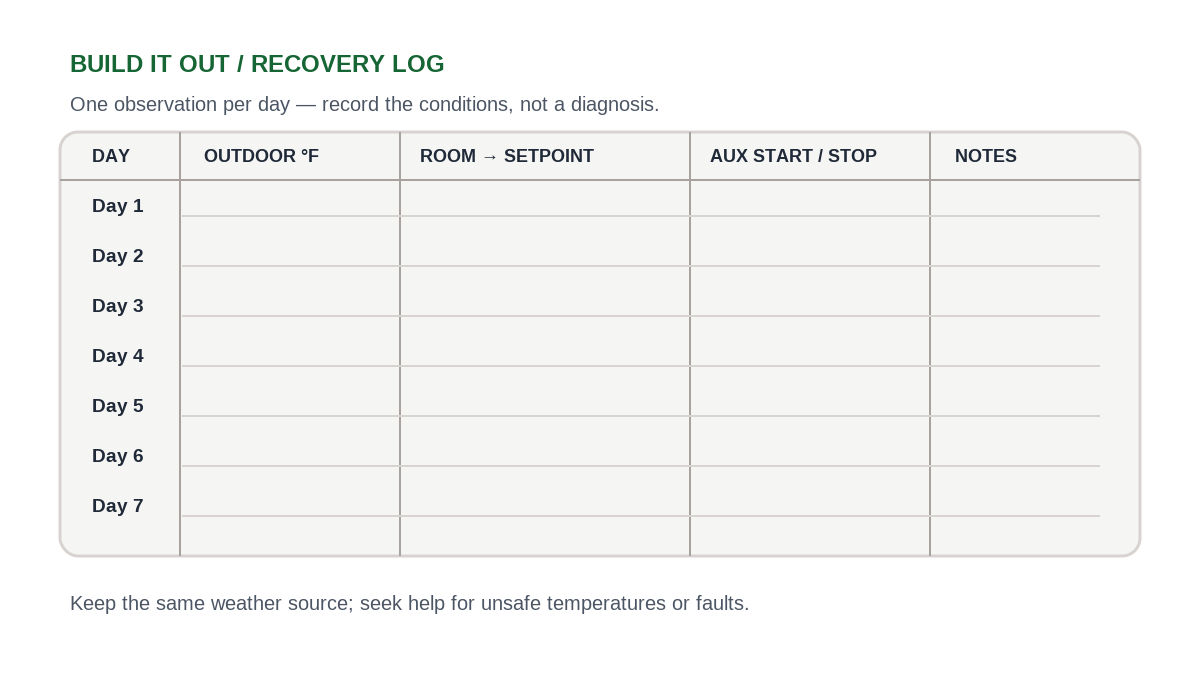
Keep a seven-day recovery log
| Date/time | Outdoor °F | Room → setpoint | AUX indicator | Notes |
|---|---|---|---|---|
| ___ | ___ | ___ → ___ | Start / stop / none | Scheduled recovery, manual change, defrost signs |
| ___ | ___ | ___ → ___ | Start / stop / none | Comfort and equipment sound only; do not open panels |
| ___ | ___ | ___ → ___ | Start / stop / none | Error code or unusual condition |
Use one consistent outdoor-temperature source and record its location. ENERGY STAR includes resistance-heat utilization by temperature bins in its smart-thermostat reporting framework; that is a reminder that weather context matters. [7]
Separate three patterns
- Schedule-linked: AUX appears mainly when a large scheduled rise begins, then stops after recovery.
- Weather/capacity-linked: AUX appears during colder conditions even without a large setpoint change.
- Unresolved: AUX runs frequently in mild weather, comfort worsens, errors appear, or the pattern is not explained by the documents.
The classification is for a service conversation, not a diagnosis. A dual-fuel system, electric strip backup and variable-capacity heat pump may use different controls.
Do not copy another thermostat’s lockout number
DOE’s standard work specification calls for supplementary-heat lockout according to manufacturer specifications. BPA’s support sheets show that menu names and thresholds differ by model. The ecobee Smart Thermostat Premium installation guide also describes model-specific thresholds. Installer settings can affect comfort, freeze protection, equipment operation and fuel switching, so a homeowner should not copy a value from a forum or another house. [1] [3] [9]
Questions for the installer or controls technician
- Which thermostat model and firmware/settings record applies?
- Is auxiliary heat electric resistance, furnace backup or another source?
- Is adaptive/smart recovery enabled, and what behavior should be visible?
- What compressor and auxiliary lockout strategy was designed for this equipment and climate?
- What balance-point or capacity information supports that setup?
- Does the seven-day log suggest a schedule issue, capacity limitation, defrost behavior or service problem?
In one home in a 2015 field study, the compressor often ran at high speed while recovering from a setback; the researchers did not study setback strategies in detail. NEEP provides broader specialist selection context. Use them to understand the concepts, while current equipment documents and a qualified technician control the actual settings. [10] [8]
When to call promptly
Seek qualified service if the home cannot maintain a safe temperature, an error or burning odor appears, breakers trip, ice persists beyond normal defrost behavior, or auxiliary/emergency heat remains on in conditions the system documents do not explain. Do not open electrical panels or change installer-level controls from this article.
For equipment buying questions, see how to compare low-temperature capacity on a heat-pump quote. For normal cold-weather vapor, see heat-pump steam during defrost.
Sources
- DOE: Standard Work Specifications for Single-Family Home Energy Upgrades
- PNNL: Thermostat Controls, Building America Solution Center
- BPA: Heat Pump Thermostat Support Sheets
- Carrier: Connect Wi-Fi Thermostat Installation Guide
- CEE / Building Science Education: You Installed an ASHP—Now What?
- Focus on Energy: Electric Heat Pump Customer Buying & Operation Guide
- ENERGY STAR: Smart Thermostat FAQs for EEPS
- NEEP: Air Source Heat Pump Buying Guide
- ecobee: Smart Thermostat Premium Installation Guide
- DOE Building America: Field Performance of Inverter-Driven Heat Pumps in Cold Climates, by CARB / Steven Winter Associates (2015)