
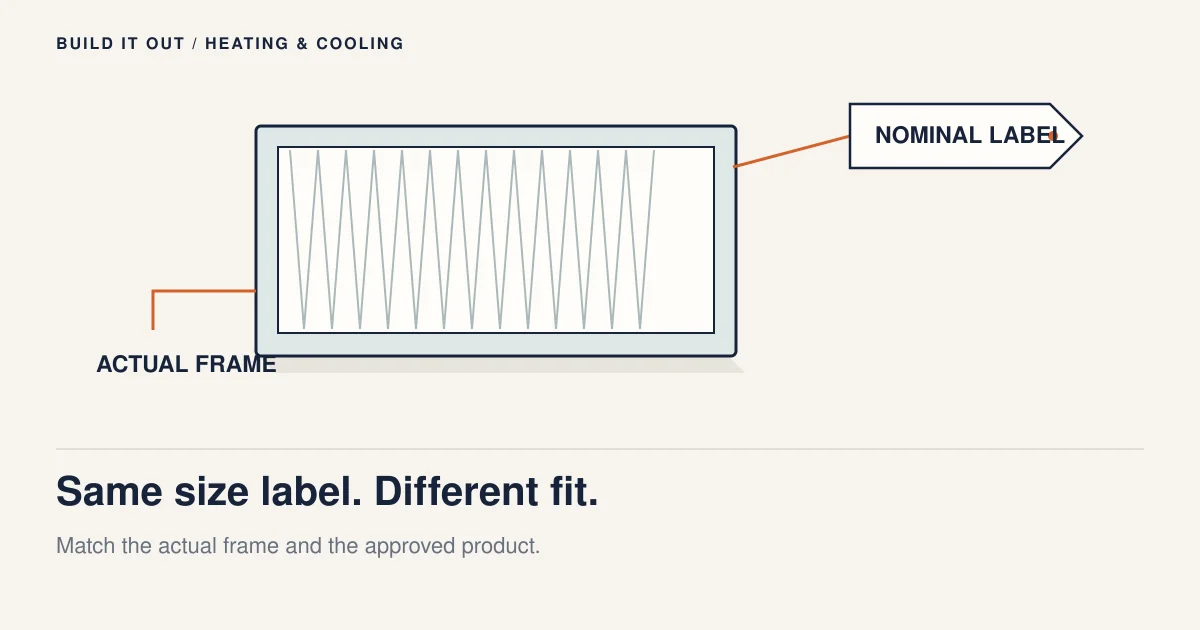
The size on the carton is usually a product name, not a tape-measure reading. A filter sold as 20 × 25 × 1 can legitimately measure less than those numbers. Match the required part or approved product, then compare its actual width, height and depth with the correct filter record. Do not fix a mismatch by crushing the frame or leaving a gap.
The frustrating purchase is the replacement with exactly the same large numbers as the old filter—and a different fit. The explanation is often nominal versus actual dimensions. That does not mean the new product is defective, or that any slightly smaller filter is acceptable. Fit depends on the intended slot, cabinet and product design.
What nominal and actual size mean
Nominal dimensions are the rounded size used for identification and shopping. Actual dimensions describe the manufactured filter. Nordic Pure explains both terms and warns that nominally similar deep filters can differ between manufacturers. A normal dimensional allowance is not a license to select an arbitrary gap.
The order of the labels also matters. Some makers use length × width × depth; others label height × width × depth. Compare the same physical axes rather than assuming the first number always means the same direction.
Three products with the same nominal name
| Named product | Nominal label | Published actual dimensions |
|---|---|---|
| Filterbuy standard 20×25×1 | 20×25×1 | 19.50×24.50×0.75 |
| AprilAire A20251 | 20×25×1 | 19.5 H×24.5 W×0.75 D |
| Glasfloss MR-13 M1320251 | 20×25×1 | 19⅝×24½×⅞ |
These are Filterbuy’s own dimensional data, AprilAire’s A20251 specification and Glasfloss’s MR-13 product table. They demonstrate variation; this is not an interchangeability chart or a recommendation that all three fit a particular home.
There is no dependable universal rule to subtract half an inch from every printed dimension. For example, ⅞ inch is 0.875 inch, not 0.75 inch. The difference in depth can matter in a retaining track or cabinet even though both cartons say 1 inch.
Build a three-line fit record before ordering
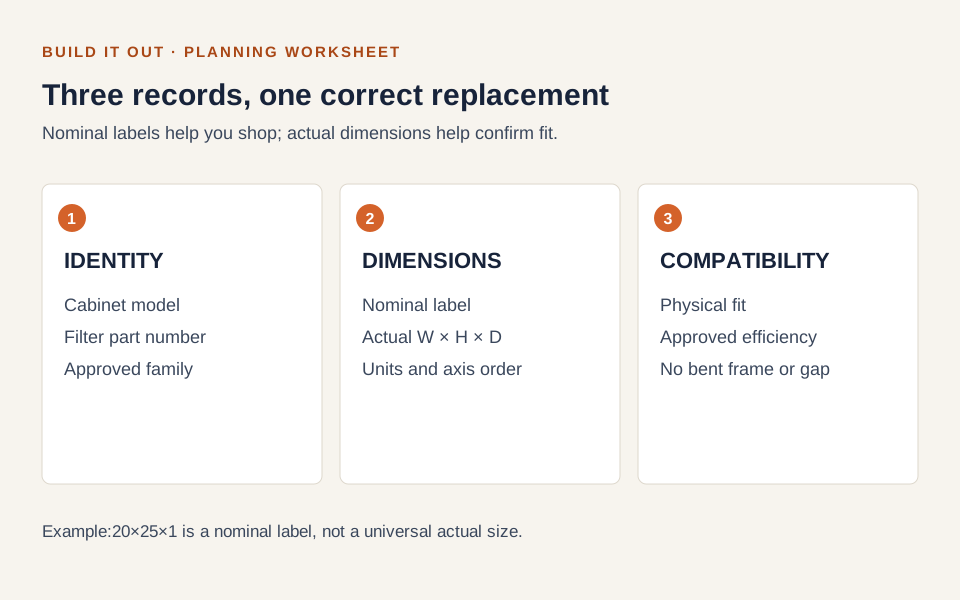
Use this original worksheet to prevent a nominal label from swallowing the details. Copy it into a phone note and attach photographs of readable labels.
- Identity: required manufacturer, filter model/part number, and cabinet model if applicable.
- Size: nominal label plus actual dimensions, with each dimension named and the units written down.
- Approval: compatible replacement family and efficiency specification from the equipment/cabinet instructions or installer.
Record the existing filter only if its fit and suitability are known to be correct. A previous owner may have fitted the wrong one. If the accessible label is missing, the cabinet is damaged, or the product binds, stop guessing and ask the installer or manufacturer to identify the correct replacement.
Trane’s sizing guidance treats the existing frame label as a useful starting point. It cannot establish that a previously installed filter was correct. Do not open equipment compartments, climb to inaccessible returns, or remove service panels to complete this shopping worksheet; have the service provider supply the information.
Why 4-inch and 5-inch names deserve extra attention
Deep filters can be specific to an air-cleaner cabinet. The cabinet’s outside dimensions are not the filter’s dimensions, and a nominal depth is not necessarily an exact depth. A brand-compatible label can also describe a reusable frame with a separate refill rather than a disposable cartridge.
Filtrete’s refillable-filter FAQ specifically asks buyers to check actual frame size. When a retailer’s chart and a manufacturer’s fit information disagree, request confirmation for the exact model rather than choosing the chart with the more convenient number.
Lennox’s accessory table distinguishes cabinet, standard filter and expandable-filter part numbers. That distinction is why a photo of a cabinet label can be more useful than simply telling a supplier “the furnace is a Lennox.”
Size and MERV are separate decisions
A filter can fit physically and still be unsuitable for the system. Conversely, the preferred efficiency does not make the wrong frame acceptable. Check both entries independently. Camfil’s technical sheet separates dimensional data from airflow and resistance information; those columns serve different purposes.
Carrier distinguishes several filter constructions and their maintenance needs. Do not substitute a washable product, thicker cartridge or higher-efficiency option merely because one dimension matches. Ask what the installed system and cabinet permit.
The final check is fit, not force
EPA advises a snug fit without bending or crushing the filter. A frame that must be deformed is a reason to recheck the specification; a loosely positioned filter with visible bypass space is not a successful size match. Do not improvise spacers, stack filters or alter the rack.
Before opening a multipack, compare its exact product identifier and published dimensions with the fit record. Keep the receipt and packaging until compatibility is resolved. If a nominally correct replacement does not fit as expected, send the supplier the old and new labels plus the cabinet identifier. That is a clearer question than asking for “a slightly smaller 20×25.”
Sources and methodology
Manufacturer documents and original technical guidance informed this article. Product examples describe the named model, not every system. Sources checked October 25, 2026. The worksheet is our editorial synthesis; it is not a professional inspection.
- Nordic Pure — Help Center: finding filter size
- Filterbuy — Air filter sizes
- Filtrete / 3M — Frequently asked questions
- AprilAire — A20251 replacement filter specifications
- Glasfloss Industries — Z-Line MR-13 product bulletin, p. 2
- Camfil — Farr 30/30 product sheet, p. 2
- Lennox — ML196DFE(K) product specifications, p. 9
- Trane — Furnace filter guide
- Carrier — All about AC filters
- US EPA — Guide to air cleaners in the home