
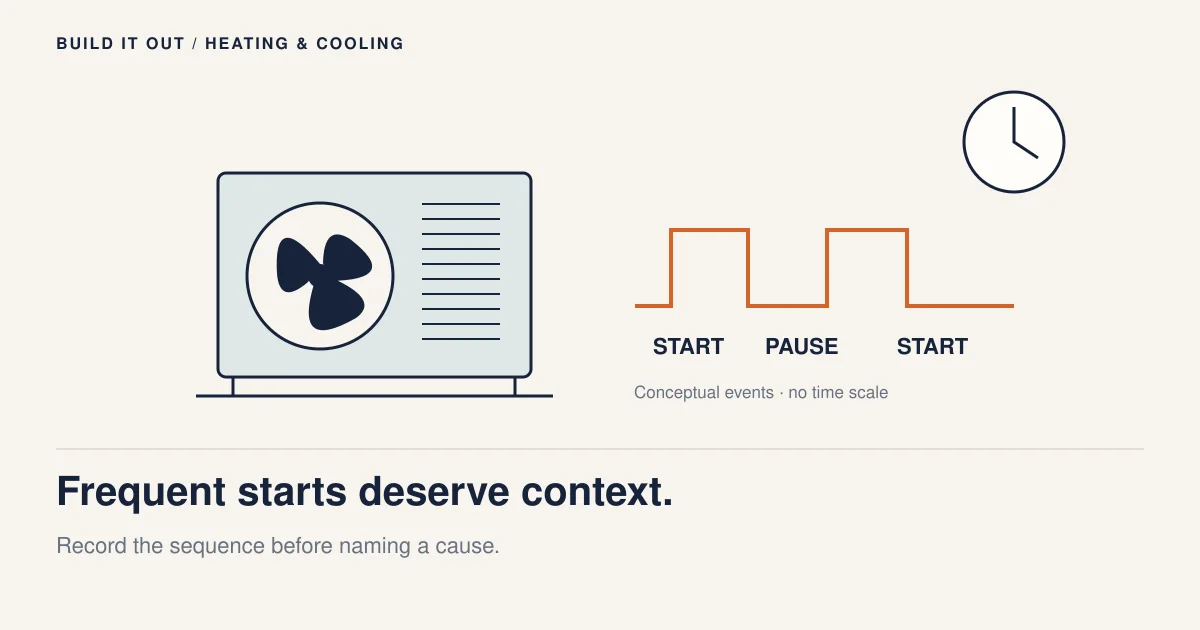
Repeated starts and stops after an AC replacement deserve an installation follow-up, but a cycle count alone cannot identify the cause. Record the thermostat message, approximate start/stop times, weather and comfort outcome. Ask the installer to verify the system’s operation against its equipment and control requirements before buying another component.
The new unit stops, starts again, and stops again. A search result declares that every cycle should last a fixed number of minutes; another says mild weather can produce short runs. The useful distinction is between normal load-dependent operation and an interrupted cooling cycle—not a universal stopwatch limit.
Why a single minute rule can mislead
Trane explicitly notes that a properly operating AC may run briefly in mild conditions or for long periods on hotter days. Carrier describes short cycling as premature shutdown followed by frequent restarting. These statements can coexist: the concern is the behavior in context, including whether the home is being conditioned as intended.
Do not use a generic 15-minute threshold to declare a new system defective. Equipment capacity, staging, controls and load affect operation. Nor should very frequent interrupted operation be dismissed simply because the weather is mild. Report it and let the installer interpret the pattern.
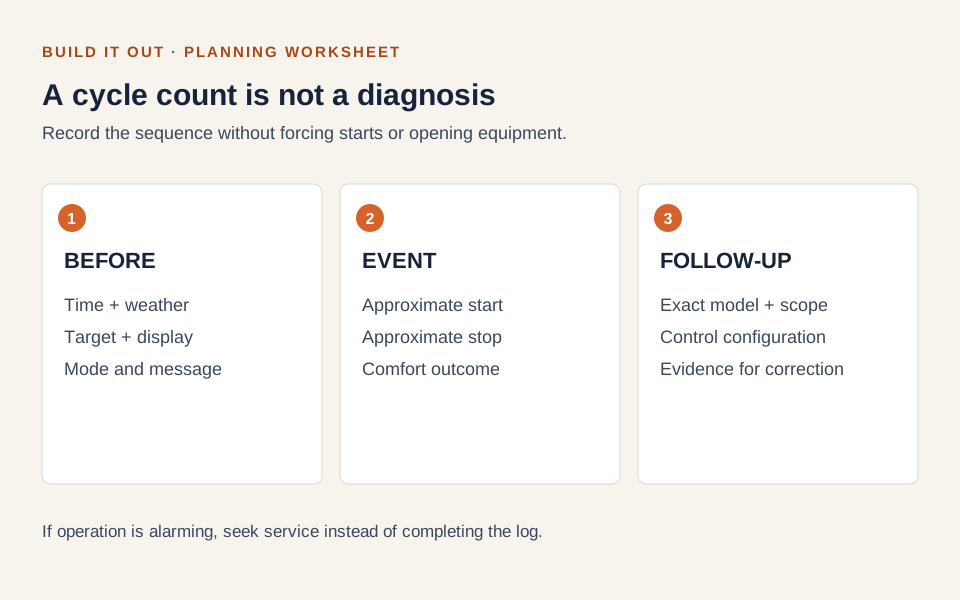
Our cooling-event log
During ordinary use, write down a short sequence of events from a safe location. You do not need to stay beside outdoor equipment or keep a struggling system running to collect data. If operation is alarming, contact service promptly instead of finishing the worksheet.
| Event | Record | Avoid assuming |
|---|---|---|
| Before the start | Time, thermostat target/display, mode, and outdoor conditions | That the displayed temperature equals every room |
| During operation | Displayed cooling call and approximate audible/visible activity | That indoor fan noise proves the compressor is running |
| At the stop | Approximate time, display message, whether target was reached | That a pause proves oversizing or a failed thermostat |
| At the next event | Next start time, any delay/code, and comfort change | That a protective delay is the same as a failed cooling cycle |
A phone photo of an accessible thermostat message can be more useful than a remembered paraphrase. Record the exact text and time. Keep the initial installation date and the date the pattern began in the same note.
Preserve the replacement history
Write down whether the replacement included the thermostat, indoor air handler, coil, controls or only the outdoor equipment. Include any later filter change or control-setting visit. This is context, not an instruction to reopen the installation.
Lennox identifies several possible explanations for repeated short cooling cycles. Since more than one condition can produce similar symptoms, it is better to tell the installer what changed than to label a component faulty before assessment.
Do not remove a thermostat cover, open an equipment panel, test a capacitor, add refrigerant or bypass a safety control. Those actions are outside a homeowner observation record and can create hazards or erase useful fault information.
The control system belongs in the conversation
Sensi explains that cycle-rate behavior varies with its control setting. Honeywell Home explains that its Lyric model suggests a cycle rate from system information. The relevant question is whether the installed control is configured and operating correctly for the actual equipment—not whether an internet setting can make the sound less noticeable.
Google’s Nest help-code documentation notes that systems can have built-in start delays. Record a delay message without repeatedly switching modes or changing the target to force a restart. A delay can be protective; persistent unexpected stopping still needs an appropriate service response.
Ask the installer to explain which part is cycling. A blower can continue after a compressor stops. Bosch’s modulating system example changes compressor capacity rather than operating only at one fixed output. That is why identifying the model and control arrangement comes before interpreting every change in sound as an off/on event.
When someone proposes another unit
Oversizing is one possible reason for undesirable cycling, but the observation alone does not prove it. Ask for the load calculation and equipment-selection basis, particularly if the house or insulation changed before replacement.
DOE’s HVAC renovation guide distinguishes load assessment from equipment selection. ACCA’s official Manual J overview distinguishes room and whole-building load analysis. Ask the contractor how the installed combination and its operating range relate to that assessment. A larger or smaller unit should not be proposed solely from a homeowner’s estimated count.
A useful follow-up request
Send the event log and ask for verification of normal starting, operation and shutdown for the installed combination. ENERGY STAR includes those cycle checks in its professional maintenance guidance. Also ask what would count as a successful correction under comparable weather and settings.
- Which events in the log are expected for this model and control?
- Which require inspection, and what evidence supports the proposed cause?
- Were airflow, control configuration and the installation’s commissioning records checked?
- What correction is proposed, and how will the result be documented?
Smoke, a burning smell, an electrical hazard or other immediate danger is a reason to move away and obtain urgent appropriate help, not to continue monitoring. For a non-emergency comfort complaint, the goal is still prompt, documented service—not a sequence of speculative purchases.
Sources and methodology
Manufacturer documents and original technical guidance informed this article. Product examples describe the named model, not every system. Sources checked October 25, 2026. The worksheet is our editorial synthesis; it is not a professional inspection.
- Trane — AC short cycling
- Carrier — What is AC short cycling?
- Lennox — Understanding air-conditioner short cycling
- Sensi / Copeland — System cycles too fast or slow
- Google Nest Help — Thermostat help codes
- ENERGY STAR — Energy-efficient heating and cooling guide, pp.6–7, 20
- US DOE / PNNL and ORNL — Energy renovations HVAC guide, pp.10, 34
- Honeywell Home / Resideo — Choosing cycles per hour
- Air Conditioning Contractors of America — Manual J residential load calculation overview
- Bosch Home Comfort — IDS Premium Connected R-454 B