
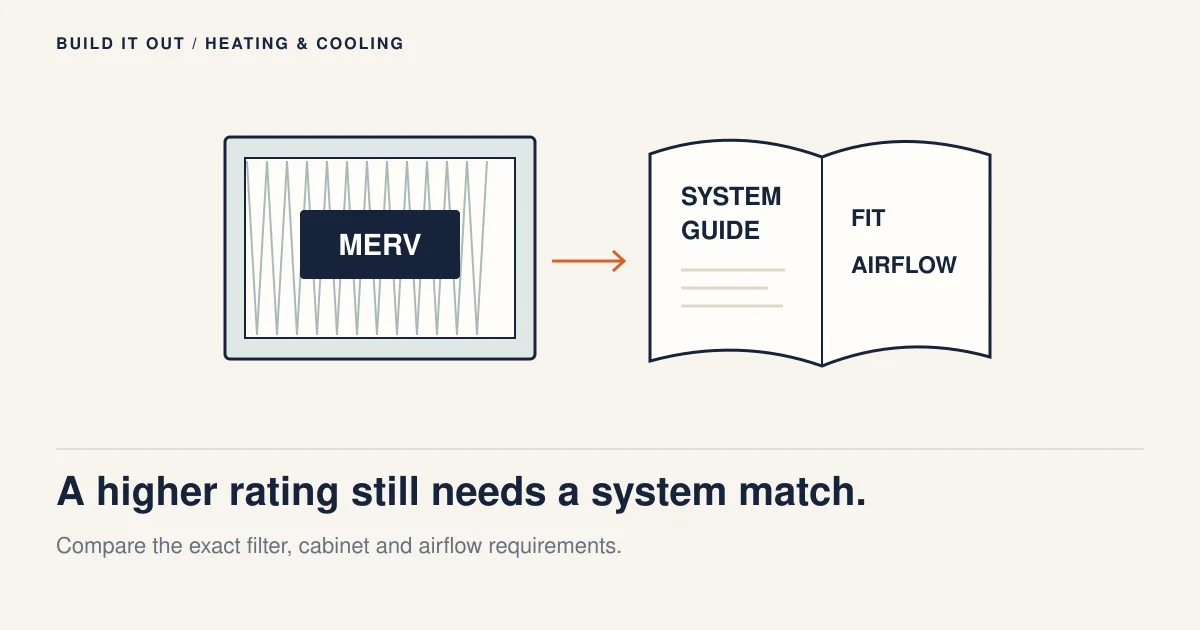
A higher MERV rating describes better particle capture under the rating test; it does not approve a filter for every HVAC system. Choose the highest suitable efficiency while preserving the airflow and fit the installed system requires. The missing purchase question is usually “At what airflow, in which filter and cabinet?”
A replacement filter seems like an easy upgrade: the numbers on the frame match, and the higher rating promises more capture. But the blower has to move air through that particular product as part of the complete system. The decision combines filtration efficiency, resistance, physical fit and the equipment’s operating requirements.
Keep the qualification in the recommendation
EPA recommends MERV 13, or the highest rating the system fan and filter slot can accommodate. The second part matters. It is neither a warning that MERV 13 is always harmful nor a guarantee that every MERV 13 product will work in every slot.
Trane likewise says some systems cannot accommodate a high-MERV filter. The appropriate response is compatibility verification, not choosing a universally “safe” number from a social-media chart. This article is a purchasing worksheet, not a health recommendation or a procedure for measuring a live system.
MERV and resistance answer different questions
MERV summarizes particle-removal performance in specified size ranges. Pressure drop describes resistance to airflow at a stated condition. They are related through filter design, but they are not interchangeable labels.
ASHRAE identifies airflow and filter efficiency as separate contributors to filtration effectiveness. A system assessment therefore has to consider both rather than assuming that the higher number settles the entire choice. Changes in filter construction and available media area are reasons to compare the actual product data.
Do not compare a resistance number quoted at one airflow with another quoted at a different airflow. A low-looking number without its test condition is incomplete information. Nordic Pure’s own resistance statement includes an airflow velocity; the condition is part of the claim, not optional fine print.
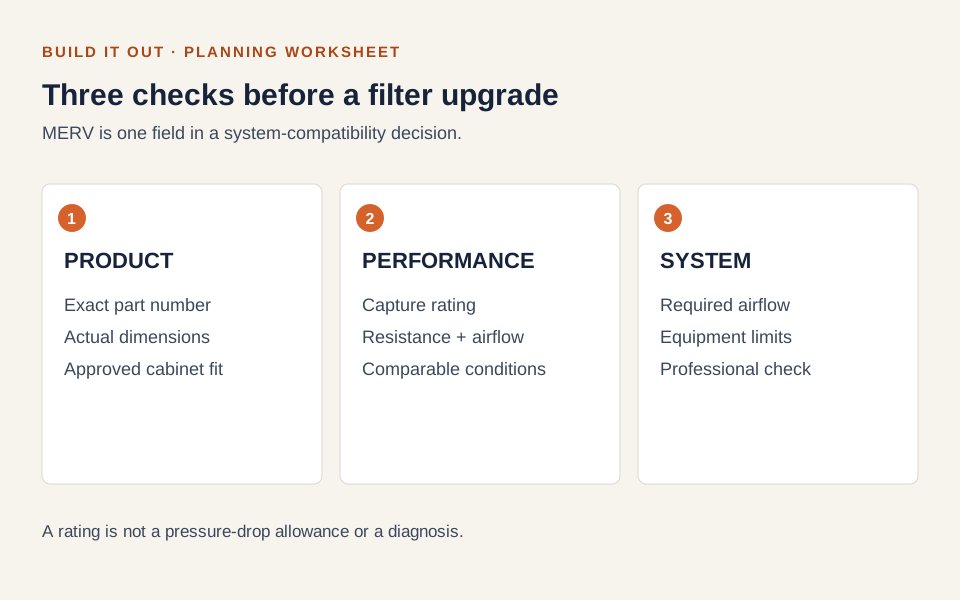
Our four-field filter comparison card
| Field | What must be recorded | What it prevents |
|---|---|---|
| Exact product | Brand, part number, actual dimensions, depth and cabinet fit | Comparing unlike frames or media |
| Capture rating | MERV; identify any separate proprietary scale | Treating MPR, FPR and MERV as the same number |
| Resistance condition | Published pressure drop, units and corresponding airflow | Comparing isolated values from different test conditions |
| System acceptance | Manufacturer requirements and professional confirmation for the installed system | Using a filter-data limit as an equipment approval |
This is an original procurement checklist, not a formula that converts MERV into an allowed pressure drop. A homeowner cannot determine the complete system’s available capacity simply from the rating on a filter carton.
What actual product data can—and cannot—show
Glasfloss’s MR-13 bulletin pairs initial resistance with rated velocity and filter depth. Camfil’s Farr 30/30 sheet also lists airflow, resistance and media dimensions. These are useful examples of the fields to request. They are not a head-to-head product ranking because the published conditions must first be matched.
A manufacturer’s recommended final filter resistance is also different from the maximum external static pressure permitted for a furnace or air handler. The first describes a filter condition; the second concerns equipment operation within its specified system conditions. Have the HVAC professional reconcile the applicable limits and establish a maintenance plan. Do not adopt a bulletin’s number as a universal replacement threshold.
Marketing comparisons need the same care. AprilAire qualifies its A20251 airflow comparison by test conditions. A statement about a particular MERV 11 product does not establish the resistance of every other product carrying MERV 11, or the improvement it will deliver in a particular house.
A deeper cabinet can change the options
A one-inch return-filter opening and a dedicated deep-media cabinet are different installations. Do not stack thin filters or push a thicker filter into a shallow track. If an upgrade calls for another cabinet, that is a system-design discussion for a qualified professional.
Carrier lists several compatible ratings for its EZXCAB family, while Lennox lists distinct MERV 11, 13 and 16 replacements within named accessory families. These examples show why the exact cabinet and product matter. They do not mean the same choices apply to every existing duct system.
Filtrete lists both MPR and MERV for specific refillable products. Use the maker’s mapping for the exact model rather than mentally converting proprietary scores into a universal scale. A larger proprietary number cannot resolve a fit or airflow problem.
What to ask before buying the upgrade
- Which filter model and actual dimensions are approved for the current cabinet?
- What airflow does the installed system need in its relevant operating modes?
- What candidate resistance data applies at that airflow, and how will system operation be verified?
- What replacement interval or condition should be used for this home and product?
If airflow becomes noticeably weaker, comfort changes or new noise starts after a filter change, record the product and timing and contact the service provider. Those observations do not prove the MERV rating caused the problem. Do not remove a required filter or adjust blower settings as an experiment.
Higher filtration can be a sensible upgrade when the system supports it. The useful shopping target is a compatible, maintainable filter—not the largest number that fits on a carton.
Sources and methodology
Manufacturer documents and original technical guidance informed this article. Product examples describe the named model, not every system. Sources checked October 25, 2026. The worksheet is our editorial synthesis; it is not a professional inspection.
- US EPA — Guide to air cleaners in the home
- ASHRAE — Filtration: airflow and system compatibility
- Trane — What is a MERV rating?
- Carrier — EZXCAB filter cabinet
- AprilAire — A20251 replacement filter specifications
- Glasfloss Industries — Z-Line MR-13 product bulletin, p. 2
- Camfil — Farr 30/30 product sheet, p. 2
- Filtrete / 3M — Frequently asked questions
- Nordic Pure — Help Center: finding filter size
- Lennox — ML196DFE(K) product specifications, p. 9