
A brief white plume from an outdoor heat pump during heating can be part of automatic defrost. White appearance alone does not establish that it is harmless. Confirm the operating context and your model’s guidance from a safe location. Suspected fire, burning odor or other danger takes priority over trying to identify a defrost cycle.
The outdoor fan pauses, a whooshing sound occurs, and a cloud rises beside the house. For a first-time heat-pump owner, this can look like a breakdown. The important detail is the sequence: what the system was doing before the plume, what the controller reports, and whether normal operation resumes as described for that equipment.
What defrost is trying to do
During heating, cold outdoor-coil surfaces can accumulate frost. The system periodically removes it. Lennox’s ML 14 XP 1 owner section describes steam during defrost and a return to normal operation afterward. That is a named-model example, not an all-model duration limit.
Trane also explains that brief defrost steam can be normal. The same guide distinguishes ice that does not melt as a reason for service. The useful distinction is not simply “steam good, ice bad”; it is whether the observed sequence matches the actual system’s normal operation.
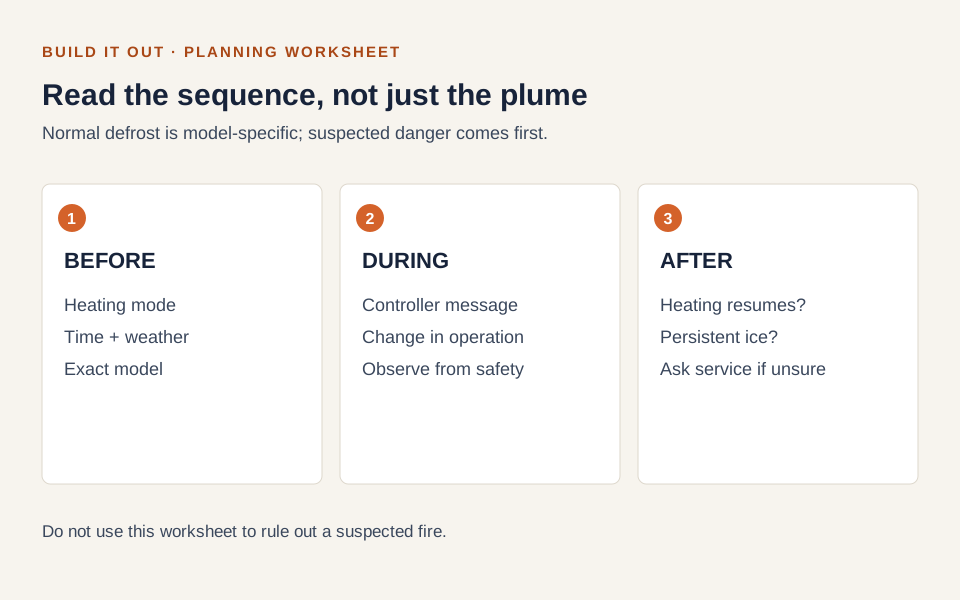
Our before-during-after observation card
| Stage | Useful record | Limit |
|---|---|---|
| Before | Heating mode, weather, approximate time, visible frost from a distance | Weather alone cannot confirm defrost |
| During | Exact controller message, brief plume, change in normal fan/noise | Color and sound are not safety tests |
| After | Whether normal heating resumes and persistent icing remains | No return to expected operation needs service advice |
Send this sequence with the model number and a safely obtained photo or short video to the service provider if you are unsure. Do not spend time filming a possible fire, and do not remain in an unsafe or icy area to complete a record.
Why a stopped fan or changed display is not the whole answer
Some models change indoor and outdoor fan behavior during defrost. LG’s support guidance describes stopped fans with the compressor still operating. Looking only at the outdoor fan can therefore misidentify the system state.
Samsung describes a defrost indicator and temporary interruption of indoor airflow for its covered products. Your controller may use another symbol or no obvious word. Compare the exact model documentation; do not assume every “dF” message, water-drop icon or pause means the same thing across brands.
Daikin’s FTQ operation manual also explains white mist after heating resumes following defrost. This is why the before-and-after context matters. A cloud near a running unit is not sufficient evidence to diagnose a refrigerant leak, an electrical fault or normal operation.
Why people call it steam
Manufacturer owner guides often call the visible plume steam. More generally, NOAA explains that a visible cloud consists of tiny condensed water or ice particles. That helps explain why moisture can become conspicuous in cold air. It does not make a household visual comparison a reliable way to rule out smoke.
Do not move close to sniff the plume, reach toward a fan, or touch a coil to decide. The observation card is for recording a non-alarming event from a safe place—not performing a smoke-versus-water experiment.
Use the model’s sequence, not a universal timer
Different equipment uses different controls, indicators and defrost strategies. A duration printed for one model or regional product family should not become an online rule for every heat pump. Record approximate timing and ask whether it is expected for your actual combination and conditions.
Bosch’s user manual separately lists post-defrost behavior and service-worthy symptoms. Its VRF examples illustrate the importance of product context; they are not timing specifications for a residential split system of another brand.
Actual performance assessment also involves more than watching a plume. NREL’s field study identified operating modes using measured temperatures and power. This article does not reproduce those tests or infer a household’s efficiency from a video.
When to contact the service provider
Ask for service advice if heating fails to return as expected, persistent ice builds up, an unfamiliar fault message appears, or the behavior differs materially from the owner instructions. Carrier directs persistent icing and unresolved operation problems to qualified technicians. Its guidance also warns against chipping ice from the coil.
Do not force defrost, open a control compartment, pour hot water on the unit, change installer settings or repeatedly reset the equipment to see what happens. Give the provider the record and follow the manufacturer’s owner-level operating instructions.
When to treat it as an emergency
If there is suspected fire, flame, a burning smell or another immediate hazard, move to safety and call emergency services as appropriate. Do not let a general article’s description of normal defrost override what is happening at the property.
US Fire Administration guidance prioritizes getting out and staying out during a fire. A normal defrost explanation is useful only after the situation is reasonably understood; it is not permission to ignore an alarm or investigate dangerous equipment.
For a routine first-winter orientation, ask the installer to show the owner manual’s normal defrost description and explain the controller’s relevant messages. That short handover can make a future harmless plume less confusing while preserving a clear service and emergency boundary.
Sources and methodology
Manufacturer documents and original technical guidance informed this article. Product examples describe the named model, not every system. Sources checked October 25, 2026. The worksheet is our editorial synthesis; it is not a professional inspection.
- Lennox — ML 14 XP 1 owner information, p. 14
- Daikin — FTQ 18–48 TAVJU operation manual, p. 11
- Trane — Homeowner heat-pump repair guide
- Samsung — Heating-mode automatic defrost guidance
- LG USA — Heating stops and defrost/preheating icon appears
- Bosch Home Comfort — Climate 5000 VRF user manual, p. 7
- Carrier — Heat-pump troubleshooting guide
- NREL / US DOE Heat Pump Database — Cold-climate heat-pump field validation
- NOAA — Jetstream: clouds
- US Fire Administration — Home fire escape plans