
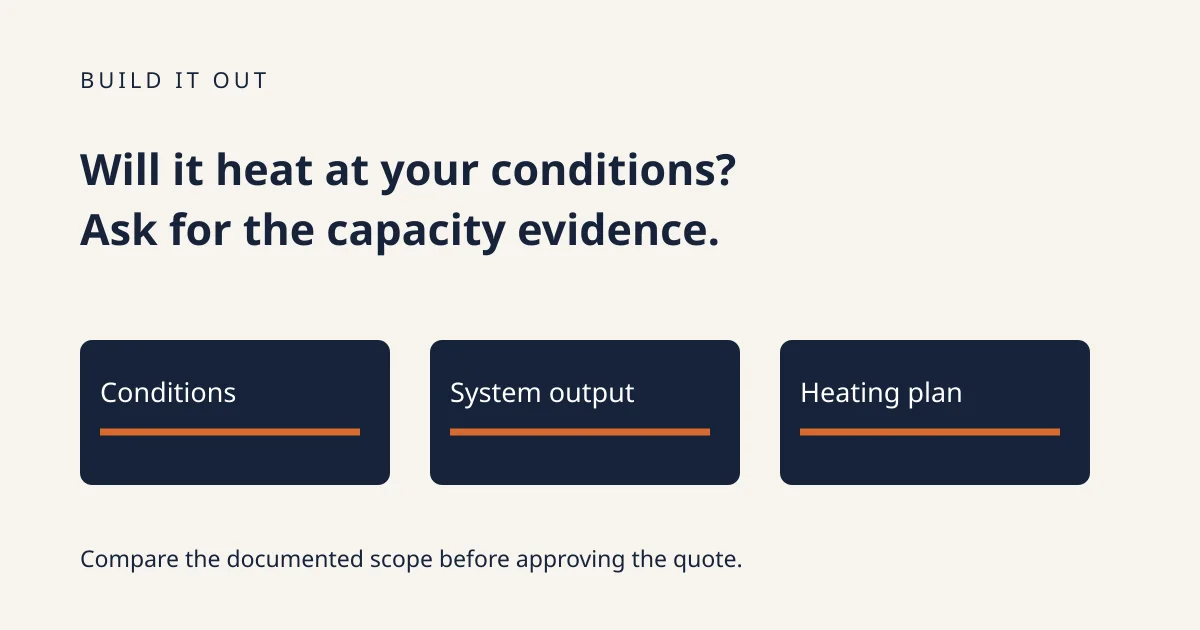
Ask for heating output at the project’s winter design conditions, not just the nominal equipment size. The quote should connect the exact indoor/outdoor combination, its documented capacity, the calculated load of the space served and the plan for any supplemental heat. An operating-temperature limit is not the same as available heat output.
A proposal calls the system a “three-ton cold-climate heat pump.” Another promises operation below freezing. Those descriptions may be accurate, but neither tells you how much heat the proposed system supplies at the temperature used to design heating for this home. That is the comparison to request before approving a substitution or paying for a larger model.
Separate three different equipment claims
| Statement | What it tells you | What to request next |
|---|---|---|
| Nominal capacity or model size | An equipment designation | Heating output for the actual system at the project’s conditions |
| Operates down to a stated temperature | A stated operating limit | Available heating output there, with the applicable conditions |
| Retains a percentage of rated capacity | A comparison to a defined reference rating | The reference, absolute output and exact combination represented |
Mitsubishi’s MXZ-D-NLHZ family page, for example, describes both low-temperature operation and rated-capacity retention. Those are different statements. They do not supply the completed selection for an unspecified combination on a homeowner’s quote. ENERGY STAR’s product criteria also use defined test temperatures and separate capacity retention from efficiency. A qualification label is useful evidence about a product; it is not a load calculation for the house.
Put load and capacity beside the same conditions
Efficiency Maine’s training module, sizing section explains why maximum heating capacity at design temperature matters, rather than relying on the rated-capacity name. It also distinguishes the load of the heated zone from the whole house. Ask which rooms or zones the proposal covers, especially if it adds one ductless head to a home that keeps another heating system.
The DOE training module calls for determining both heating and cooling loads. ACCA’s public ManualS overview then describes equipment selection using those loads, manufacturer performance information and design conditions. Request a copy or clearly explained summary of the professional’s calculations. A rule based only on floor area does not give you the same record.
Use a condition-matching record
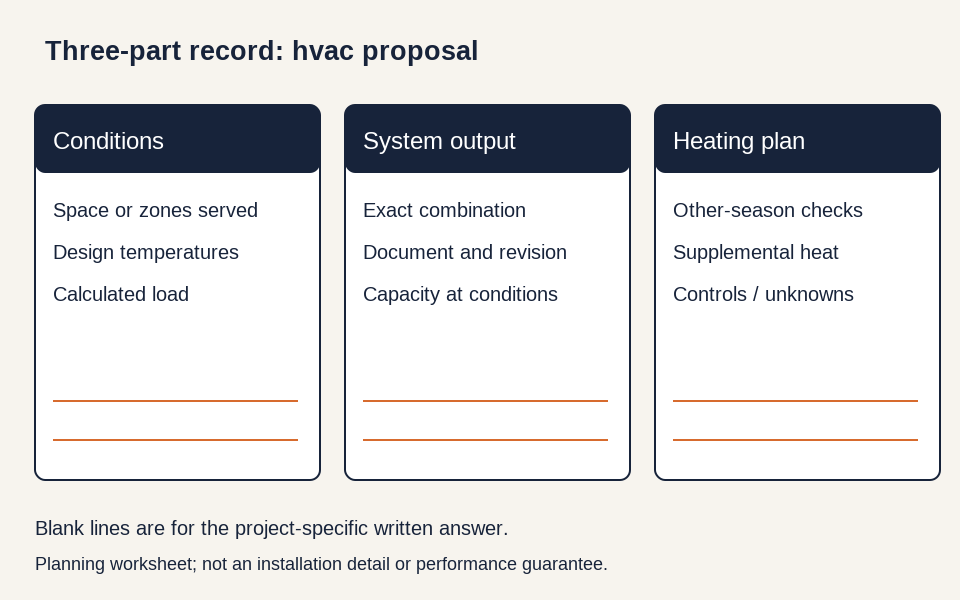
- Service scope: rooms or zones heated and cooled, and which existing equipment stays.
- Design basis: selected indoor/outdoor design conditions and who selected them.
- Load: calculated heating and cooling requirements for that scope, with units and report date.
- Equipment: exact outdoor unit, indoor units, air handler and relevant configuration.
- Capacity evidence: manufacturer document or tool output, revision, temperature, operating conditions and available heating output.
- Other-season behavior: minimum output, cooling and humidity considerations addressed by the designer.
- Heating plan: supplemental equipment, controls, responsibility and unresolved conditions.
NEEP’s February 2024 user guide is explicit that its tool is preliminary. Final assessment must consider manufacturer information and factors such as line length and multiple indoor units. Save the source used for the final combination rather than copying a database result for a similar-looking model.
A larger nominal size does not close every gap
NYSERDA’s sizing fact sheet distinguishes maximum and minimum capacity and describes cycling when load falls below minimum output. Ask how the proposed selection also behaves in milder weather. This is a question for the designer, not a reason to increase or reduce equipment size from a brochure alone.
The Center for Energy and Environment’s Minnesota guidance explains different ways secondary heating can work with ducted or ductless equipment. Its regional examples are not a rule that every US home needs the same backup. Ask whether the project intends full heating coverage, partial coverage or a coordinated system, and how the controls deliver that plan.
Compare before changing the order
Suppose Quote A lists only nominal size while Quote B includes a condition-specific capacity document and a heating-load report. Quote A is missing comparison information; this alone does not prove its equipment is wrong. Request the missing fields, then have the professional explain any remaining difference.
Mass Save recommends retaining the home’s heat gain/loss calculations. The homeowner sizing question on Houzz shows why an equipment label and house area leave people uncertain; its replies are not an assessment of another home. Our room-comfort observation guide addresses a separate issue: recording an existing comfort problem before buying more equipment.
Sources
These references inform the comparison and planning questions. Product-specific documents do not approve a different product or a particular home.
- Cold Climate Heat Pump Sizing Support Tools user guide
- What is the best air source heat pump system to choose?
- Cold Climate Heat Pump Sizing training module
- Heat Pump Equipment Key Product Criteria
- Annual Heat Pump Basics Module, sizing section
- Air Source Heat Pumps: avoiding oversizing fact sheet
- Heating and Cooling Tips: proper sizing
- ManualS Residential Equipment Selection — official public overview
- MXZ-D-NLHZ residential outdoor model
- How do I know if my house HVAC is sized correctly? — homeowner discussion; question evidence only.