
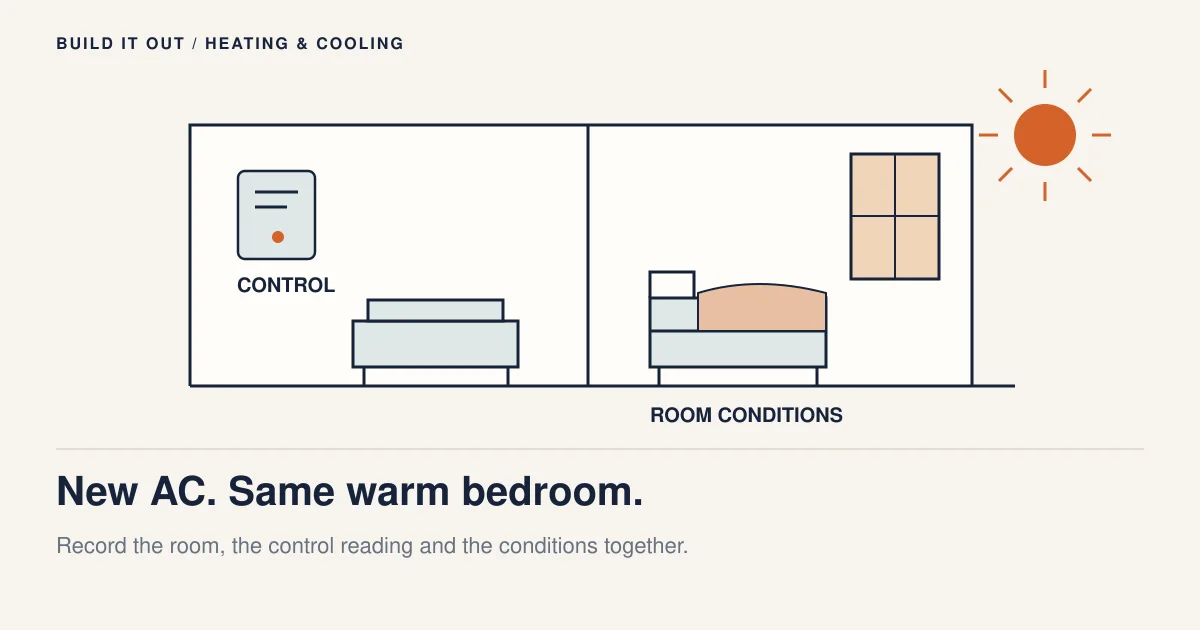
A new AC can cool the house while the same bedroom stays warm because cooling equipment and room-by-room air delivery are different parts of the problem. Before accepting another equipment purchase, document when the room diverges, what the thermostat is doing and the conditions in that room. Ask the installer to evaluate the complaint as a room-specific performance issue.
The old unit struggled with the back bedroom. The replacement is quieter and the living room feels better, but bedtime still feels the same. That pattern deserves a follow-up; it does not, by itself, prove the new AC is too small, too large or defective.
Carrier treats design, sealing, insulation and airflow as separate aspects of duct performance. Replacing a condenser does not establish that those other aspects were evaluated or changed. Find out what the installation scope actually included.
Start by separating a room complaint from a house complaint
Is only one room uncomfortable, several rooms on one side, the whole upper floor, or the whole home? Does the thermostat reach its target while the bedroom remains warm? Record the pattern without changing several settings at once. A room complaint and an entire-home capacity complaint lead to different questions.
Mitsubishi Electric’s contractor guidance emphasizes the timing and location of comfort complaints. A symptom is useful evidence for discovery, not a shortcut to a diagnosis. Report “the west bedroom is warmer in late afternoon” rather than “the new AC needs more refrigerant.”
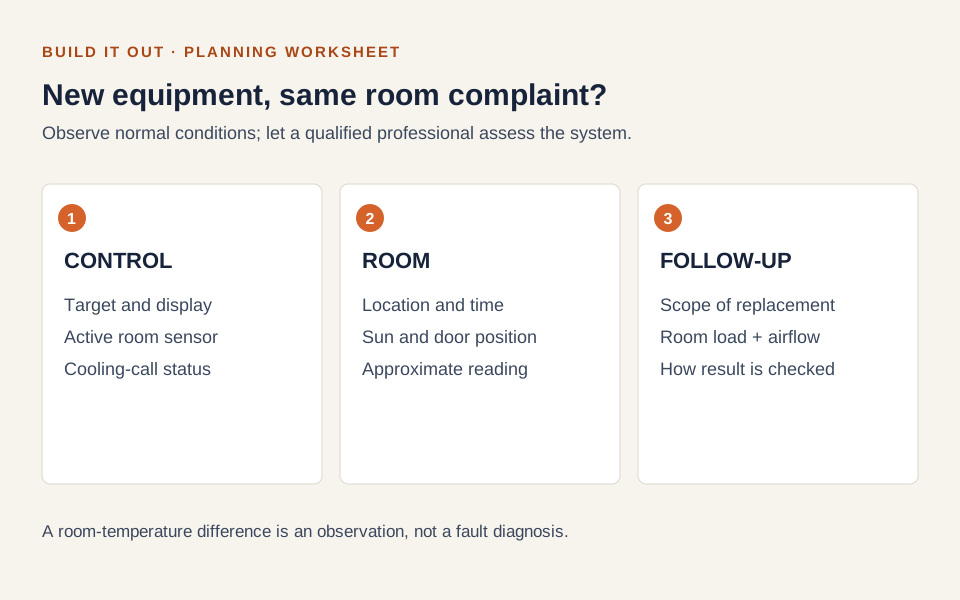
Use our same-time comfort log
Complete the following record during normal use on a day when the problem occurs. Do not create an uncomfortable or unsafe situation merely to complete a comparison. If a portable thermometer is already available, use a consistent sheltered position away from direct sun and supply-air jets; ordinary consumer readings remain approximate.
| Record at the same time | What to write | Why it helps the service visit |
|---|---|---|
| Control | Time, thermostat target/display, active room sensor if any | Distinguishes the control reading from bedroom conditions |
| Room | Bedroom reading or description; another room for context | Shows location and extent of the difference |
| Conditions | Sun on windows, shades, normal door position, occupancy | Preserves relevant context |
| Operation | Displayed cooling call, visible airflow obstructions, unusual sound | Gives the technician a reproducible starting point |
Repeat at another naturally occurring time, such as morning and late afternoon. A useful log records what stayed the same as well as what changed. Label a missing reading “not measured”; do not substitute the thermostat setting for a bedroom measurement.
When the pattern follows the sun
Note which windows receive direct sun, whether normal shades are open, and whether the complaint is concentrated on the upper floor or an addition. DOE’s guidance separates summer solar gains and unobstructed vents from equipment efficiency. These are reasons to describe the room and building, not proof that a window or insulation upgrade is required.
Trane discusses attic conditions and solar exposure in upstairs comfort complaints. The homeowner’s role here is observation from occupied rooms. Do not enter a hot attic, open insulation assemblies or climb into a crawlspace to search for a cause.
Before buying another unit, ask whether the original assessment considered the bedroom’s windows, exposure, insulation and use. An overall floor-area estimate cannot explain every difference between two rooms.
When the complaint follows the door
Record whether the door is normally open or shut when the room feels warm. Building Science Corporation explains why bedrooms supplied with air can need a suitable return path to a hall return. A door position can therefore be useful context.
This does not turn an open-door observation into an airflow measurement. It also does not mean the solution is trimming the door. Return paths, acoustic separation, fire requirements and the installed system need professional consideration. Ask for an assessment; do not cut grilles, adjust hidden dampers or block other rooms’ registers to force more air into the bedroom.
A new sensor is not automatically a new zone
Changing which room the thermostat listens to can change when the entire system runs. It does not necessarily change where the conditioned air goes. Google explains this distinction for its temperature sensors and single-zone systems. Other rooms can become colder while the bedroom is prioritized.
Lennox explicitly states that its Smart Room Sensor is not a zoning product. By contrast, GENERAL describes individual room control as part of a designed multi-room system. These are different arrangements, not interchangeable accessories. Do not purchase sensors or smart vents on the assumption that they can repair an unverified distribution problem.
Five questions for the installation follow-up
- What equipment, controls and ductwork were actually included in the replacement?
- Was the bedroom assessed separately from the total house load?
- What supply airflow and return-path evaluation is appropriate with the door in its normal position?
- Could duct leakage, insulation or room exposure explain the recorded pattern?
- How will the proposed correction be checked under comparable conditions?
ACCA distinguishes room-load analysis from whole-building block loads. ENERGY STAR identifies duct performance as relevant to hot and cold rooms. Neither source diagnoses this bedroom; together they support asking for a complete explanation rather than a second unexamined equipment choice.
Send the log, installation paperwork and exact room location before the appointment. The goal is a documented plan for the persistent complaint, with an agreed way to check the result.
Sources and methodology
Manufacturer documents and original technical guidance informed this article. Product examples describe the named model, not every system. Sources checked October 25, 2026. The worksheet is our editorial synthesis; it is not a professional inspection.
- US Department of Energy — Guide to home heating and cooling, p. 2
- ENERGY STAR — Benefits of duct sealing
- Carrier — Understanding HVAC ductwork
- Trane — House hot upstairs and cold downstairs
- Building Science Corporation — Info-804: undercutting doors
- Air Conditioning Contractors of America — Manual J residential load calculation overview
- Lennox — Are Smart Room Sensors the same as zoning?
- Mitsubishi Electric HVAC US — Common summer comfort complaints
- GENERAL / Fujitsu — Individual control: multi-room zoning
- Google Nest Help — Learn about the Nest Temperature Sensor