
Some window tracks are designed to collect incidental rainwater and drain it outdoors. Water reaching the finished indoor sill, wall or floor is a different observation. A blocked weep path can contribute to trouble, but an open exterior hole cannot prove the entire window and surrounding wall are watertight.
Start by recording where the water first appears, when it appears and what happens after the rain. Those details help the manufacturer or installer investigate the right part of the assembly. They are more useful than immediately sealing every visible gap.
A track can be part of the drainage system
Weep openings let collected water leave parts of a window frame. Pacific Northwest National Laboratory’s window-weep guidance explains that blocked openings can trap water and shows that the path can include interior and exterior frame openings. “Interior” here can mean within the frame—not a promise that water on the room’s finished sill is acceptable.
FGIA’s homeowner guidance describes temporary accumulation in drainage tracks during wind-driven rain and notes that drainage may occur as wind pressure subsides. Andersen’s product-care document likewise notes that sill water may not drain immediately during heavy rain and distinguishes continued pooling as something to check. Neither source supplies a universal number of minutes after which every product must be dry.
That distinction matters: a photograph of a wet channel does not establish a failure, and the phrase “tracks can get wet” does not explain away water damaging an interior wall. Identify the intended channel for your exact window before deciding what the observation means.
Not every window has the same visible holes
Gerkin’s maintenance guidance contrasts designs with weeps against particular sloped-sill products without them. Kolbe’s Ultra sliding-window description identifies a hidden weep system. A missing obvious slot can therefore be a product-identification question rather than a reason to create a new hole.
JELD-WEN’s vinyl-window care manual describes inner and outer routes, including components that can cover parts of the path. Covers or baffles may have a purpose. Ask for the relevant care diagram instead of assuming every small opening should be bare or every plastic flap should be removed.
Drainage is also different from initial water exclusion. Sun Windows’ explanation of its water-management system separates weather sealing from an internal route that carries moisture outside. The details are specific to that construction, but the distinction is useful: inspecting one visible outlet does not inspect every seal and joint.
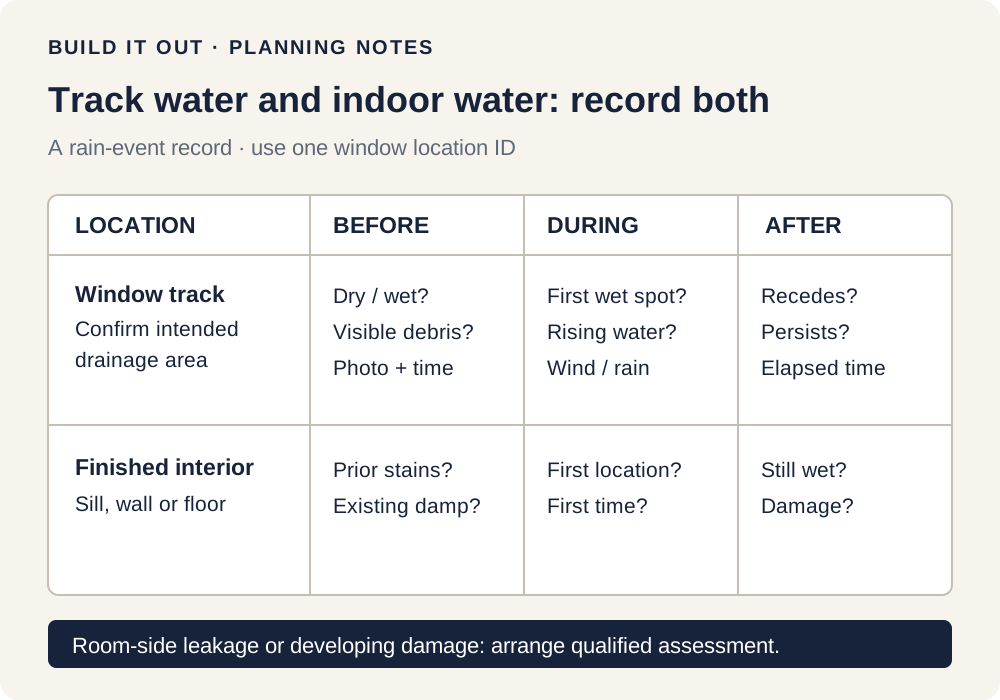
Use location and timing to organize the evidence
Give the affected window a location ID. Photograph the whole window and the first wet area from a safely accessible position. Note whether it was closed and locked normally when the event began. Keep observations separate from theories such as “the weep is clogged.”
| When | Window frame or designated track | Finished indoor sill, wall or floor |
|---|---|---|
| Before rain | Dry/wet condition; visible debris; product ID; photograph | Existing stain, swelling, peeling or previous dampness; photograph |
| During rain | First wet location; rising or draining water; wind and rain direction | First wet location and time; whether water runs down glass, from a joint or from above |
| After rain | Whether water recedes, persists or returns; elapsed time recorded without a pass/fail cutoff | Whether surfaces remain wet or damage develops; service contact and response |
Add recent work: exterior painting, caulking, new siding, window installation or construction dust. Photograph visible obstructions from a safe position, but leave concealed components and inaccessible exterior areas for service personnel. A second unaffected window can provide a useful comparison only if the product and exposure are recorded too.
If rainwater reaches the room or visible damage is developing, arrange a qualified assessment promptly. The worksheet helps explain the event; it is not a reason to wait through repeated leakage. Describe persistent dampness or staining even when there is no water in the track at the appointment.
Why “the holes are clear” may not finish the investigation
Northern Architectural Systems’ care guidance lists drainage, weatherstripping, hardware and caulk condition as separate observations. The surrounding installation matters as well. Weather Shield’s use-and-care guide discusses moisture management as a whole-building matter involving wall details, flashing and workmanship. That older guide supports the general principle, not a current repair specification for your window.
Ask the service provider: “Is this the intended drainage channel? Is the complete route functioning? Where is water crossing toward the room? Does the window itself or the surrounding installation need further investigation?” A clear answer should name the observed route and the proposed next step rather than assigning every leak to the same cause.
Milgard’s drainage-test document describes a controlled, product-specific procedure involving particular components. It illustrates why a service test has conditions and limits. Spraying a window or wall indiscriminately is not an equivalent diagnosis and can create a misleading result.
Keep the drainage design intact while arranging service
Use the exact product’s current maintenance instructions for routine accessible cleaning. Do not caulk or tape designated drains, drill a new outlet, remove baffles, probe an unseen route with rigid tools or use a pressure washer as a test. An apparently untidy gap may be functional, while an unrelated perimeter joint may require a different assessment.
The useful distinction is not “water means failure” versus “water is normal.” It is water in a product’s intended drainage area versus water reaching places the home needs to keep dry, documented over time. That gives the installer a defensible starting point without turning a quick observation into an unsupported diagnosis.
Sources and method
We inspected these ten independent manufacturer, technical or service resources on October 25, 2026. Product examples explain why requirements differ; use the current US instructions for the exact product being supplied. Worksheets and illustrative calculations are Build It Out editorial tools, not field tests or professional certification.
- Andersen Windows: Important Product, Care and Maintenance Information
- Milgard: How to Test the Weep System on Windows and Doors
- JELD-WEN: Care and Maintenance: Vinyl Windows and Patio Doors
- Kolbe: Ultra Series Quad Sliding Windows
- Sun Windows: Water Management / Weep System
- Gerkin Windows and Doors: Product Care / Maintenance
- Northern Architectural Systems: Care and Maintenance
- Pacific Northwest National Laboratory: Clean Window Weep Holes
- Fenestration and Glazing Industry Alliance: Caring for Your Windows, Doors and Skylights
- Weather Shield: Windows and Doors: Use and Care Guide