
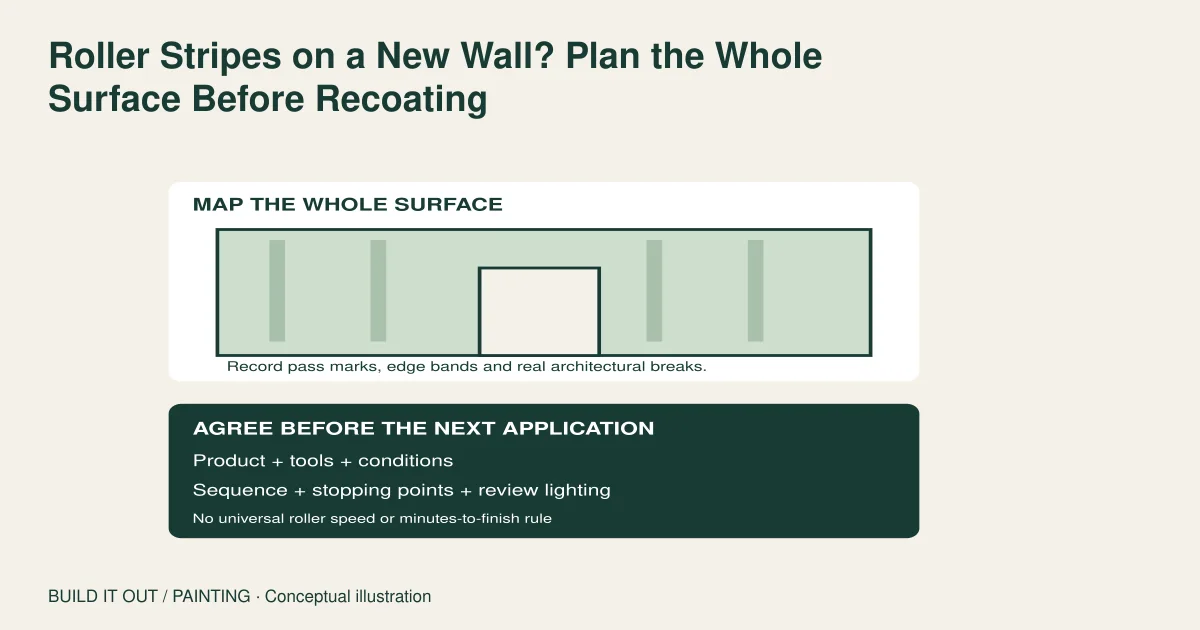
Broad roller stripes can be an application or surface issue, even when the whole wall uses one color. Before adding another coat, record whether the marks follow roller overlaps, cut-in edges or underlying wall joints. Ask the painter to assess the exact product, tools, preparation and drying conditions. Then plan the whole wall’s next application around manageable work and appropriate stopping points.
The wall looked even while wet. In daylight, vertical bands now look darker or shinier. The tempting response is to roll over each stripe. That can introduce fresh boundaries without settling the cause. Benjamin Moore describes lap marks as darker or glossier areas where wet and dry layers overlap. Other marks can resemble them, so the pattern matters before a remedy is chosen.
Identify the pattern, not just the word “patchy”
| Pattern | Question to investigate | Record |
|---|---|---|
| Bands following roller passes | Could overlap timing, coverage or application contribute? | Width, direction and where work stopped |
| Different appearance around edges | Did cut-in and rolled areas develop differently? | Ceiling/trim border and painting sequence |
| Ridges or repeated surface texture | Is the roller/tool or flow behavior relevant? | Sleeve type, texture and exact product |
| Lines following wall joints | Could substrate variation and lighting be involved? | Whole-wall photograph and normal viewing position |
The table is an observation aid, not an inspection standard. More than one condition can exist. A whole wall with repeated pass marks is also a different reader problem from a small touch-up patch made months later.
Not every visible stripe is a lap mark
Dunn-Edwards distinguishes poor flow and leveling, including brush or roller marks that remain as paint dries. The selected cover and conditions can matter. A photograph of light reflecting from a wall does not reveal the coating’s thickness, substrate or application history.
USG’s specialist finished-appearance paper, pages 1–3, explains how strong light can accentuate surface variations and uneven panel joints. We use those physical observations here, not its older referenced standards as a current legal acceptance rule. Ask whether the finish, the wall underneath or both need assessment.
The “wet edge” is a planning issue, not a fixed timer
Sherwin-Williams recommends manageable areas and natural breaks such as a corner, door or window when planning interruptions. The aim is continuity of application under the product’s instructions—not completing any wall within one internet-prescribed number of minutes.
Crown’s lap-mark guidance identifies warm conditions, direct sunlight and porous surfaces as potential contributors. Use foreign manufacturer examples for those general principles, while following the actual US paint’s application range. A large sunny wall may need different scheduling and crew coordination from a shaded small wall using the same coating.
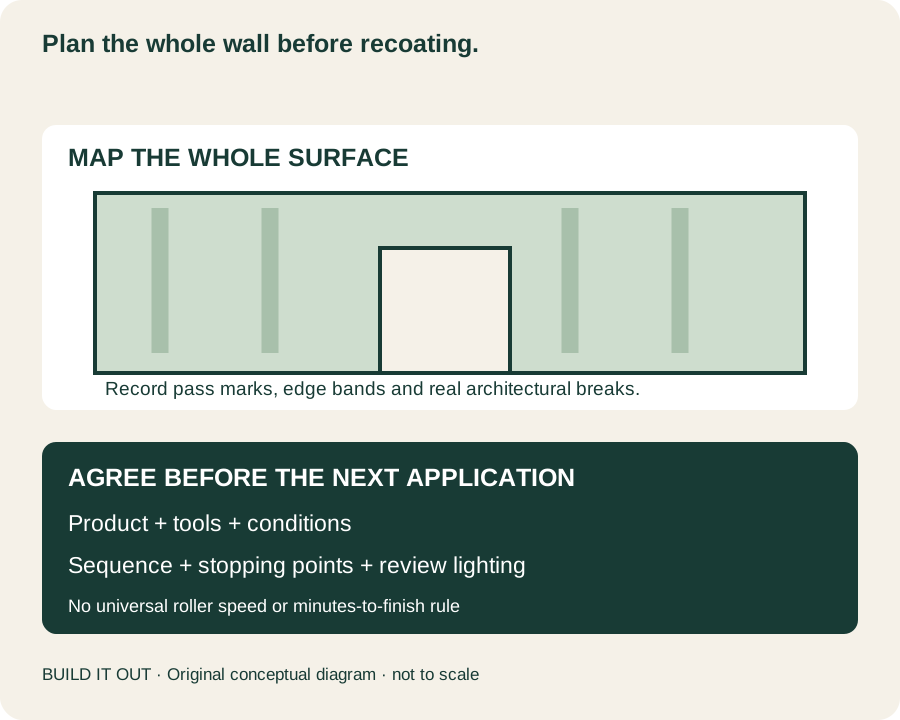
Our whole-wall interruption map
Before the next coat, make a simple sketch and agree the following with the painter:
- Boundary: identify the complete wall surface being assessed, including recesses, high sections and openings.
- Work sequence: record who handles edges and the main field, and how they will coordinate the product’s requirements.
- Supplies: identify the exact coating, approved roller cover and sufficient product before work begins.
- Conditions: note when direct sunlight reaches the wall and any unusually warm, dry or humid conditions to discuss.
- Breaks: agree appropriate stopping points rather than leaving an arbitrary half-finished band.
- Review: inspect after the product’s stated development period under representative room lighting, using the agreed scope.
This original planning record does not prescribe a roller pattern, crew speed or coat thickness. It makes those decisions traceable to the product and project rather than improvised after stripes appear.
Record the tools and product before adding anything
Purdy’s tool guidance emphasizes appropriate roller loading and avoiding a dry cover. That gives the painter another variable to check. A description such as “the expensive roller” is less useful than the actual sleeve specification.
Do not automatically add water or an extender to slow the paint down. Behr’s MARQUEE Interior Eggshell sheet, page 1, for example, says not to thin for brush or roller application. Another coating may have different instructions. A generic additive recipe is not an appropriate substitute for the chosen product’s technical advice.
What about a different band around the wall edges?
Farrow & Ball’s US Modern Emulsion sheet, page 7, discusses picture-framing/hatbanding and maintaining continuity at meeting edges, particularly with darker shades. Include the cut-in border in the whole-wall assessment instead of treating every border as a separate color error.
A useful real-world support question appears in Resene’s June 2025 interior Q&A: a reader reports streaking after two coats. Its answer asks about several application variables and lighting rather than assuming that a third coat alone is the answer. We adopt that inquiry approach, not a product-specific repair from another market.
Set the review conditions before more work
Photograph the complete wall and close details; retain product labels, coat dates and the sequence already attempted. Agree with the painter what work is proposed and what outcome is being assessed in ordinary room use. Do not switch between harsh inspection lighting and unrelated phone exposures without recording the change.
This guide does not cover sanding, stripping or hazardous preparation. Before disturbing coatings in a pre-1978 US home, follow EPA’s lead-safe contractor guidance. The immediate useful step is a clear pattern record and a product-specific plan for the whole surface, not another series of unplanned spot coats.
Sources and method
Prepared by Build It Out from the primary and specialist resources below; checked October 25, 2026. The decision aid and artwork are editorial synthesis, not a field test or professional inspection. Product examples retain their own scope; follow the current instructions for the exact US product being used.
- Sherwin-Williams: Lapping
- Benjamin Moore: How to Prevent Paint Lap Marks
- Dunn-Edwards: Poor Flow & Leveling
- Crown Decorating Centres: Lap Marks
- Resene: Interior Paint Experts Q&A: streaking after two coats
- Farrow & Ball: Modern Emulsion US product advice sheet
- Purdy: Painting Tips and Techniques
- USG: Wallboard Finished Appearance: Managing Expectations and Best Practices
- Behr: MARQUEE Interior Eggshell Enamel technical data sheet
- US EPA: Lead-Safe Renovations for DIYers