
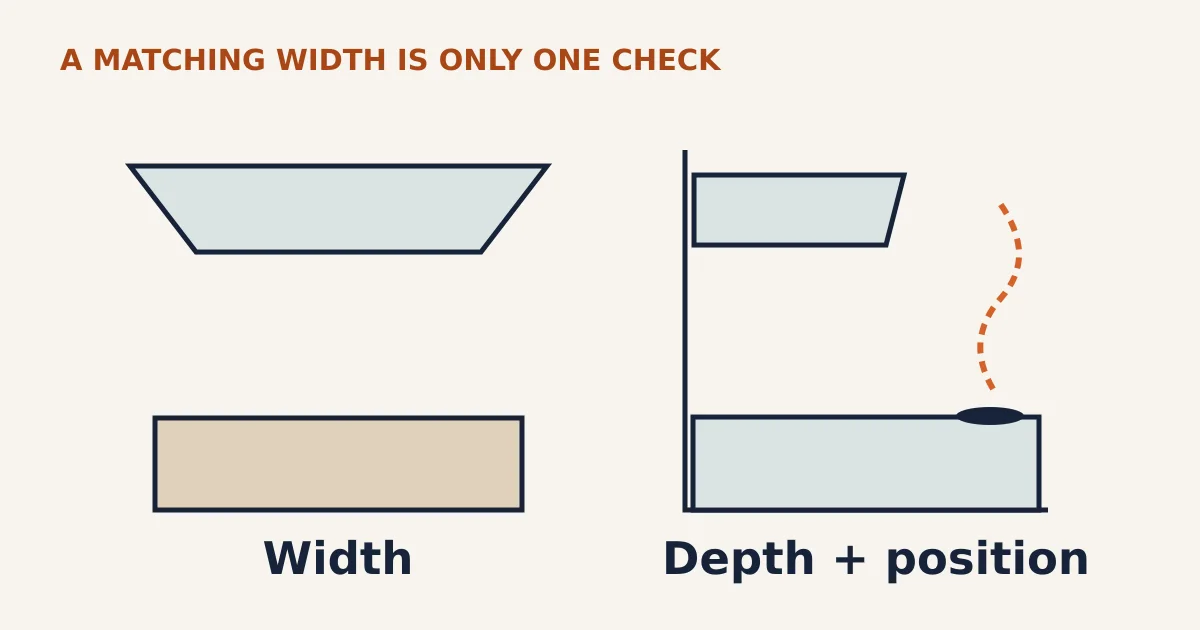
A hood can match the range’s width and still miss cooking fumes. Its depth, position above the burners, operating airflow and kitchen layout also matter. Use the cooking appliance and hood manuals together; a room-size formula or a large advertised CFM number cannot settle the selection alone.
The hood fits beautifully between the cabinets, but steam drifts around its front edge. Replacing it with a more powerful unit might help—or might leave the underlying coverage problem untouched. The useful question is whether the proposed system can catch the cooking plume where it is produced.
Lawrence Berkeley National Laboratory describes capture efficiency as the fraction of cooking contaminants exhausted directly outdoors by the hood. That is a different question from how much air a fan is rated to move. This guide concerns the questions to resolve before purchasing; it does not provide duct, electrical, combustion or make-up-air design instructions.
Put four checks on the selection drawing
| Check | Question for the supplier or designer |
|---|---|
| Footprint | How does the active hood coverage compare with the cooking surface in width and depth? |
| Approved height | Is the proposed position permitted by both the cooking appliance and hood instructions? |
| Operating performance | What airflow, sound and capture information applies at the speed likely to be used? |
| Whole system | Does the approved exhaust arrangement, duct route and required replacement air support that selection? |
Broan-NuTone’s selection guidance treats width, mounting height, CFM and hood style as separate factors. The point of the worksheet is to keep one successful check from hiding an unresolved one.
Width is a front-view measurement; fumes also escape at the front
Compare the hood and cooking appliance in plan view as well as elevation. Mark the front burners and the hood’s leading edge. A decorative enclosure’s outside width may not describe the capture footprint of the insert inside it.
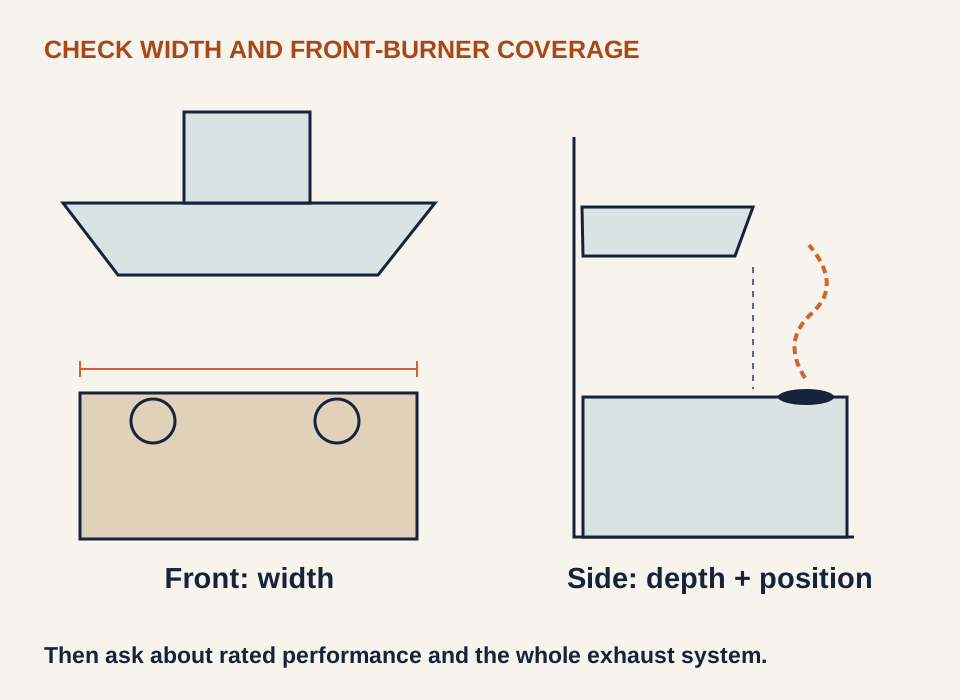
Vent-A-Hood’s catalog asks about hood width and depth separately and recommends covering the burners. Miele discusses cooktop width and available space when explaining hood width. Those are useful manufacturer perspectives, not a substitute for the actual model pairing.
There is no need to pretend every brand gives an identical overlap rule. A recommendation for an island hood, an enclosed wall hood or a professional-style cooking appliance can differ because the situation differs. Bertazzoni’s range instructions distinguish wall and island hood selection. Ask the designer to resolve the combination rather than choosing whichever generic recommendation is easiest to fit.
More headroom can change capture
Raising a hood to improve the view or avoid a head bump can change how it intercepts the plume. Broan-NuTone’s “not drawing” support answer warns that mounting above the recommended height can reduce capture and says not to go below the model’s minimum.
Elica’s guide for its listed insert models provides appliance-specific height conditions and warns about diminished capture at excessive height. The solution is not to copy those heights onto a different hood, or to lower a hood below a required clearance. Have the selected models checked together before cabinet or enclosure dimensions are fixed.
A CFM number is not a capture percentage
CFM describes airflow volume per minute. Capture efficiency asks how much of the cooking emission the hood actually intercepts. A large number does not by itself explain the effect of the hood’s shape, installation or burner position.
The public summary of ASTM E3087-18(2026) describes capture-efficiency measurement under controlled conditions and limits its scope to specified wall-mounted exhaust hoods. It is not a claim that every hood has such a rating, that all product types share the same test, or that a laboratory result guarantees identical performance in a home.
HVI says kitchen ventilation needs vary with cooking and range location, and refers professional-style cooktop selection back to the appliance manufacturer. Request comparable rated airflow and sound information for the proposed unit. Keep marketing comparisons or proprietary “equivalent” ratings separate from directly comparable measured airflow.
Why a room-volume formula is only one input
A room-volume calculation describes the size of an air volume; it does not draw a capture zone above a front burner. Falmec Australia’s buying guide discusses room volume, cooking intensity, motor configuration, noise and hood style together. Its regional sizing suggestions are not adopted here as US code requirements or a universal CFM prescription.
Likewise, a hood rated for an exhaust arrangement must be assessed with its actual system. PNNL’s retrofit guide explains that duct restrictions can reduce achieved flow and directs installers to the manufacturer’s duct requirements. The same guide distinguishes a decorative chimney over a recirculating unit from an actual outdoor exhaust path.
What to ask before ordering a replacement
- Identify both appliances. Keep the exact cooking appliance and hood model numbers, including the insert and blower configuration.
- Request two views. Compare width from the front and depth over the burners from the side.
- Confirm the permitted position. Ask the qualified installer to resolve both manuals and local requirements.
- Check usable performance. Discuss airflow, capture information if available and sound at the intended operating speed.
- Review the system before changing power. Have the professional assess the exhaust path and applicable replacement-air requirements; a higher-output purchase can change the project.
The useful specification is a coordinated appliance-and-room selection. It explains why this hood works in this position with this cooking surface, rather than relying on width or room size alone.
Sources and method
Ten independent primary technical and manufacturer resources checked October 25, 2026. The four-part worksheet and two-view diagram are Build It Out’s synthesis. No field testing, indoor-air diagnosis or professional ventilation design is claimed.
- Broan-NuTone: Range Hood Specifications Explained, and model-height troubleshooting linked above.
- Vent-A-Hood: How to Choose Your Vent-A-Hood, pages 26–27; historical catalog used for selection factors.
- Miele: Built-In Ventilation Hoods—Appliance Widths
- Bertazzoni: Electric Range Installation Manual—Ventilation Preparation; hosted by Manuals+.
- Elica: ETR134S1 / EAR-series Hood Guide; manufacturer document hosted by Manuals+.
- Lawrence Berkeley National Laboratory: Development of a Standard Capture Efficiency Test Method
- ASTM: E3087-18(2026) public scope and significance summary
- Home Ventilating Institute: How Much Ventilation Do I Need?
- Falmec Australia: Choosing the Right Rangehood; selection variables only, not US requirements.
- Pacific Northwest National Laboratory: Kitchen Exhaust Retrofit Duct Guide