

The size in an appliance’s name is not a cabinet-cutting instruction. Compare the exact product dimensions, the specified opening and the room needed for operation. A nominal “24-inch dishwasher” can have a narrower body; an older slide-in range can have a cooktop wider than the opening beneath it.
A replacement is described as the same size as the old appliance, but one drawing says 23¾ inches, another says 24, and the delivery carton is wider again. These figures need not conflict. They may describe the product, its installation opening and its packaging.
Whirlpool explicitly explains that dishwasher size labels can refer to the opening they are intended to fit. The first useful task is to put every dimension in the right column, rather than picking the smallest number and hoping it will work.
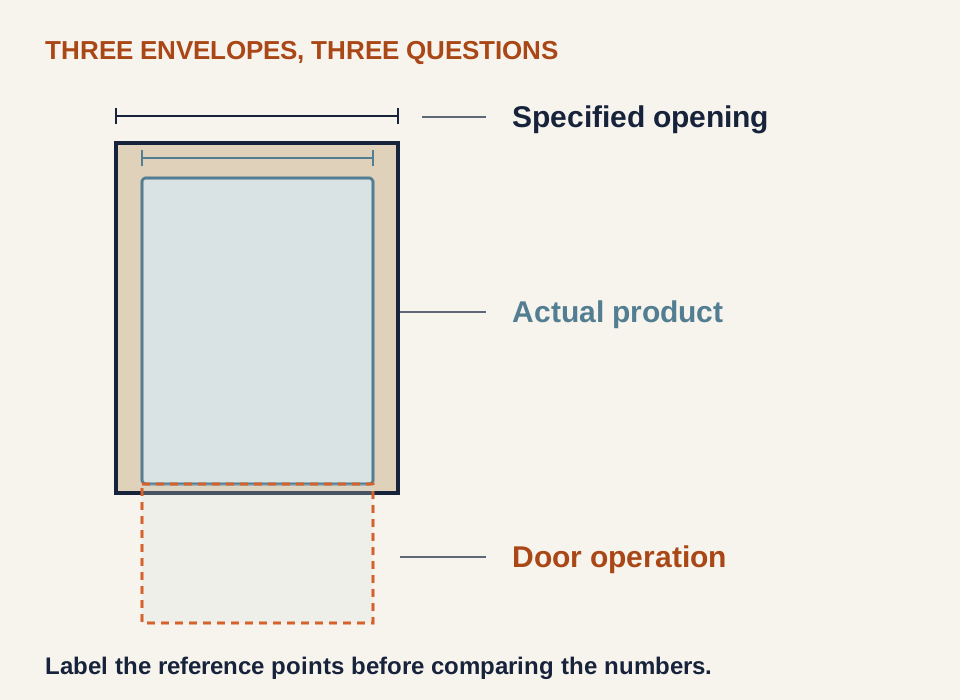
Separate the product, the opening and the operating envelope
| Envelope | What belongs in it | Common wrong comparison |
|---|---|---|
| Product | The appliance body, trim, panel, handles and other items included in the stated dimension. | Using a dimension that excludes the door panel as the complete closed depth. |
| Specified opening | The manufacturer’s cutout or niche width, height, depth and any allowed range. | Assuming the opening must equal the overall product outline. |
| Operation | Space for the door or drawer, nearby obstructions and required access. | Approving an appliance simply because its closed body fits. |
GE’s measuring guidance lists overall dimensions, air clearance, cutout dimensions and door-opening space separately. The delivery route is another check: packaging dimensions and doorway measurements should not be substituted for the installation drawing.
Why a 24-inch dishwasher may measure less than 24 inches
A nominal size can describe the cabinet module rather than a precisely identical machine width. As one actual example, LG’s LDT5678 builder sheet lists a 23¾-inch product width and a 24-inch cutout width. Its product, handle-inclusive depth, open-door depth and carton size also have separate entries.
The difference between those two widths is ¼ inch overall: 24 − 23¾ = ¼. That arithmetic does not independently authorize an installation with ⅛ inch on each side. The current model instructions, required fastening arrangement and actual cabinet geometry still govern the fit.
Another model can use different dimensions. Miele’s G 7966 SCVi specification separates overall unit dimensions from the minimum niche and excludes the door panel from a stated depth. Bosch’s SGX78B55UC sheet also separates the appliance dimensions and required cutout, then directs readers to installation instructions for final data. Do not turn either example into a universal dishwasher opening.
An old range can have a wider top than its cutout
For certain older overlapping designs, measuring the top surface can overstate the body opening underneath it. GE explains this specifically for many slide-in models manufactured before 2018: the top may overlap the adjacent counters even though the cabinet cutout is narrower. It also distinguishes later GE slide-in designs without that overlap.
A historical Frigidaire FGES3075KB drawing separately labels range width, cooktop width and cutout width. The lesson is to identify the old installation’s construction before selecting its replacement, not to reproduce that old drawing for a current range. A new appliance with a different top profile can expose an existing gap or call for a different approved arrangement.
Samsung’s NE58K9500 instructions distinguish slide-in and freestanding cutouts and identify a particular rear-filler application. Such requirements are why a retailer’s simple width filter cannot replace a model and accessory check.
Measure the finished opening, including its narrowest points
Record width, height and depth where the manufacturer’s drawing defines them. Mark projections, countertop edges and other obstructions rather than averaging them away. GE recommends measuring the narrowest point and accounting for molding and baseboards.
The opening must be checked as a volume, not merely as a clear rectangle at its front. Fisher & Paykel’s DD24DTX6HI1 planning guide qualifies minimum cavity dimensions by requiring an unobstructed cavity. It also says the planning guide is not the complete installation guidance.
Beko’s DDT25401X sheet distinguishes product, required cutout and packed dimensions, and advises checking current final data before making a cutout. Use legacy sheets to understand an existing appliance; obtain the current documents for the replacement actually being ordered.
Make a one-page approval sheet
- Identify the exact appliance. Include model suffix, selected front panel or handle and required accessories.
- Label every dimension. State product, opening, packaging or open-door measurement beside each number.
- Record the room’s actual opening. Note minimum and maximum points and the finished surfaces used as references.
- List unresolved conditions. Include obstructions, clearance requirements and any difference between the current and proposed appliance profile.
- Obtain the installer’s confirmation. Have the professional responsible for the appliance approve the current drawing before cabinetry or countertop work is released.
A range introduces more than a dimensional question. Bertazzoni’s range instructions distinguish the appliance outline from adjacent-cabinet and surrounding clearances. Gas, electrical work, anti-tip provisions and changes to surrounding construction require the appropriate installer; this worksheet does not authorize those alterations.
Sources and method
Ten originally authored manufacturer and technical resources reviewed October 25, 2026. Older model documents illustrate dimension definitions, not current universal requirements. The three-envelope worksheet and ¼-inch subtraction are Build It Out’s analysis; no installation test or professional approval is claimed.
- GE Appliances: Prepping Pathways and Measuring Your Space, and its legacy-overlap explanation linked above.
- Whirlpool: Standard Dishwasher Sizes and Measuring
- LG: LDT5678 Builder Specification Sheet, page 2.
- Miele: G 7966 SCVi Specification Sheet
- Bosch: SGX78B55UC Specification Sheet
- Frigidaire: FGES3075KB Installation Instructions, page 2; manufacturer document hosted by ManualOwl.
- Samsung: NE58K9500SG/AA User Manual, page 20; manufacturer document hosted by ManualOwl.
- Fisher & Paykel: DD24DTX6HI1 Planning Guide, cavity specifications; hosted by Device.report.
- Beko: DDT25401X Specification Sheet; hosted by Device.report.
- Bertazzoni: Freestanding Electric Range Installation Manual; manufacturer document hosted by Manuals+.