

New concrete can look mottled for several different reasons; color alone does not establish a strength problem or guarantee that everything will fade away. Record the pattern under comparable conditions, identify the curing or sealing products, and ask the contractor to separate an appearance assessment from any physical-performance concern.
The new patio was supposed to be one shade of gray. Instead, there are dark patches, pale edges or lines that follow a covering. Before trying to “fix the stain,” establish what is on the surface and what changed. An unsuitable treatment can alter the finish and make the original pattern harder to evaluate.
“Mottled” describes a pattern, not its cause
NRMCA’s discoloration bulletin identifies several contributors involving materials, finishing and curing; it does not name one cause for every discolored slab. It also distinguishes discoloration originating in the placement from later staining by foreign material. A pale area, dark area and rusty spot need not belong to the same problem. National Ready Mixed Concrete Association
The Concrete Society discusses inherent variation and differences in formwork and exposure. The American Cement Association identifies the influence of constituent materials on color. These help explain why concrete is not a painted color sample, but neither source excuses an agreed appearance requirement or diagnoses this particular placement. The Concrete Society · American Cement Association
Our same-view, same-condition record
Take a wide photograph that locates the pattern and a closer photograph showing the surface. Note whether it is naturally wet or dry, in shade or sunlight, and whether a coating or covering was recently applied. Repeat from the same viewing position under comparable conditions. Do not wet, scrub or chemically treat an area solely to produce a comparison.
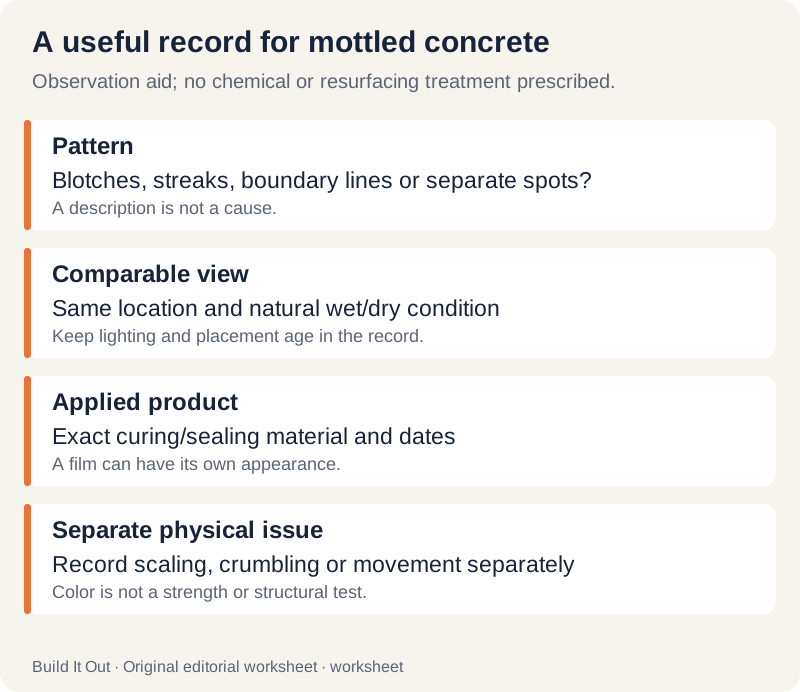
| Record | Useful detail | What to ask |
|---|---|---|
| Pattern | Blotches, covering-shaped boundaries, streaks or discrete spots | Which explanation fits this pattern and the project history? |
| Condition | Naturally wet/dry, shade/sun, placement age | Are we comparing equivalent conditions? |
| Applied products | Exact curing, sealing, color or release product | What appearance is expected from that specific product? |
| Physical change | Describe any crumbling, scaling, movement or other concern separately | Does this require a different professional assessment? |
This is an original record-keeping aid. It is not a test of compressive strength, surface durability, bond or structural adequacy. If a physical problem is present, photograph and report it separately rather than allowing a discussion about color to absorb it.
Placement and covering history can narrow the questions
Loveland Ready Mix’s original technical FAQ discusses several possible influences, including temporary coverings and different placement days. Ask the contractor what was actually used and when, rather than deciding from a photograph that the entire batch was wrong. Loveland Ready Mix Concrete
Useful records include the placement date, identified concrete mixture, finish type, curing method, covering dates and any later applied product. If neighboring areas were placed on different days or received different treatments, preserve that distinction. Two adjacent surfaces may not have the same history.
Do not translate “moisture may affect appearance” into a universal instruction to add water or remove a curing system. The curing plan and product requirements belong to the contractor and the actual project. This guide is about questions and records, not a new curing procedure.
A surface film can have its own appearance
Euclid’s technical discussion distinguishes a curing compound from a cure-and-seal and explains that these product choices can produce different visual effects. LATICRETE also describes how some waterborne products can initially appear white and how application conditions affect appearance. Identify the exact material before describing all pale patches as a concrete defect. Euclid Chemical · LATICRETE
W. R. Meadows gives a particularly clear product-specific example: its 1600-WHITE curing material leaves a temporary white appearance while present on the surface. That does not mean every white film is that product, or that every film follows its timetable. Ask for the label and the contractor’s record. W. R. Meadows
Sika’s Clear Guard data likewise notes that excessive buildup can affect appearance. That is a reason to ask the applicator about the actual coating, not an invitation to strip, solvent-wash or recoat the slab. Compatible remedial options require the product manufacturer’s and contractor’s assessment. Sika
Compare with the agreed finish, not a phone-screen color
ASCC’s specialist paper explains that color chips are representations and that finishing, placement age and site conditions influence the in-place result. It recommends defining appearance expectations through appropriate samples and specifications. Keep any approved sample and the written finish description available for the discussion. American Society of Concrete Contractors
The accessible abstract of ACI’s guide for formed-concrete surface effects also places acceptable appearance in the contract documents. We have not applied its paywalled detailed guidance or treated a formed-surface guide as a diagnosis of a residential patio. The useful principle is to identify the agreed criteria before declaring either automatic acceptance or automatic failure. American Concrete Institute
Ask for a documented follow-up without a universal deadline
Send the same-condition photo record and ask: What is the proposed explanation? Which project record or product document supports it? Is the next step an observation period, a coating assessment, or a separate investigation of physical performance? Who will review it, and when?
A statement that the color may change over time should identify what is expected and how it will be reviewed. It should not become a promise that every patch will disappear. Keep the initial condition documented before any approved treatment. Do not use acid cleaners, aggressive abrasion, pressure washing or additional sealer as a trial diagnosis from general advice.
The goal is a clear distinction among the concrete’s own variation, an applied film, later staining and any separate physical concern. That lets the contractor propose a relevant next step while preserving the evidence needed to evaluate it.
Sources and method
Sources inspected October 25, 2026. The worksheet is Build It Out’s original editorial synthesis, not an on-site inspection, professional review or product certification.
- National Ready Mixed Concrete Association: CIP 23—Discoloration
- The Concrete Society: Colour Variation—An Inherent Feature of Concrete
- American Society of Concrete Contractors: Appearance Requirements for Colored Concrete Slabs, Problems and Practice #1
- American Concrete Institute: 309.2R-15: Visible Surface Effects on Formed Concrete—Abstract
- American Cement Association: Applications of Cement: Color
- Loveland Ready Mix Concrete: What Causes Discoloration of Concrete?
- Sika: SikaCem-100 Clear Guard Product Data
- W. R. Meadows: Does 1600-WHITE Leave Concrete White?
- Euclid Chemical: Demystifying Curing and Sealing, Part 4
- LATICRETE: Curing and Sealing Installation Guidance