
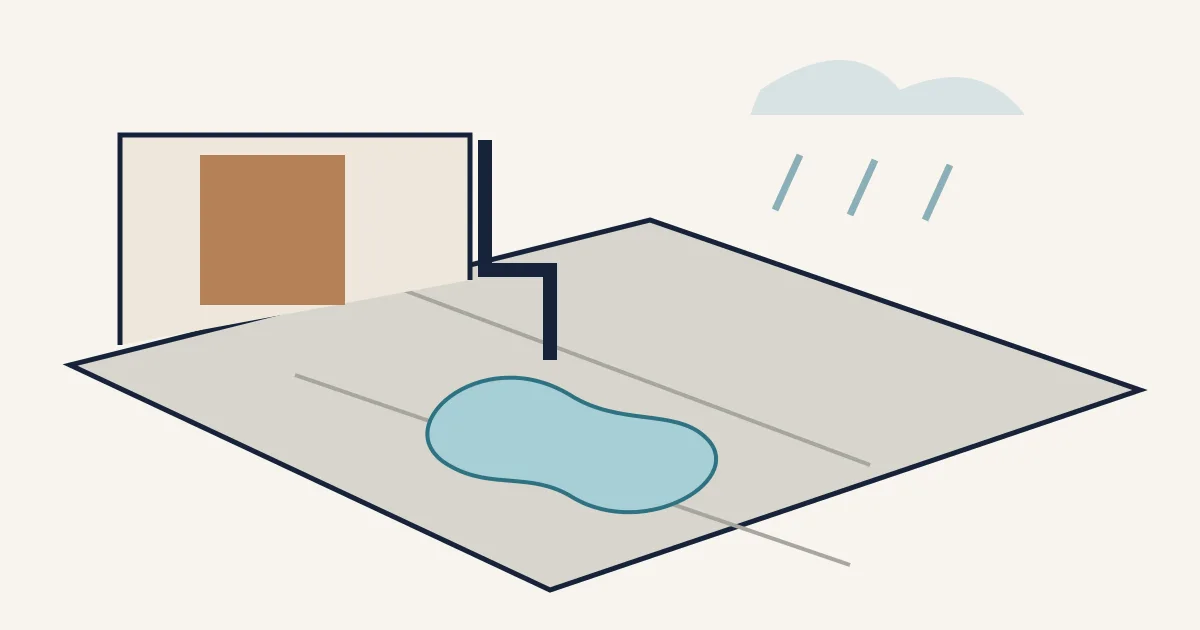
If a new concrete patio holds puddles after rain, document the location, timing and surrounding water flow before asking the installer to assess it. A puddle alone does not establish settlement, a wrong overall slope or a contract defect. Those are different questions, and useful photographs should help distinguish them rather than assume the answer.
This guide is for observation and communication. It supplies no universal allowable puddle depth, drainage slope or evaporation deadline, and no grinding, patching, lifting or structural-repair instructions.
A local depression and the overall drainage are different
A surface can direct water generally toward an outlet and still have local variations. ASCC's position statement discusses small puddles, often called birdbaths, on level or sloped slabs. It presents the concrete contractor association's view of expectations and tolerances; it does not settle your specification, local requirements or warranty. Read the original position statement.
Flatness and levelness also describe different characteristics. The accessible abstract of ACI-published original research distinguishes surface bumpiness from levelness. A photograph cannot provide a professional tolerance measurement. Ask what assessment method and agreed criteria apply to the actual patio rather than importing an interior-floor number from an unrelated search result. See the research abstract.
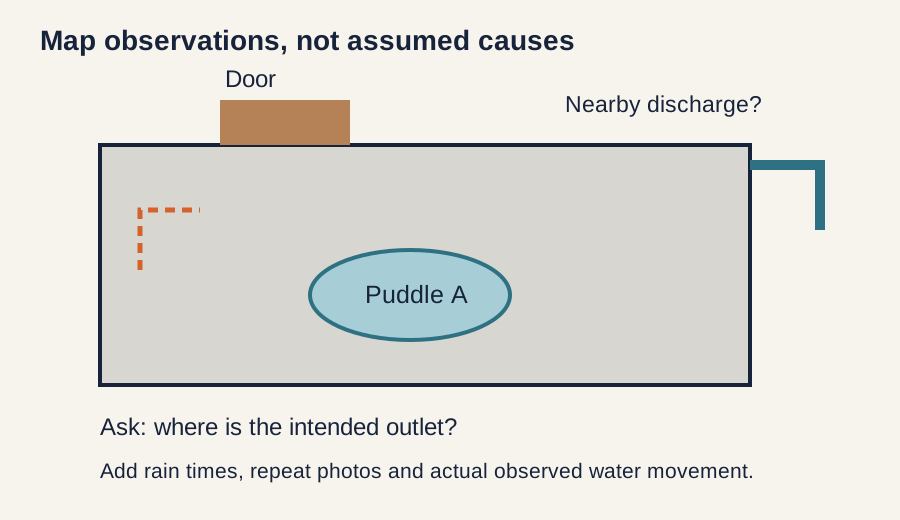
Record where the water comes from and where it should go
The water on the patio may include direct rain plus runoff from another surface. USGS explains that roofs and other impervious surfaces contribute runoff and that storm conditions and saturated ground affect it. A close photo of a puddle can miss that context. Include a wider view showing the patio edges, nearby roof discharge, doors and any intended drainage outlet. USGS's runoff explanation.
Seattle Public Utilities' maintenance guidance is an example of why observing gutters, downspouts and drainage components is useful. It does not establish the cause at your property, and its local distance or ownership rules should not be applied elsewhere. Record an observed blocked inlet or concentrated discharge as an observation for the relevant professional, not an instruction to redirect water yourself. Seattle's visual-inspection guidance.
Ask the installer to identify the intended runoff route in the agreed plan. QUIKRETE's patio-planning guide treats that route as part of the layout, particularly near a house. That supports the question about design intent; it does not supply a universal slope for every patio or attached drainage system. The manufacturer's patio guide.
Make the time record meaningful
For each photograph, record the actual time and whether rain was still falling, had stopped, or restarted. If you did not observe when it stopped, mark the stop time unknown. Keep photos from repeated safe observation points so the apparent size of the puddle is not merely a different camera angle.
Weather-app or station data can provide context, but label the source and location. An NWS explanation notes that rainfall at a gauge does not establish exactly what fell at nearby locations. Do not turn a regional report into a measured rain total for your patio. See the newsletter's rainfall discussion, page 8.
A useful record might say “rain observed stopped at 3:10 pm; photos at 3:25 pm and 5:00 pm; no further rain observed during that interval.” These are illustrative entries, not a test interval or acceptance standard. Also note sunlight, shade and whether other water continued to arrive.
Do not borrow a deadline from a different drainage feature
A particularly easy mistake is applying a rain-garden rule to a concrete patio. Portland's stormwater-facility guidance discusses features intentionally designed to hold water and gives a 48-hour contact trigger in that context. That is not evidence that every patio puddle is acceptable for 48 hours, or defective after that time. Read the original facility-specific context.
If the concrete is still in its curing period, record the installation date and the installer's curing instructions as well. The American Cement Association explains that maintaining moisture serves concrete hydration. Intentional curing conditions and later rain-drainage observations are different situations; do not alter the curing plan or create a hose test for this worksheet. Its curing explanation.
Our installer observation packet
| Include | What it contributes |
|---|---|
| Job identity | Installation date, agreed layout/specification and any curing or use restrictions. |
| Location map | Label each affected area and show its relation to doors, joints, edges and intended outlets. |
| Matching photographs | Wide and close views, repeated from comparable positions without entering a restricted or unsafe area. |
| Rain chronology | Actual observation times, known or unknown stop time, and any restart or continued inflow. |
| Surrounding flow | Observed roof runoff, inlet condition and water reaching or leaving the patio edge. |
| Change over time | When first noticed and whether the location/pattern appears different across comparable events. |
| Requested assessment | Applicable criteria, intended drainage route, measurements needed and who will evaluate them. |
Do not label a changing pattern settlement without an assessment. NRMCA's technical sheet explains that concrete slabs can also curl because of moisture or temperature differences. This is a reason to leave the mechanism open, not a suggestion that curling is the explanation for your patio. NRMCA's curling overview.
Get a proposed remedy matched to the assessed problem
Ask the installer to explain whether the concern is a local surface variation, the intended drainage route, surrounding inflow or another condition requiring further evaluation. If a repair is proposed, request its compatibility, appearance implications and written scope before agreeing.
A repair material is not selected just by the word concrete. ARDEX's exterior-capable patch, for example, has defined product scope and thickness conditions. That is evidence for checking a specific system, not a recommendation to patch a puddle yourself. Read its product limitations. Where water is entering the building or causing an immediate access problem, contact the responsible installer or drainage professional promptly rather than waiting to complete a routine photo series.
Sources and method
We reviewed the following original guidance on October 25, 2026. Product and jurisdiction examples apply to the identified source, not every project. Our worksheets are editorial planning tools, not professional determinations.
- American Society of Concrete Contractors: Position Statement 7: Birdbaths on Concrete Slabs
- National Ready Mixed Concrete Association: CIP19: Curling of Concrete Slabs
- American Concrete Institute / Eldon Tipping and Rick Smith: A Comparison of Floor Tolerance Measuring Approaches, 2020: accessible abstract
- QUIKRETE: Building a Concrete Patio
- ARDEX Americas: ARDEX CP: Concrete Patch
- US Geological Survey: Surface Runoff and the Water Cycle
- National Weather Service Boise / Jay Breidenbach: How Do You Measure Rainfall When There Are No Measurements?, Spotter newsletter, page 8
- Seattle Public Utilities: Drainage System: private system maintenance
- City of Portland Environmental Services: Care for a rain garden or other stormwater facility: ponding section
- American Cement Association: Applications of Cement: concrete curing