

Slab square footage cannot tell you the concrete volume without thickness. A 20-by-12-foot rectangle has 240 square feet of area. At an illustrative uniform four-inch thickness it contains about 2.96 cubic yards; at five inches, about 3.70 cubic yards. That one-inch assumption changes the modeled volume by 25% before any ordering allowance.
A quote may sell an installed slab by square foot while a supplier sells fresh concrete by cubic yard. Both units can be legitimate, but they answer different questions. Keep area, design thickness, geometric volume and delivered order quantity in separate rows.
Use the formula with the units still attached
For a uniform rectangular slab, convert thickness in inches to feet before multiplying:
Cubic yards = length in feet × width in feet × thickness in inches ÷ 12 ÷ 27.
Cemex explains that a cubic yard contains 27 cubic feet. Procore’s original calculator guidance separates shapes and unit choices, while the Calculated Industries manual demonstrates the same length-width-depth approach. These are volume calculations, not a slab-design recommendation. Cemex US · Procore · Calculated Industries
Our worked example: same area, different thickness assumption
Assume a perfectly uniform 20-by-12-foot rectangle with no thickened edges, steps, pads, voids or additional features. The four- and five-inch depths are scenarios used to demonstrate sensitivity; neither is a prescribed thickness for a patio, driveway or structural slab.
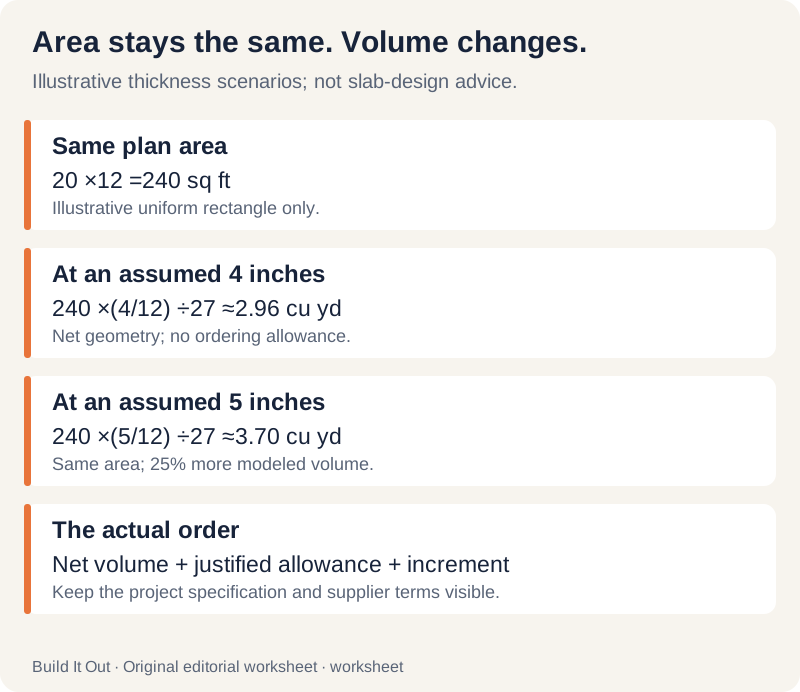
| Quantity | Four-inch scenario | Five-inch scenario |
|---|---|---|
| Plan area | 20 ×12 =240 sq ft | 20 ×12 =240 sq ft |
| Depth in feet | 4 ÷12 =1/3 ft | 5 ÷12 =5/12 ft |
| Geometric volume | 240 ×1/3 =80 cu ft | 240 ×5/12 =100 cu ft |
| Net cubic yards | 80 ÷27 ≈2.96 cu yd | 100 ÷27 ≈3.70 cu yd |
| Relative change | Baseline | 100 ÷80 −1 =25% more |
The 25% difference comes entirely from the assumed depth. It is not waste, shrinkage or proof of excess ordering. Conversely, if the actual job has varying depth or other concrete features, this simple rectangular model is incomplete.
Our four-quantity reconciliation sheet
- Area: Which plan boundaries and openings are included?
- Thickness: What actual project specification and geometry were used?
- Net volume: What does the modeled concrete shape contain before contingencies?
- Order quantity: What allowance and supplier increment were applied, and why?
NRMCA’s ordering guide treats quantity as one field among mixture, delivery and placement requirements. Shelby’s supplier guidance also distinguishes a dimensional estimate from contingencies. Ask the contractor to explain the transition between rows, rather than hiding all differences in a word such as “extra.” National Ready Mixed Concrete Association · Shelby Materials
If part of the slab is thicker, ask for a separate calculation for that defined zone. If another feature is included, identify it. Avoid double-counting an edge strip as both full-depth slab and an entire additional full-depth member. The actual designer or contractor should establish the geometry and requirements; our worksheet only makes the quantity basis easier to read.
Net geometry is not necessarily the order
Heidelberg’s calculator describes its result as an estimate and separately discusses order quantities. Sakrete also presents extra-quantity advice outside its net estimating tools. Those published allowances should not be averaged into a supposedly universal percentage for every concrete project. Heidelberg Materials US · Sakrete
Ask what the project-specific allowance addresses and whether the supplier rounds to an ordering increment. Preserve the net value before showing the rounded order. If the proposed order exceeds the model, that difference deserves an explanation; the arithmetic alone neither approves nor rejects it.
For a bagged product, use its own approximate yielded volume. QUIKRETE’s No.1101 sheet, for example, lists about 0.60 cubic foot for an 80-pound bag. The 80-cubic-foot scenario would therefore be 80 ÷0.60 ≈133.33 bags, or 134 whole bags before any separately justified allowance. This does not apply to every 80-pound concrete-related product. QUIKRETE
A cubic-yard price is not the installed-slab total
Ozinga’s ordering information separately asks for mixture, amount, extras and delivery details. Chaney’s buying guide similarly separates estimating quantity, obtaining the actual quote and scheduling delivery. A volume result cannot tell you whether forming, preparation, reinforcement, finishing, access or disposal is included in an installed proposal. Ozinga · Chaney Enterprises
When comparing two slab quotes, request the actual design thickness and included work. Do not assume identical square footage means identical volume, or identical volume means identical performance and finish. Do not change a specified thickness or mixture to make the total cheaper based on an online arithmetic example.
The question to send with the quote
“Please show the plan area, the specified thickness and any separate thickened zones, the net calculated volume, and the allowance or order rounding. Please also distinguish the concrete supply quantity from the installed-slab scope.”
That request keeps the disagreement focused. A surprising cubic-yard figure may come from a different depth assumption, a legitimate additional shape, ordering provisions or an error. Labeling the quantities lets the contractor resolve the difference with actual project information instead of competing rules of thumb.
Sources and method
Sources inspected October 25, 2026. The worksheet is Build It Out’s original editorial synthesis, not an on-site inspection, professional review or product certification.
- National Ready Mixed Concrete Association: CIP 31—Ordering Ready Mixed Concrete
- Cemex US: Ready Mix Concrete Calculator
- QUIKRETE: Concrete Mix No.1101 Product Data
- Sakrete: Concrete Calculators
- Shelby Materials: Ordering Concrete for Your Residential Project
- Heidelberg Materials US: Concrete Calculator and Ordering Notes
- Ozinga: Placing an Order
- Chaney Enterprises: Ready Mix Concrete Buying Guide
- Calculated Industries: HeavyCalc Pro Pocket Reference Guide
- Procore: Concrete Calculators