

A new fan can remove moisture while the mirror still fogs during a shower. Fog records condensation on cool glass; it does not measure the fan’s airflow. If the room stays wet, conditions worsen, or staining appears, document the pattern and ask the installer to verify controls, installed airflow and the exhaust route before buying another fan.
The replacement sounds quieter and the box promises more CFM, yet the mirror disappears behind droplets again. Two different expectations are being mixed together: keeping one surface clear during a moisture burst, and removing moisture from the room over time. The observations below help separate them without treating either a foggy or a clear mirror as proof of a successful installation.
Why the mirror is an incomplete fan test
NOAA’s bathroom example explains how shower water vapor condenses on cool mirror glass. The surface temperature and moisture conditions matter. That is why fog during a hot shower cannot, by itself, tell you whether the fan is defective, undersized or operating normally.
Look beyond the glass. Record whether moisture clears after use, whether walls remain visibly wet, and whether the concern is new or has persisted since before replacement. A fog-free mirror also cannot establish that a hidden exhaust duct reaches outdoors.
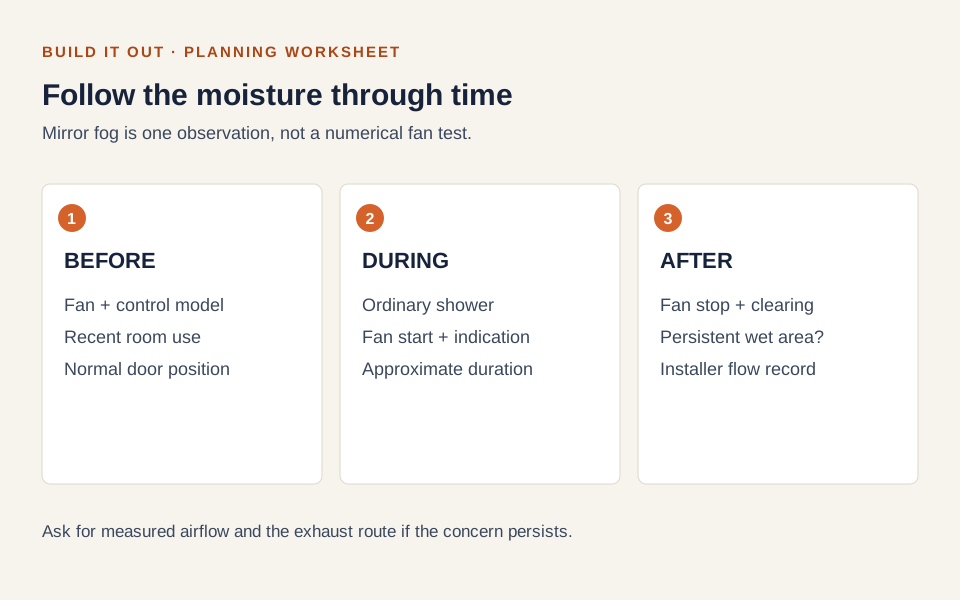
Our shower-to-drying observation sheet
Use an ordinary shower, not a deliberately hotter or longer test. Note approximate times from the bathroom floor. No ceiling access, grille removal or equipment disassembly is needed.
| Stage | Record | What it helps explain |
|---|---|---|
| Before | Date, recent bathroom use, fan/control model and normal door position | Starting conditions and replacement-air context |
| During | Approximate shower duration, fan start time and visible control indication | Whether ventilation was operating during moisture production |
| After | Fan stop time; when mirror and other surfaces visibly clear | Drying pattern rather than one foggy moment |
| Follow-up | Persistent wet area, stain, dripping or recurrence outside shower use | Whether a broader moisture assessment is needed |
Photograph the same area from a similar position if doing so is safe. The record is comparative, not a moisture-meter reading or a pass/fail test. Do not continue showering to reproduce a problem if water is dripping through a ceiling or another active leak is suspected.
Confirm what the new control actually does
A light switch, timer and humidity sensor can produce different fan behavior. Ask the installer which wall control and fan modes were supplied, what the visible indicators mean, and which owner instructions apply. A quiet fan may be harder to notice; perceived sound is not an airflow measurement.
For example, Broan-NuTone’s P82W supports several humidity and timer modes. Delta’s GBR80H separately specifies low-speed and full-speed operation. These examples show why “the switch is on” is not always enough information. They are not instructions to change concealed settings or a recommendation for either product.
Do not copy another model’s humidity percentage. A selectable sensor value is a control feature, not a universal healthy-room target or a guarantee that the mirror will stay clear. Have the installer explain the intended operation for this installation.
Why a timer number is not a drying guarantee
HVI recommends leaving bathroom ventilation on for 20 minutes after use. PNNL’s bathroom guide recommends a longer, one-hour post-shower period. These are different published guidance examples, not evidence that every bathroom must dry at the same minute.
Use the equipment’s owner instructions and the installer’s assessment of the room. Report the actual drying pattern if the prescribed operation is not controlling moisture. Do not repeatedly extend runtime to avoid reporting persistent wet surfaces, a suspected leak or a fan that never appears to operate.
A bigger number on the box does not settle installed performance
CFM means cubic feet per minute. Panasonic explains that duct resistance is expressed as static pressure. The fan’s published airflow belongs to a stated test condition; the completed exhaust path can affect what the installation delivers.
Air King’s E110S specification lists airflow at several pressures and distinguishes boost operation. Fantech gives a specific pressure-selection recommendation for its own bathroom-fan application. Comparing only headline CFM can miss both the test condition and the operating mode.
Some products compensate for rising resistance. S&P describes speed adjustment intended to help maintain set airflow in its PCD-IL example. That feature still does not establish the airflow in your bathroom. Ask for an installed-flow assessment rather than assuming that a particular motor type solves every duct constraint.
The air needs a complete path
Exhausted air needs replacement air. Record the normal door position and any change associated with the remodel, such as new flooring or a replacement door. HVI and Fantech both discuss makeup air. Give that context to the professional; do not cut a door or alter a fire-rated assembly based on this worksheet.
EPA directs bathroom exhaust outdoors, rather than into an attic, and distinguishes leaks from shower-generated moisture. Ask the installer to confirm the complete route and termination. You do not need to climb onto a roof or enter an attic to supply a useful symptom record.
Send a focused installation follow-up
Attach your record and ask: Was the intended control mode operating? What airflow was measured after installation, and under which conditions? Was the replacement-air path considered? Does the exhaust reach outdoors? Is the persistent moisture pattern consistent with ventilation alone, or does another source need assessment?
A tissue held near a grille is not a numerical CFM result. PNNL describes professional airflow measurement with appropriate instruments. Request the measured value and method if capacity is disputed. That gives the next decision an evidence base while keeping a momentarily foggy mirror in perspective.
Sources and methodology
Manufacturer documents and original technical guidance informed this article. Product examples describe the named model, not every system. Sources checked October 25, 2026. The worksheet is our editorial synthesis; it is not a professional inspection.
- Home Ventilating Institute — Bathroom ventilation guidance
- Panasonic North America — Homeowner frequently asked questions
- Broan-NuTone — P82W Sensaire humidity-sensing wall control
- Delta Breez — GBR80H specifications and operating features
- Air King — E110S expanded performance specification, updated February 2025
- Fantech — Bathroom ventilation frequently asked questions
- S&P USA Ventilation Systems — Premium Choice inline fans: PCD-IL
- Pacific Northwest National Laboratory / US DOE — Bathroom exhaust fans: ensuring success
- US EPA — Main ways to control moisture in your home
- NOAA NESDIS — What is humidity?