
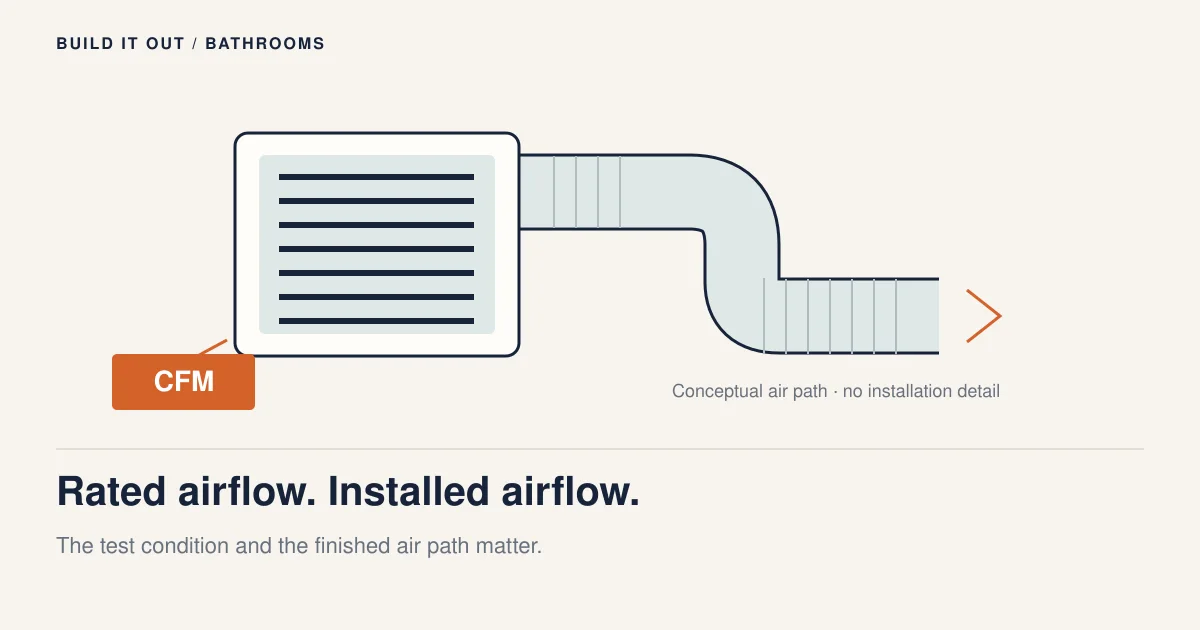
Keep three numbers separate: the room’s planning airflow, the fan’s rated airflow at a stated pressure, and the airflow measured after installation. A room-size calculation starts the selection; it does not prove that the chosen fan delivers that amount through the actual duct. Ask the installer to connect all three numbers before ordering a replacement.
A shopping page may label a fan “110 CFM” and suitable for a certain bathroom area. A contractor may discuss a lower measured flow. Those numbers can describe different conditions rather than a disagreement over arithmetic. Our worksheet makes the conditions visible so two proposals can be compared fairly.
Start with a defined room, not a product label
HVI recommends 1 CFM per square foot for bathrooms up to 100 square feet. Its example uses an 8-foot ceiling. Treat this as a published planning guideline, not a statement of your jurisdiction’s current code or a complete design for every bathroom.
For the simple example below, assume a rectangular bathroom measuring 8 feet by 10 feet, with an 8-foot ceiling and no separate enclosed compartment. The measurements are illustrative; they are not a surveyed home. Taller ceilings, steam showers, enclosed toilets, larger rooms and unusual layouts deserve a project-specific assessment.
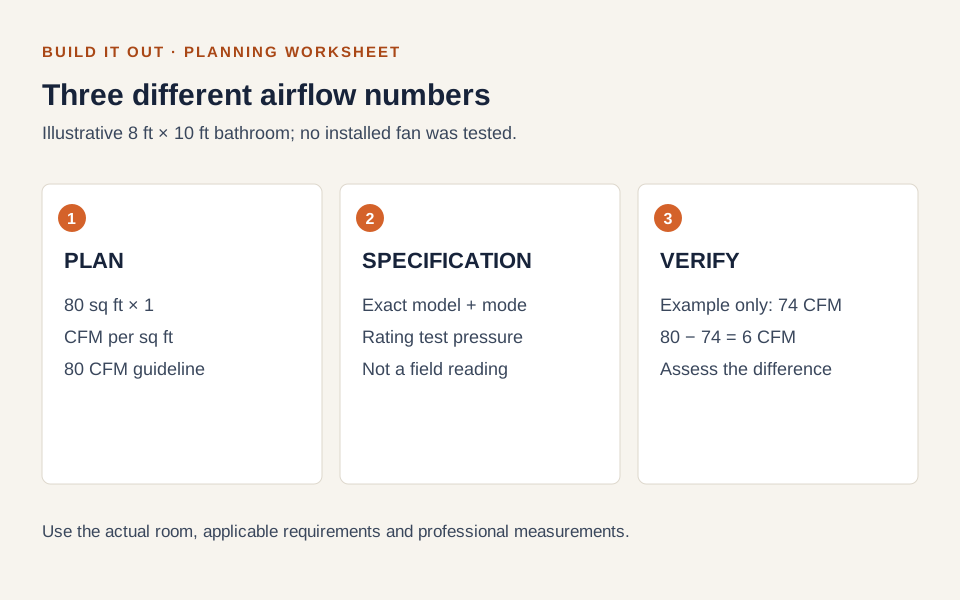
A transparent three-number example
| Number | Example | What it means |
|---|---|---|
| Room area | 8 ft × 10 ft = 80 sq ft | Rectangular floor area for this example |
| Planning airflow | 80 sq ft × 1 CFM/sq ft = 80 CFM | HVI guideline within its stated room-size scope |
| Candidate rating | 110 CFM at the stated pressure and mode | Manufacturer data to evaluate, not a field reading |
| Hypothetical installed reading | 74 CFM | Made-up example showing why actual measurement matters |
| Comparison | 80 − 74 = 6 CFM below the planning value | A reason for assessment, not proof of a failed motor |
The 74 CFM value is deliberately hypothetical. We have not tested a fan or measured this room. Do not use the resulting 6 CFM difference as a diagnosis or a universal permitted tolerance. The contractor must determine the applicable requirement, measurement method and appropriate correction.
For an irregular floor plan, ask which portions were included and how the area was calculated. Do not enter an unknown length as zero, confuse inches with feet, or round room measurements down to fit a preferred fan. A quote with missing assumptions is not ready for meaningful comparison.
Why the pressure beside CFM matters
Panasonic defines static pressure as resistance to airflow through the duct, measured in inches of water gauge. Longer or more complicated paths can add resistance. CFM and pressure are different quantities, so a label saying 0.25 in. w.g. is not another airflow number.
Read the full table rather than applying a universal percentage reduction to every fan. Fantech’s own bathroom FAQ specifies a pressure-selection approach for its products. That is a reason to obtain the correct manufacturer data and a qualified assessment, not to assume the same pressure describes every house.
Two real specifications show the comparison problem
Delta’s GBR80H full-speed table gives 80 CFM at 0.1 in. w.g. and 64 CFM at 0.25 in. w.g.. The same product has separate low-speed data. “80 CFM” without the pressure and speed omits important information.
Air King’s E110S expanded table lists 110 CFM at 0.1 in. w.g., 67 CFM at 0.25, and a separate boost value of 111 CFM at 0.25. The boost footnote matters. Comparing one model’s boost setting with another model’s ordinary setting would be misleading.
These are manufacturer-published examples, not product recommendations or head-to-head tests. They do not show what either fan would deliver in your home. Check current documentation for the exact model and configured operating mode.
Controls affect which rating is relevant
Some fans have selectable speeds, timers or automatic humidity operation. Broan-NuTone’s P82W example includes different humidity-response and timed-operation modes. Ask which airflow mode the proposed control actually calls for during bathroom use.
Some fan designs adjust speed in response to resistance. S&P describes that compensation in its PCD-IL inline-fan example. A feature intended to sustain flow is useful information, but it is not evidence of unlimited pressure capability or a substitute for verifying the completed installation.
A sone rating describes sound, not airflow. A quieter product is easier to live with, but less noise does not establish more CFM. Keep noise, electrical consumption, control operation and airflow in separate quote fields.
Ask for an installed-flow record
PNNL distinguishes factory-rated flow from the amount delivered through the installed duct and describes professional measurement. Request the measured CFM, test method, operating mode, normal door position and date. The measurement belongs to the complete installed system, not merely the motor.
Ask the professional to assess the duct route, termination and replacement-air path when a rating and result do not align. EPA says bathroom exhaust should discharge outdoors rather than into an attic. This is a scope question for the installer; it is not a homeowner instruction to inspect a roof or modify ducts.
Use these fields to compare proposals
- Room and use: dimensions, ceiling height, compartments and unusual moisture loads.
- Design basis: required installed airflow and the guideline or applicable requirement used.
- Candidate: exact model, rated CFM, test pressure and intended operating mode.
- Installation: professional duct and replacement-air assessment, with necessary work included in scope.
- Verification: who measures completed airflow, how the result is recorded and how a shortfall is resolved.
Finally, keep purchase capacity separate from mirror appearance. NOAA explains that fog forms when moisture condenses on cool glass. A clear mirror is not the commissioning certificate, and a foggy moment alone is not a numerical capacity test. The three-number record gives a stronger basis for the purchase.
Sources and methodology
Manufacturer documents and original technical guidance informed this article. Product examples describe the named model, not every system. Sources checked October 25, 2026. The worksheet is our editorial synthesis; it is not a professional inspection.
- Home Ventilating Institute — Bathroom ventilation guidance
- Panasonic North America — Homeowner frequently asked questions
- Broan-NuTone — P82W Sensaire humidity-sensing wall control
- Delta Breez — GBR80H specifications and operating features
- Air King — E110S expanded performance specification, updated February 2025
- Fantech — Bathroom ventilation frequently asked questions
- S&P USA Ventilation Systems — Premium Choice inline fans: PCD-IL
- Pacific Northwest National Laboratory / US DOE — Bathroom exhaust fans: ensuring success
- US EPA — Main ways to control moisture in your home
- NOAA NESDIS — What is humidity?