
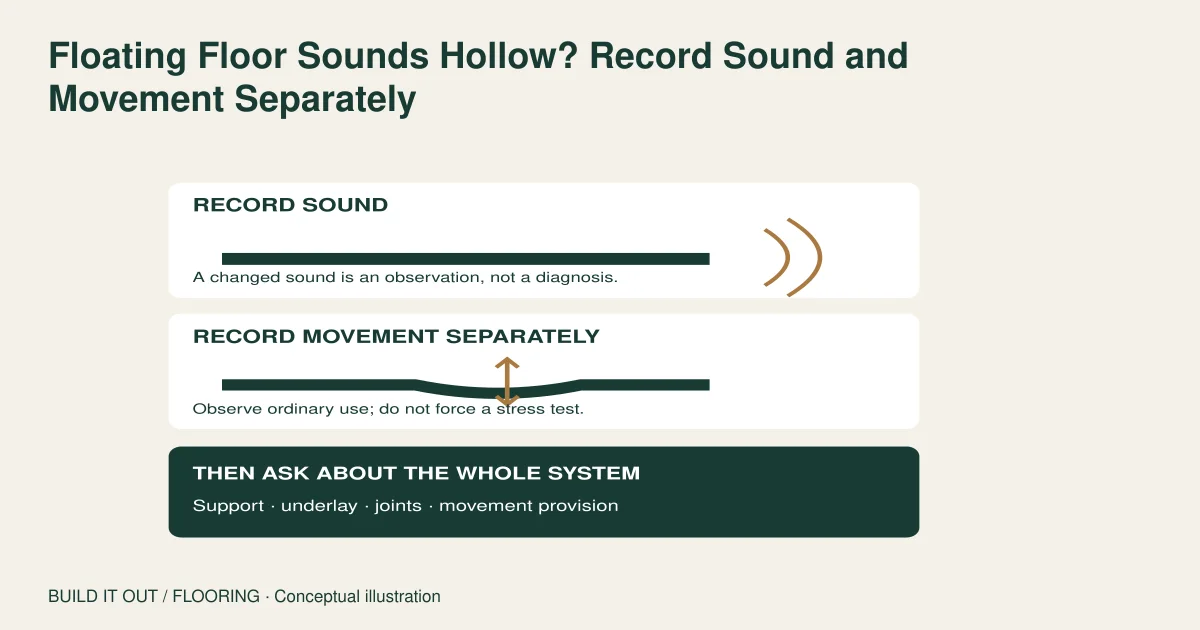
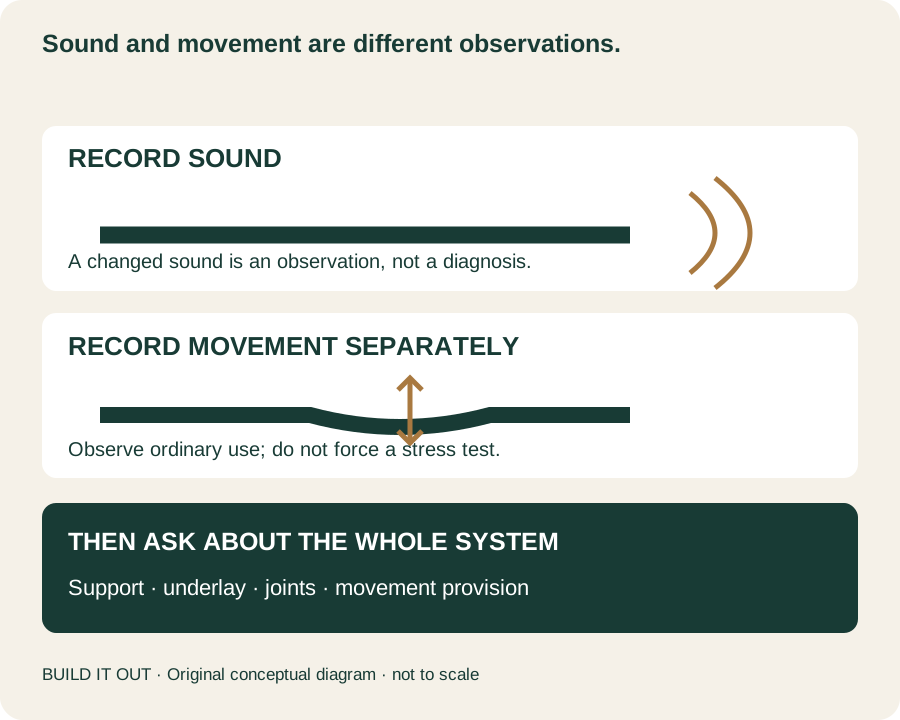
A hollow sound and visible movement are different observations. Record where the sound occurs, whether a joint moves during ordinary walking, and whether the change is new. Then ask the installer to assess the exact floating-floor system. Sound alone does not prove a loose board, and “floating” does not make every bounce acceptable.
A new plank floor looks good but sounds different near the doorway. One person says all floating floors sound hollow; another recommends gluing the noisy spot. Neither statement establishes what is happening in this installation. CALI’s engineered-bamboo manual, page 7, describes several influences on floor noise, including substrate, flatness, deflection and environment. Its product-specific noise position is not a blanket verdict on another brand or a visibly damaged floor.
Start with three separate observations
| Observation | Useful record | What it does not prove |
|---|---|---|
| Different sound | A room sketch locating a hollow, clicking or squeaking area | That a plank needs adhesive underneath |
| Movement | A short video during ordinary walking, if safely observable | Whether the movement is in the finish, underlay or structure |
| Changed joint or surface | Photographs of visible separation, edge change or damage | Warranty responsibility or the correct repair |
Do not create a stress test by jumping, repeatedly flexing a joint or loading it with a heavy object. If a surface feels unsafe, stop using the affected area and arrange assessment. The record should capture normal behavior, not produce a failure.
Why support underneath belongs in the assessment
A plank can bridge a low area in the substrate. Flooret’s Modin guidance explains how air pockets under bridged areas can sound hollow or loose, and how pronounced changes of angle can stress a click joint. That is a plausible mechanism for an installer to investigate; it is not a diagnosis based on a sound recording.
Mannington Essentials’ guide, pages 1 and 3, separately addresses subfloor unevenness and a base free from deflection. Ask what preparation measurements were recorded before the new floor covered the substrate. If those records do not exist, say so; do not invent them from the finished appearance.
Extra cushioning is not an automatic solution
Identify any attached pad and any separate layer underneath. Karndean’s US 5G rigid-core guide, page 1, says a separate underlay is not normally recommended for that system. Mohawk’s RevWood Plus instructions, page 1, distinguish planks with and without attached underlayment. Different constructions need their own approved arrangement.
Audacity’s WPC manual warns about soft substrates and existing floor conditions. Adding another soft layer to a completed floor is not a sound diagnosis or a universal repair. Give the installer the actual pad specification rather than describing it simply as “premium underlay.”
Check the system’s freedom to move, too
Support and restraint are separate issues. A floating surface also needs its specified movement provision. Tarkett’s wood manual, page 2, describes a floor free to move and warns about heavy objects locking it. We use that general principle, not its UK dimensions, for this planning discussion.
Kährs distinguishes floating and fully bonded wood installations, including how fixed heavy loads are treated. NovaFloor’s NovaCore HPC manual, page 1, also identifies movement space and fixed-fixture constraints. Ask the installer to assess doorways, transitions and fixtures against the applicable guide; do not remove trim or cut the flooring to investigate yourself.
Our sound-and-movement service record
Use one sketch for the room and number each concern. For each number, record:
- Location: near a doorway, wall, fixed cabinet, seam or middle of the room.
- Observation: sound only, visible movement, a changed joint, or more than one.
- Timing: present from installation, noticed later, intermittent, or changing after another project.
- Product: exact manufacturer/range, floating installation method, pad and any additional layer shown on the invoice.
- Context: known spills, recent room-condition changes, moved furniture or fixture work. Record facts rather than guessing a cause.
- Evidence: photographs and, where safe, a short normal-use recording with the location identified.
This is an original observation worksheet. It does not determine whether the sound is within a manufacturer’s acceptance criteria. Ask for the applicable criteria and the installer’s written explanation.
Ask for an assessment before approving a spot fix
A useful service question is: “Can you distinguish surface sound from unsupported movement, check the specified preparation and underlay, and explain the proposed remedy for this product?” Ask whether additional investigation is needed and who will authorize it. Keep the original invoice, installation date and guide with the service record.
Armstrong’s rigid-core overview still calls for a dry, clean, flat base and recommends professional installation support. A rigid product’s ability to accommodate minor irregularities is not proof that a pronounced dip or movement is acceptable.
Do not inject adhesive, fasten a floating plank through to the base, or apply an improvised expanding filler merely because it might quiet a spot. Those actions change the system and can conceal evidence. Obtain the product maker’s approved approach and an installer assessment first. A clear distinction between sound, movement and visible damage gives that conversation a better starting point.
Sources and method
Prepared by Build It Out from the primary and specialist resources below; checked October 25, 2026. The decision aid and artwork are editorial synthesis, not a field test or professional inspection. Product examples retain their own scope; follow the current instructions for the exact US product being used.
- Mohawk: RevWood Plus installation instructions
- Mannington: Essentials installation guidelines
- CALI: Engineered Bamboo Flooring Installation Guide
- Karndean: US 5G Rigid Core installation guide
- Tarkett: Wood floating installation instructions
- Flooret: Modin LVP: subfloor flatness FAQ
- Audacity: WPC Planks North America installation manual
- NovaFloor / Novalis: NovaCore HPC installation, maintenance and warranty guidelines
- Kährs: FAQ about flooring
- Armstrong Flooring: Rigid Core Flooring Installation