
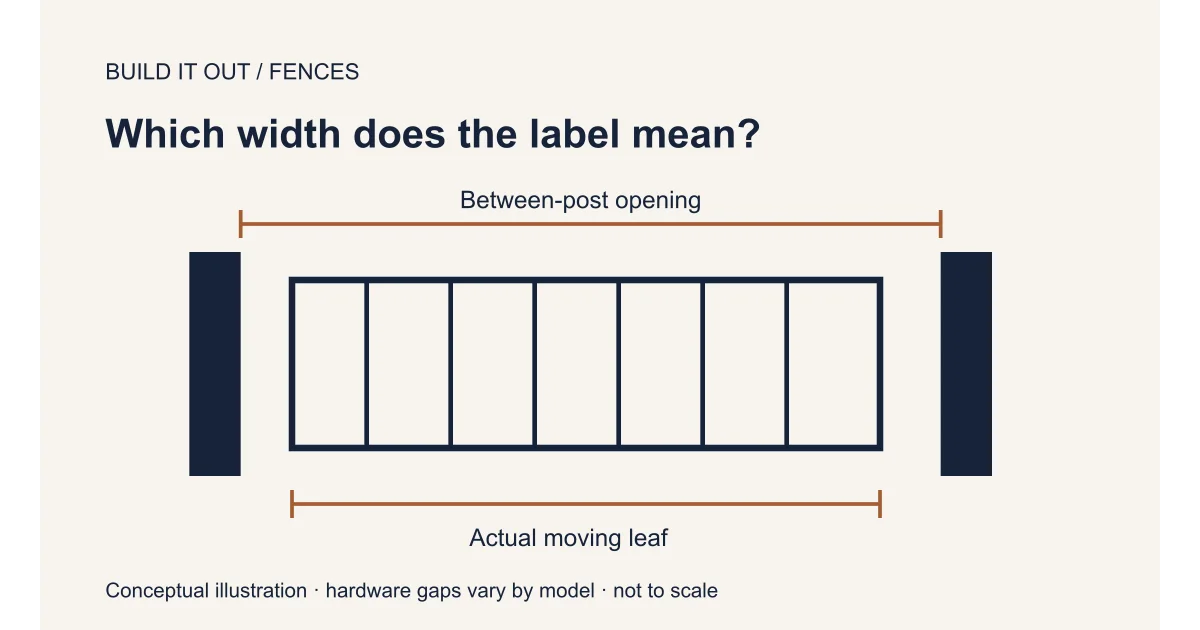
Ask for the unobstructed passage width with the gate in its intended open position, as well as the gate-leaf width and inside-to-inside post spacing. A “4-foot gate” label does not establish all three. Before ordering, tell the supplier what needs to pass through and ask which dimension its label describes.
Hoover Fence addresses exactly this ambiguity in its gate FAQ: the actual leaf and the opening differ according to the hinges and latch. Ultra Aluminum defines its gate width as the opening between the inside faces of the posts. Those are supplier conventions to confirm for the selected model, rather than a universal deduction to apply to every gate. [2] [10]
Put four widths on the same drawing
| Dimension | What to ask the supplier to identify |
|---|---|
| Labeled size | Opening, actual leaf, kit limit or another stated reference? |
| Actual leaf width | The physical moving assembly, with its measurement endpoints. |
| Post opening | Inside face to inside face; distinguish it from center-to-center spacing. |
| Usable passage | The narrowest unobstructed width on the intended route, with the gate open to the agreed position. |
Barrette’s manual treats hardware clearances as part of the opening calculation and refers to the selected hardware instructions. FenceTrac offers adjustable gate kits; the kit size alone does not identify the final assembled width. Ameristar’s catalog makes the distinction visible by listing opening and leaf width in separate columns. [1] [4] [11]
The useful question is therefore more specific than “Is this gate four feet?” Ask: “Which width is four feet, what hardware is included, and what unobstructed passage will the finished installation provide?” Keep the answer with the quote and model drawing.
A closed-gate fit does not prove an open-gate passage
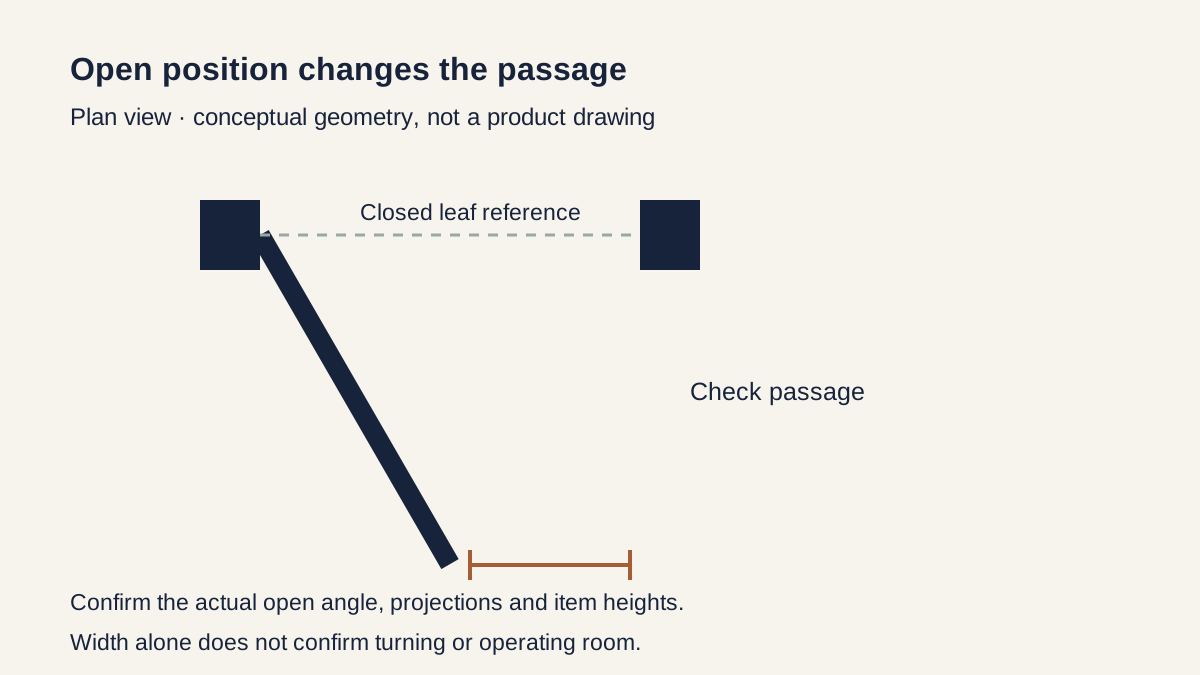
Confirm the permitted open position before assuming the leaf can fold flat against the fence. Nationwide’s TB450 closer, for example, lists a maximum opening angle of 100 degrees and requires a stop. That is a limitation of that product, not the opening angle for all gates. D&D also lists different gap ranges for different versions of its adjustable hinge. Ask for the exact closer, hinge and latch models. [5] [3]
Ultra’s guide explicitly calls for clearance to open without obstruction. Record nearby steps, walls and changes in ground height for the installer; Forjj’s measuring guide likewise identifies slope and steps as swing constraints. Do not force an existing gate past a stop or change hardware to test a hoped-for opening. [10] [7]
For handing, write the viewing direction on the sketch: for example, “viewed from the yard.” Jacksons’ ordering drawing is a useful example of recording that viewpoint alongside separate leaf and post dimensions. Its UK product allowances are not US installation specifications. [8]
Use a passage worksheet before accepting the size
Complete this record with the supplier or installer. For an existing manual gate, record only observations that can be made safely during normal use. Keep fingers and measuring tools away from moving hinges and latches. For a proposed gate, ask the installer to supply the finished dimensions and motion drawing.
| Record | What belongs in the answer |
|---|---|
| Purpose | Item or equipment model; actual widest dimension in its manufacturer-approved transport configuration. Do not substitute a mower’s cutting-width label for its overall width. |
| Ordering basis | Leaf/opening/kit label; model; exact measurement endpoints; drawing revision. |
| Finished opening | Between-post dimensions at relevant heights; any variation recorded separately for supplier assessment. |
| Open position | Hinge side and viewing direction; expected angle; stop, closer and latch models. |
| Passage | Narrowest unobstructed width and location; projections at the item’s relevant heights. |
| Approach and exit | Available space to approach, turn and leave; steps, grade and nearby fixtures. |
| Confirmation | Who confirms usable passage and necessary operating space before manufacture; unresolved items and agreed drawing. |
This combines a width check with a separate route check. A positive width difference alone does not establish turning room, safe operation or accessibility. Do not remove an equipment guard, chute or other component to meet the worksheet; confirm the permitted configuration with its manufacturer.
Worked example: two inches left is not a fit approval
Suppose an illustrative finished passage is 46 inches wide and an item is 44 inches at its widest relevant point. The residual width is 46 − 44 = 2 inches total. If centered perfectly, that is 1 inch on each side—not 2 inches on each side. These are invented example dimensions for arithmetic, not recommended gate or operating clearances.
If the passage were 43 inches, 43 − 44 = −1 inch: a one-inch width deficit. If either dimension is unknown, write “unconfirmed.” Do not enter zero. Even a positive result needs confirmation of the approach, projections and operating space; never use this subtraction as an automated pass/fail safety rule.
Resolve the order before the posts or gate are made
A custom order should identify the accepted drawing. Ideal Aluminum describes a submittal preparation and review process for its estate gates. The same useful procurement question applies to a smaller yard gate: which revision states the finished opening and selected hardware? [6]
Avoid subtracting an allowance found in another product’s instructions. The historical UFP aluminum-gate manual lists its own hinge and latch ranges, illustrating why a single gap number does not travel between systems. Ask the current supplier to reconcile its gate, hardware and opening together. [9]
This worksheet concerns passage planning for a manual yard gate. Pool barriers, required egress routes, automated gates and structural/post design need their applicable professional assessment; this article does not specify them. Keep boundary confirmation separate too: see what to settle about the property line before replacing a fence. Neighbor-facing appearance is a different decision, covered in the fence-facing planning guide.
Sources
- Barrette Outdoor Living: Aluminum Fence Gate instructions
- Hoover Fence: Gate FAQ
- D&D Technologies: TruClose Mini Multi-Adjust Regular
- FenceTrac: Frequently asked questions
- Nationwide Industries: TB450 adjustable hydraulic gate closer
- Ideal Aluminum: Estate Gates
- Forjj: How to measure for a gate
- Jacksons Fencing: Jaktop gate handing and opening order drawing
- UFP Industries: Aluminum Gate installation instructions
- Ultra Aluminum: Ultra Installation Guide
- Ameristar: Montage residential catalog