
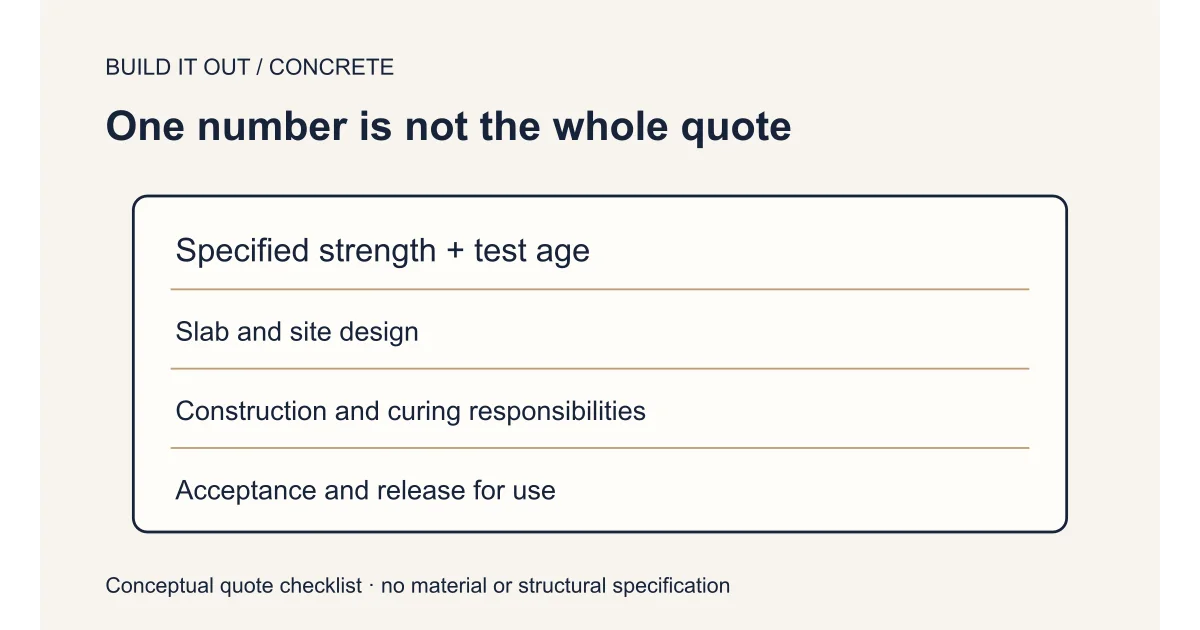
A higher concrete compressive-strength number does not complete a slab quote. Keep the strength and its test age, intended use, slab design, exposure requirements, construction responsibilities and acceptance terms visible as separate fields. Ask the contractor to explain the project basis for the proposed strength before treating it as an upgrade—or a substitute for another part of the work.
A quote that says “5,000 psi concrete” may be specifying useful material performance. It still leaves unanswered questions if the thickness, support preparation or curing responsibility is absent. This is a way to compare the completeness of proposals, not a method for designing or accepting a slab.
What does the strength number describe?
PSI means pounds per square inch. In this context it describes compressive strength, rather than the total vehicle weight the finished driveway can carry. ACI explains that specified compressive strength is selected by the designer and determined using standard-cured cylindrical specimens tested in compression. It also notes that pavement strength can be specified in flexure, using a different test. [1]
The age belongs beside the number. The American Cement Association identifies 28 days as the conventional point for compressive-strength measurement, while explaining that some projects specify later ages. NRMCA likewise discusses earlier or later specified ages. “At 28 days” is a test-age statement; it does not by itself give permission to park a vehicle on this particular slab. [3] [2]
Compare the proposal in four groups
| Group | Ask the contractor to state | What the PSI label leaves open |
|---|---|---|
| Material | Specified strength, test age, mixture identification and applicable exposure requirements. | Whether the listed mixture is selected for this use and environment. |
| Slab and site | Intended loads, applicable design/drawing, thickness and edges, support preparation, reinforcement and joints where required. | The geometry, support and load path of the finished work. |
| Execution | Who handles preparation, placement, finishing, curing and weather protection; what the written scope includes. | Whether the intended material performance can be developed in the installed work. |
| Acceptance and use | Inspection/testing responsibilities, records supplied, project-specific release for use and correction process. | Who decides that work is ready, and what evidence supports the decision. |
These are questions to resolve, not specifications to fill from an internet table. Concrete Network’s driveway guide and JLC’s structural-slab field guide both discuss thickness separately from material strength. Their general examples do not establish this property’s design. Retain the actual proposed drawings and identify who is responsible for project-specific decisions. [4] [6]
Why “higher” does not answer every durability question
NRMCA’s specification guide explains that design-load and durability criteria both matter when strength is selected. Ask which exposure conditions the specification addresses rather than deleting a requirement because a strength label looks impressive. [2]
NCDOT’s field-technician guide provides an example of why the fields differ: entrained air helps freeze-thaw durability, while changes in air content also affect strength and workability. It explicitly warns that admixtures do not replace good concrete practices. This is a reason to have the mixture and exposure requirements reconciled by the project professional, not a recipe for adding an admixture. [8]
Curing is another separate responsibility. FHWA’s pavement-curing guide describes control of moisture and temperature and explains how inadequate curing can damage near-surface properties. Its highway procedures are not residential instructions here; the relevant planning question is who will provide and document the curing and protection required for this job. [7]
Worked comparison: do not award a winner to an incomplete quote
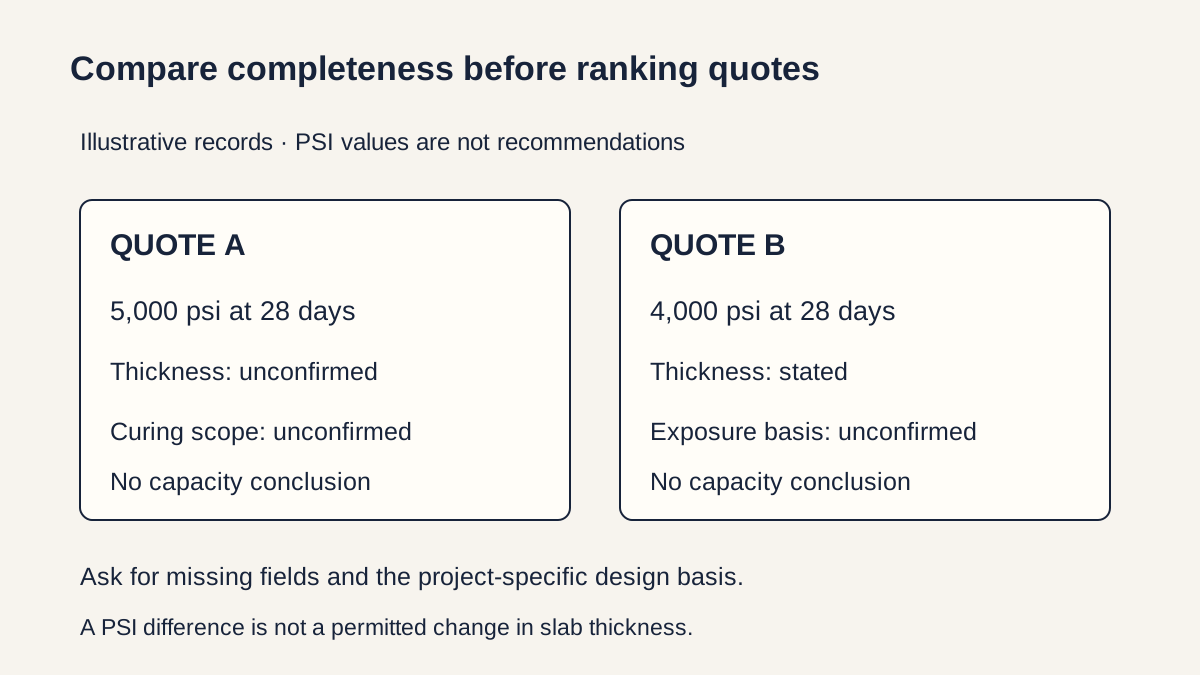
Consider two invented proposals. Quote A lists 5,000 psi at 28 days but leaves thickness and curing scope unconfirmed. Quote B lists 4,000 psi at 28 days and a thickness stated by the installer, but leaves the exposure basis and release-for-use criteria unconfirmed. These numbers illustrate missing information; they are not recommended strengths or designs.
Quote A has the higher stated material strength. Quote B states one more geometry field. Neither record proves the proposed slab is adequate. Do not convert the difference between the PSI labels into a percentage of extra vehicle weight, a thinner slab or a dollar value. Request the missing fields, then have the contractor or designer explain the complete proposal for the intended loads and site.
Use three statuses in a comparison sheet: stated, excluded and unconfirmed. An excluded item needs an identified provider or revised scope. An unconfirmed item needs an answer. Neither means the item has no cost or does not matter.
Keep product timing separate from the project handover
Manufacturers sell products with different early-strength and use claims. Sakrete’s historical product guide separates strength, application thickness and timing in product tables. CTS’s Rapid Set CONCRETE MIX datasheet describes a particular fast-setting material, including its own conditions and instructions. These documents cannot supply the traffic-opening time for an unnamed ready-mix driveway. [5] [10]
CJM’s customer FAQ and QUIKRETE’s FAQ independently show the recurring practical questions: how thick should the slab be, and how soon can it be used? Their broad answers do not replace the project’s specified handover. Ask for the relevant product, conditions and responsible decision-maker in writing. [9] [11]
Send one focused request before agreeing
“Please identify the intended use and loads; strength and test age; applicable slab drawing and exposure requirements; included preparation, reinforcement, joints, curing and protection; and the inspection and release-for-use responsibilities. Please mark exclusions and unresolved items rather than assuming they are included.”
That request does not require the homeowner to choose a mixture or redesign a slab. It asks the people providing the work to make the scope reviewable. For quantities, use the separate guide to square feet, thickness and cubic yards. For an existing puddling concern, use the rain observation record; a higher strength label cannot diagnose drainage.
Sources
- ACI: How is required strength selected, measured and obtained?
- NRMCA: Guide to Improving Specifications for Ready Mixed Concrete
- American Cement Association: Cement and Concrete FAQ
- Concrete Network: Concrete driveway installation: essentials
- QUIKRETE group: Sakrete2021Product Guide
- JLC: Structural Slabs field guide
- FHWA: Guide for Curing of Portland Cement Concrete Pavements, chapter1
- NCDOT: Concrete Field Tech Study Guide: admixtures
- CJM Concrete: Frequently asked questions
- CTS Cement: Rapid Set CONCRETE MIX datasheet
- QUIKRETE: Frequently Asked Questions